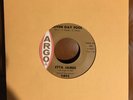
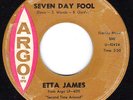
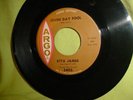
"Etta James" 1963 6-song stereo-jukebox 33 Little LP Argo 7-LPS-4013 EX+
$
34


Favourite Auctions
To save auctions to your favourites, please login
If you don't have an account, please register
Description
Up for auction is this excellent plus condition, original 33 1/3 rpm juke-box 33 or "Little LP", "Etta James" by same on silver-on-dark-blue Argo Records # 7-LPS-4130 from 1963. Argo only issued four 7" 33s; three in the Jazz Series and this, the only one in the Blues Series. ~ :~ :~ Records are not play graded and I do not use the Goldmine record grading standard. Every effort is made to accurately describe and photograph any defects or damage. LP discs come in paper inner sleeves, original if possible but usually plain white, and with the cover and disc in a plastic outer sleeve. 45rpms are sent in original company paper sleeve if possible but usually in a plain white paper sleeve. 45rpm EPs are shipped in plastic outer sleeves with the disc in a separate plain white paper sleeve. Picture discs are sent in plain plastic sleeves, original if possible. International buyers, special handling or for multiple wins in same auction, please request an invoice when you are finished bidding and then pay when you receive the invoice. More photos available upon request. No return policy; item is sold as is. Please ask any questions before bidding. Shipping for this item only is $4. (As of March 15, 2018 shipping will increase to $4.50 for single items). Will be mailed USPS media mail. International buyers, special handling or for multiple wins in same auction, please request an invoice when you are done bidding then pay after you receive the invoice. Shipping to most countries is $28.50 for 1-2 LPs and $18.50 for 1-2 45rpms. Thank you for looking and check out our other eBay listings under The Vermont Village Gallery.
Lorraine & John, jbvvg, North Bennington, USA ~ Rare & Unusual Records & Collectibles.
~~~~~~~~~~
from bsnpubs.com: Argo Blues Series: 7-LPS-4013 - Etta James - Etta James [1963]
Waiting For Charlie To Come Home/A Lover's Mourn/You Can Count On Me//Nobody But You/Let Me Know/My Dear
From bsnpubs.com: The Stereo Singles Project, Part 3 Compact-33 Little LPs (Juke Box EPs) By Mike Callahan, Tim Neely, Dave Edwards, Patrice Eyries, Randy Watts, and Thomas Reed
Last update: November 25, 2015
…… The First Generation …….. But somebody was listening. That somebody was in the form of Seeburg jukebox company. They liked the idea of Little LPs, but wanted them in stereo to play in a jukebox they had planned. They began working with various labels on a very hush-hush project, to produce some of these stereo Little LPs. Then in September, 1962, they began to tease the industry about a new jukebox that would be "revolutionary." The curtain was unveiled later in September on their new stereo jukebox console which could play Little LPs and had places to display album covers for them (see photo below). Seeburg gave credit to Cadence for the innovation of the Little LP, and pointed out that jukeboxes had largely become fixtures in adult rather than teenage venues, and Little LPs with adult content such as easy listening or country would sell very well in bars and other adult meeting places.
Immediately, the industry as a whole spoke up, as usual with divided opinions. Making Little LPs for jukebox purposes could be seen as a promotional tool to sell their albums. But nobody was jumping on any bandwagon that even remotely suggested they would be viable as a retail item in stores. Been there, done that, got the red ink. Everyone seemed to see making Little LPs for Seeburg — and whatever other jukebox manufacturer wanted them — would be a promotional jukebox-use-only sort of thing. Seeburg agreed, although by making the Little LPs available for jukebox operators through "one-stop" record distributors, it also meant that should members of the general public want these, they could be ordered through record stores. But no advertising aimed at the general public would be done.
Seeburg hit the ground running. Before the new jukebox was even available, they had signed up ABC-Paramount, Audio Fidelity, Cadence, Columbia, Command, Decca, Dot, Everest, Impulse, Jazzland/Riverside, Kapp, London/Monument, Mercury, RCA-Victor, Time, and Washington. The list of artists looked like a who's who of easy listening and classical music. Nary a rock and roller in the bunch. The discs would cost the jukebox operators $1.50 each and would be distributed mainly through Seeburg as well as the individual record labels' distributors. Seeburg would put together a catalog of available titles for jukebox operators.
By January, 1963, just a mere few months after the jukebox became available, that catalog included 233 different Little LPs. By 1964, Seeburg was openly gloating in the trade press about how their idea had been a success in the face of all the naysayers, and that they had sold in excess of 200,000 Little LPs. Seeburg noted in January, 1966, that they had spent over 5 million dollars on the program. By 1966, there would be over 1000 Little LPs in the catalog, and that didn't include the Little LPs in circulation specifically made for other jukebox companies like Wurlitzer or ATI.
But by October, 1967, Seeburg found that being a Little LP producer and distributor was getting to be a drag on their jukebox business. So they sold their catalog, inventory and distribution network to Robert Garmisa at Garmisa Distributing who would set up a new company (Garwin Sales) to take over their catalog and distribution (Billboard, 10/28/67, page 1, see right). Bobby Garmisa was enthusiastic, and promised that Little LPs would henceforth be released at the same time as the parent albums, not later as had been the case. Garmisa, it turned out, had underestimated the effect of problems such as a no-return policy on Little LPs, and the ambivalence of the one-stops to carrying the product, not to mention that the jukebox programmers and operators were not all sold on the idea of Little LPs.
By 1969, after more than a year of Little LP hassles, Garmisa finally gave up. "We thought it would be a cinch because we were record distributors and had a pulse on the business.," Garmisa later told Billboard (8/29/70, page 43). "But even our best release only sold 5,000 to 7,000 copies even though there's an estimated 500,000 jukeboxes. We invested 86 cents to $1 in each package, which didn't leave one-stops too much room to work, especially when we could not offer a return privilege."
When Garmisa left the Little LP business, he sold the 100,000 Little LPs he had in the erstwhile Seeburg inventory to WIND-Chicago newsman Henry Baskin (aka Bill Churchill), along with partner Reuben "Rube" Lawrence. Baskin began offering this older stock at 50 cents on the dollar through his new company Baskase Products. Baskin's stock, including Little LPs from Columbia/Epic. Soma, Bomar, Warner Bros., Atlantic, London, UA, Blue Note, Hilltop, and Reprise, was sold off piecemeal. By February, 1973, Lawrence noted that they had peddled some 50,000 Little LPs overseas to the UK and Sweden.
The zenith of the Little LP was the 1966-67 period. By 1969, however, with Garmisa exiting the business, output of Little LPs dropped to nearly zero. A few small manufacturers, like Thunderbird and Juke, issued some, but that was about it. For over a year, from 1969 to mid-1970, there were no firms actively producing and distributing large numbers of Little LPs for the big labels, and this marked the end of the first generation of the Little LPs. ……..
.
Some might describe this item as a gem, one-of-a-kind, the holy grail, a first edition, grade A, top quality, 5 star, five star, a museum piece, stone mint, out of print, unavailable, rare, rarely seen, unique, psa 10, investment quality, new to the market, may never be seen again or never before seen, but I won’t. Not in visible font anyway. This also has nothing to do with bit-coins.
price rating