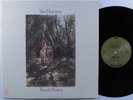
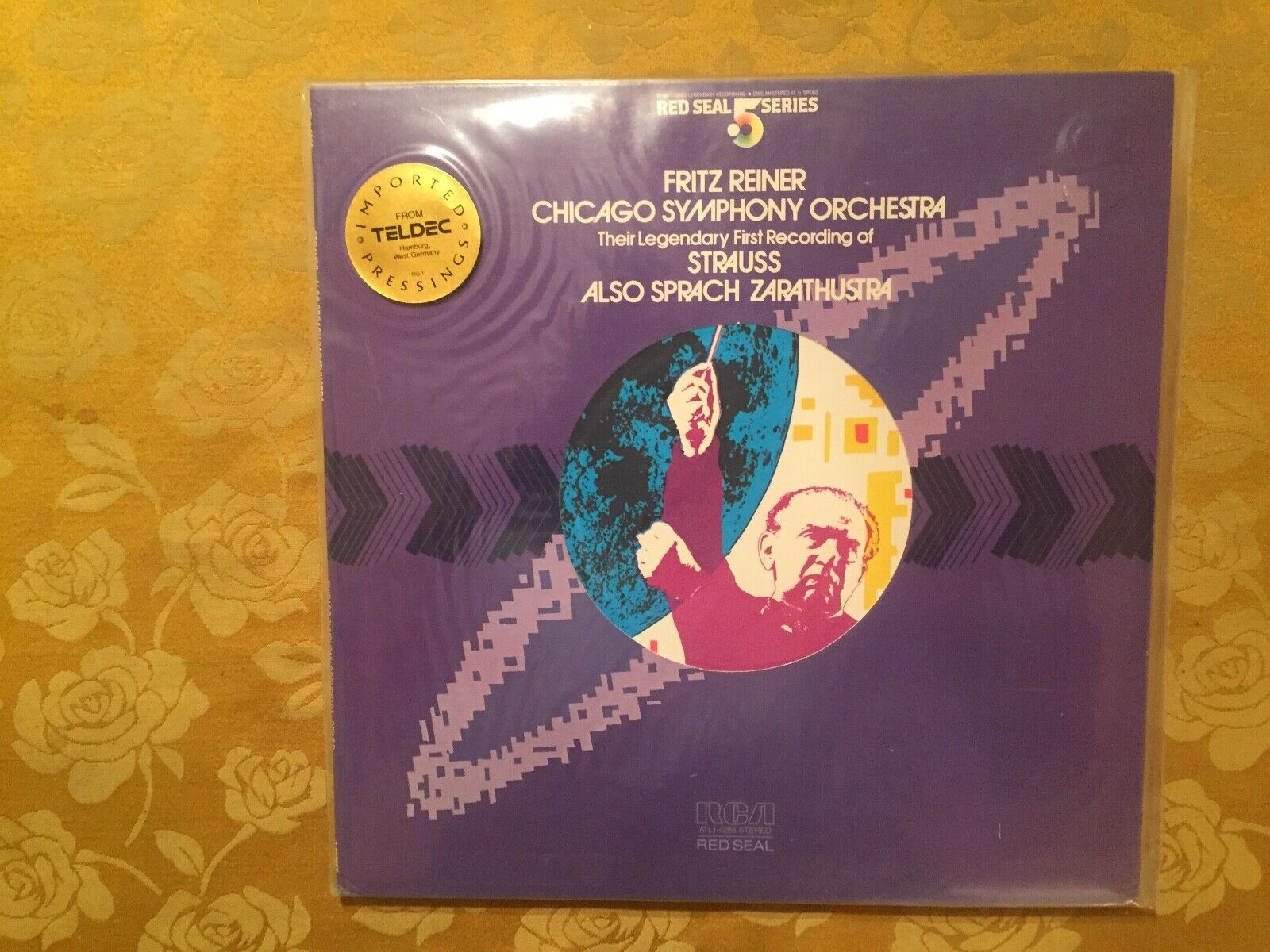
FRITZ REINER Also Sprach Zarathustra SEALED RARE 1982 RCA Die Cut Import
$
38




Favourite Auctions
To save auctions to your favourites, please login
If you don't have an account, please register
Description
Vinyl: Sealed! This is the Original 1982 RARE RCA Red Seal 1ST PRESSING! Reiner & The Chicago Symphony perform one of the greatest recorded versions of Strauss' Masterpiece!! RCA Red Seal .5 Series half speed mastered audiophile issue ATL 1-4286, red label disc pressed in the US. Richard Strauss, Also Sprach Zarathustra, with Fritz Reiner and the Chicago Symphony Orchestra. This is from the legendary, and rare, LSC 1806, recorded in 1954. See Biography Below!
Cover: Sealed! (see photos) Hype Sticker. Die-Cut. The record appears straight; when I look down with one eye down all 4 edges there's no big, ominous bow to it that would suggest that it's warped.
I will gladly accept the return of Sealed records as long as they have not been opened (i.e. as long as they are still in the condition I sent them in). Every record has a "fingerprint" of imperfections in the seal and/or the cover and I separately photograph and keep these details to prevent fraudulently returned items...yep, there are a few rotten apples out there!) I will not accept a previously sealed record that has been opened, even if the complaint is that the record is warped. This is why I look down the edge of all 4 sides of the record, to assess for potential bowing. Look for that in the description of the covers of all my Sealed items. Thanks! By the way, I've never (knock on wood!) had a buyer complain that they received a warped Sealed record. :)
Goldmine Standards.
U.S. Shipping: $4.99 Media Mail. Tracking included. 50 cents additional shipping per additional item, when the shipment is combined. If you wish to take advantage of my COMBINED SHIPPING deal, simply select your items by clicking on "ADD TO CART" on the main listing page. Do this for all of your selections and then go to your cart to checkout. Your combined shipping discount will be computed automatically. Free domestic shipping if you spend $100 or more!
All records are packaged securely with the vinyl sandwiched between two cardboard stiffeners and shipped in a custom cardboard record mailer box.
INTERNATIONAL BUYERS! EBAY'S PLATFORM DOESN'T ACCOMMODATE FOR COMBINED SHIPPING FOR INTERNATIONAL BUYERS---BUT DON'T LET THAT STOP YOU!!!---I CAN COMBINE SHIP FOR YOU AND MINIMIZE SHIPPING COSTS!!! TELL ME WHICH ITEMS YOU WANT TO BUY, AND I WILL WEIGH THEM AND THE SHIPPING BOX TOGETHER AND THEN I WILL CREATE A "LOT OF 2..." OR "LOT OF 3...", OR "LOT OF 4...", ETC WITH THE ITEMS YOU WANT, AND CREATE A LISTING WITH THE EXACT WEIGHT OF YOUR LOT. THIS WILL SAVE YOU A LOT OF MONEY!!! IF YOU'RE INTERESTED IN THIS, SEND ME A MESSAGE TELLING ME WHICH ITEMS YOU WOULD LIKE TO PURCHASE AND WE'LL GO FROM THERE. OR, FEEL FREE TO ASK QUESTIONS.
I ship internationally through EBay's Global Shipping Program. Check to be sure that they ship to your country. Feel free to ask any questions and happy shopping!
Once you're satisfied with your purchase, please leave positive feedback and I will do the same for you. If you're unsatisfied, please let me know so we can resolve it. I do not give partial refunds. Take a look at my previous feedback and buy with confidence. I've qualified for the "Top Rated Plus" seal from eBay, awarded to the most reputable sellers who consistently deliver outstanding customer service. Check my other items this week, check back often & CLICK ON "SAVE THIS SELLER" at the top of my listings page to be notified of New Listings as I will be adding more Rare items in the coming weeks! Thanks!
Why buy a first or early pressing and not a re-issue or a ‘re-mastered’ vinyl album?
First and early pressings are pressed from the first generation lacquers and stampers. They usually sound vastly superior to later issues/re-issues (which, in recent times, are often pressed from whatever 'best' tapes or digital sources are currently available) - many so-called 'audiophile' new 180g pressings are cut from hi-res digital sources…essentially an expensive CD pressed on vinyl. Why experience the worse elements of both formats? These are just High Maintenance CDs, with mid-ranges so cloaked with a veil as to sound smeared. They are nearly always compressed with murky transients and a general lifelessness in the overall sound. There are exceptions where re-masters/re-presses outshine the original issues, but they are exceptions and not the norm.
First or early pressings nearly always have more immediacy, presence and dynamics. The sound staging is wider. Subtle instrument nuances are better placed with more spacious textures. Balances are firmer in the bottom end with a far-tighter bass. Upper-mid ranges shine without harshness, and the overall depth is more immersive. Inner details are clearer.
On first and early pressings, the music tends to sound more ‘alive’ and vibrant. The physics of sound energy is hard to clarify and write about from a listening perspective, but the best we can describe it is to say that you can 'hear' what the mixing and mastering engineers wanted you to hear when they first recorded the music.
BIOGRAPHY
In his 1954 recording with theChicago Symphony Orchestrafor RCA Victor, re-released on Living Stereo,Fritz Reiner’s close familiarity with the score and personal relationship with Strauss himself add extra weight to the authority and importance of his interpretation of Strauss's celebrated tone poem.
Richard Strauss’s tone poemAlso sprach Zarathustra (“Thus Spoke Zarathustra”) was composed in 1896 and inspired by Friedrich Nietzsche's book of the same name, which was published between 1883 and 1891. The work had its first performance on 27 November 1896 in Frankfurt with Strauss himself as the conductor and has remained popular ever since, having become an integral part of the orchestral repertoire.
As in other works by Strauss (such as his tone poemAn Alpine Symphony),Nietzsche's philosophy plays a central role, almost as essential as the music itself. In a program note for the work’s Berlin premiere, Strauss had written:
“I do not intend to write philosophical music or to portray in music Nietzsche’s great work. I meant to convey by means of music an idea of the evolution of the human race from its origin, through the various phases of its development, religious as well as scientific, up to Nietzsche’s idea of the Superman. The whole symphonic poem is intended as an homage to Nietzsche’s genius.”Also enlightening is Strauss’s original subtitle for the work: ‘Symphonic Optimism in fin de siècle form, dedicated to the 20th century’- although it was eventually dropped, it is indicative of the composer’s intentions at the time. Also sprach Zarathustra is indeed a workforandofthe future: Strauss’s majestic and pioneering composition anticipates in many ways the harmonies and experiments with tonality that would be realized by modern composers in decades to come.
Divided into nine sections named after selected chapters of Nietzsche’s book, the piece opens with a sustained low C on the double basses, contrabassoon and organ, aided by a bass drum roll, until the famous “dawn” motif is introduced with its three notes in intervals of a fifth and octave (C–G–C). Also known as the nature motif, it is central throughout the work’s structure, while its adaptation for the opening of Stanley Kubrick’s 1968 cinematic epic2001: A Space Odyssey hasfurther boosted the work’s enduring popularity.
A special place in the long interpretative history ofAlso sprach Zarathustra no doubt belongs to the performance of the piece by theChicago Symphony OrchestraandFritz Reiner, a particularly acclaimed interpreter of Strauss who had worked closely with the composer before moving to the United States in the early 1920s.
Reiner’s close familiarity with the score and personal relationship with Strauss himself add extra weight to the authority and importance of his interpretation ofAlso sprach Zarathustra. His great attention to detail, dynamics, and motivic interrelationships, while never losing focus of the greater whole is evident is his 1954 recording of the piece with the Chicago SO for Living Stereo. Reiner does an exceptionally good job in bringing out the nuances and tonal relationships of the score that, in return, aspires to convert Nietzsche’s elaborate philosophy into musical elements through challenging conventional notions of harmony and tonality.
Its great musical value aside, Reiner’s landmark recording is also of significant historical importance. His interpretation of Strauss’s magnificent tone poem has had a considerable impact upon subsequent renditions, such as the 1970 performance of the piece by theNew York PhilharmonicandLeonard Bernstein, who had been a pupil of Reiner at the Curtis Institute of Music in Philadelphia.
price rating