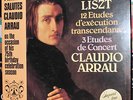
Franz Liszt Leonid Brumberg Piano Vinyl LP Record VG+
$
55


Favourite Auctions
To save auctions to your favourites, please login
If you don't have an account, please register
Description
Yes we combine shipping for multiple purchases. Add multiple items to your cart and the combined shipping total will automatically be calculated.
Franz Liszt Leonid Brumberg Piano Vinyl LP Record VG+
Record Grade per Goldmine Standard: VG+
SONATE H-moll Als bedeutendstes Klavierwerk Liszt’s wurde die H-moll Sonate 1852 — 53 geschajfen. Dieses Werk ist eng mit den symphoni- schen Dichtungen und der Faustsymphonie verbunden. Nicht nur im formalen Aufbau (man kann Liszt f ur einen Vorgiinger der zyklischen Form halten), sondern auch in der thematischen Arbeit. Diese H-moll Sonate ist in Architektur und Inhalt eine grofie Klavierdichtung. Ahnliche Beispiele gab es bereits bei Chopin (Balladen, F-moll Phantasie) und bei Schubert’s Wan- dererphantasie, Innerhalb des ganzen Lebens war Liszt vom Faustthema fasziniert. Davon zeugen nicht nur die Faustsym- phonie sondern auch 6 Mephistowalzer (die letzten 2 in Skiz- zen) und die Mephistopolka. Diese Sonate ist Robert Schu- mann gewidmet, der ebenfalls sein Leben lang von diesem Thema berilhrt blieb (z. B. die Faustszenen, Intermezzi op. 4). Man kbnnte in der Thematik 3 Charaktere unterscheiden: Faust, Mephisto, Gretchen. Nach Liszt’s eigener Konzeption sind Faust und Mephisto philosophisch untrennbar in einem einzigen Menschen verbunden. Mephisto ist der Antipode von Faust. Leonid Brumberg unterstreicht in seiner Interpretation in diesem auch in technischer Hinsicht schwierigen Werk die Tragik dieser Konzeption. MEPHISTOWALZER NR. 1 ist eine freie Klavierubertragung der 2. Episode (Tanz in der Dorfschenke) aus Lenau’s Faust in der Orchesterfassung. Es ist auch eine Klavierdichtung des Faustthemas in ineinandergreifen- der Thematik im virtuosen Stil. In seiner grandiosen Kunst, die Klaviertechnik zum charakteristischen Ausdruck des Geschehens zu gebrauchen, verwendet Liszt rezitativische Phrasen und dia- bolische Sprungeffekte um die Welt dieser uralten Menschheits- geschichte voll schmerzlicher Sehnsucht auszudriicken. GNOMENREIGEN Ein duftiges, spukhaftes Stiick von mendelssohn’schem Reiz. Es erinnert fast an die grazibse Figur des Puck im Sommer- nachtstraum. Das rondoartige Stuck wurde im Jahre 1893 kom- poniert, Liszt's Schuler Dr. Pruckner zugeeignet. WALDESRAUSCHEN (wurde 1863 komponiert) Ein Naturbild voll von Frieden, eine typische romantische Etilde, als ware es inspiriert vom sanften Rauschen der Baume. Es ist ein Charakterstilck mit Charme und Noblesse, das durch Liszt’s klavieristische Raffinesse zum Ausdruck gebracht wird. CHASSE NEIGE (endgUltige Ausgabe 1852) In der Etiide Chasse neige (12. Etude des Zyklus Etudes d’execu- tion transcendante) widerspiegelt Liszt einen Schneesturm tragi- schen Ausmafies mit den Mitteln vieler Tremolofiguren, weiten Spriingen und chromatische Passagen. Unvergesslich sprach E Busoni liber die unheimliche Stimmung dieses Werkes, als kame ein Schneesturm, um die Menschheit zu bedecken. Klavier: Bbsendorfer Tonmeister: Ing. Josef Kamykowski Titelbild: Archiv der Gesellschaft der Musikfreunde Wien LEONID BRUMBERG wurde in Rostow am Don geboren. Studium am Moskauer Konservatorium bei Heinrich Neuhaus (Klavier), Dimitrij Schostakowitsch (Instrumentation) und Nikolaij Mjaskowsky (Komposition). Von Jugend an hiiufiges offentliches Auftreten mil Klavierabenden und Konzerten mil Orchestern. Nach Absolvierung des Moskauer Konservatoriums Unterrichtsttitig- keit an der Gnessin-Akademie in Moskau, zuerst als Assistent von Professor Heinrich Neuhaus, dann fast 20 Jahre als ordent- licher Professor fiir Klavier. Im Laufe der Zeit wuchs das Repertoire auf uber 100 Soloprogramme (damnter alle 32 Beethoven-Sonaten). Klavierkonzerte u. a. mit den Dirigenten Ewgenij Svetlanow, Gennadij Roschdestwenskij und Kyrill Kondraschin in vielen Stadten der Sowjetunion. In dieser Zeit hat Leonid Brumberg viele Schallplatten eingespielt. Er war einer der Kilnstler, die ausgewahlt warden, bei den 2. Festspie- len fiir sowjetische Solisten zu spielen, welche im Jahre 1979 in Mailand, Italien stattfanden. Seit seiner Emigration im Jahre 1981 hat Leonid Brumberg in ganz Europa und Vorderem Orient viele Konzerte gegeben. Darilberhinaus hat er in vielen Landern Rundfunkaufnahmen gemacht. Seit 1982 ist Leonid Brumberg Professor am Konser- vatorium der Stadt Wien. Brumberg’s besondere Starke scheint die Wiedergabe extrem schwieriger Werke zu sein. Was auch durch seine Programme zu belegen ist. Er spielt hdufig „Schwerstes vom Schwerem" und „bietet ilberwaltigenden, vollendeten Tastenzauber" wie in einer Wiener Kritik zu lesen ist. LEONID BRUMBERG was born m Rostov on the Don, USSR. When he was nine years old he entered the Central Music School for Talented Children in Moscow. After graduating, he was admitted to the Moscow Conservatory, where he studied piano with Heinrich Neuhaus, instrumentation with Dimitrij Schostakowitsch and composi- tion with Nikolaij Mjaskowsky. After serving as Neuhaus's assi- stant, he became a professor at the Gnessin Conservatory. In the course of time he developed an enormous repertoire, embracing well over 30 concertos and 100 solo programms, including all the Beethoven sonatas. He gave concerts through- out the USSR. He appeared as a soloist with different orchestras under the direction of such outstanding conductors as Ewgenij Svetlanow, Kyrill Kondraschin and Gennadij Roschdestwen- skijj. Leonid Brumberg also has made numerous recordings. He was one of the artists chosen to perform in the Second Festival of Soviet Soloists, held in Milan, Italy, in 1979. Since emigrating in 1981, Leonid Brumberg has given many concerts throughout Europe and the Near East. Brumberg’s particular forte is the performance of extremely diffi- cult works, as can be seen by his repertoire. He frequently chooses the „most difficult of the difficult" and ..overwhelming, absolutely magical touch", as was reported in a Viennese critique. SONATA B-Minor The B-Minor Sonata of 1852-53 is Liszts’ greatest work. It is closely related to the symphonic poems and the Faust Sym- phony, not only its’ formal structure (Liszt can be considered a predecessor in the use of cyclical form), but also in its thema- tic development. This B-Minor Sonata is in its architecture and content a great piano poem. Similar examples are Chopins’ Ballades and F-Minor Phantasie and Schuberts' Wanderer- phantasie. During his entire life, Liszt was fascinated with the Faust theme. Testimony to this are not only the Faustsymphony, but also 6 Mephisto Waltzs (the last two in sketches) and the Mephisto Polka. This Sonata is dedicated to Robert Schumann, who similarly remained captivated by this theme (examples in his works are the Faust scenes and op. 4 Intermezzi). It is to distinguish three thematic characters: Faust, Mephisto and Gretchen. According to Liszts’ own conception, Faust and Mephisto are philosophically inseperable, united in a single per- son. Mephisto is the antipode of Faust. Leonid Brumberg brings out the tragedy of this conception in his interpretation of this also technically demanding work. MEPHISTO WALTZ NR. 1 is a free piano representation of the second episode (Dance in the Town Inn) of Lenaus’ Faust, orchestral version. It is also a piano poem on the Faust theme written in overlapping, virtuose style. In his grandiose artistry at transforming piano technique into the characteristic expression ofoccurences, Liszt uses reci- tativelike phrases and diabolical leaps to depict with painful longing the world of this ancient tale. GNOMENREIGEN A dainty, haunting piece of Mendelssohnian charm. It is remi- niscent of the graceful Puck in Midsummernights’ Dream. This rondo-like work was composed in 1863 and dedicated to Liszts’ pupil D. Pruckner. WALDESRAUSCHEN (composed 1863) This typical romantic etude depicts a peaceful scene of nature, as though inspired by the gentle rustling of trees. It is a charac- ter piece full of charm and elegance, graced by Liszts’ refined pianistic expression. CHASSE NEIGE (Final edition 1852) Chasse neige is the twelfth etude in Liszts' cycle, „ Etudes d'execu- tion transcendante“. Here a snowstorm of tragic dimensions is depicted through numerous tremolo figures, large leaps, and chromatic passages. F. Busoni poignantly remarked on the eery atmosphere of this piece, seeming to show a snowstorm cover- ing mankind. Piano: Bosendorfer Recording Engineer: Ing. Josef Kamykowski
lp1828
price rating







![SLASH MADE IN STOKE 24/7/11 3 Lp Gatefold USA 2011 GREEN VINYL [UNPLAYED]](https://www.popsike.mobi/php/thumbnail.php?url=https://www.popsike.pics/pix/20150922/291571300932.jpg)