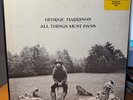
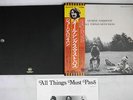
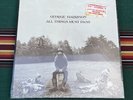
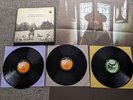
George Harrison 1970 All Things Must Pass SEALED UNOPENED LP VINYL Promo
$
150


Favourite Auctions
To save auctions to your favourites, please login
If you don't have an account, please register
Description
Welcome to
This is the real deal not a reissue
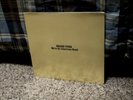
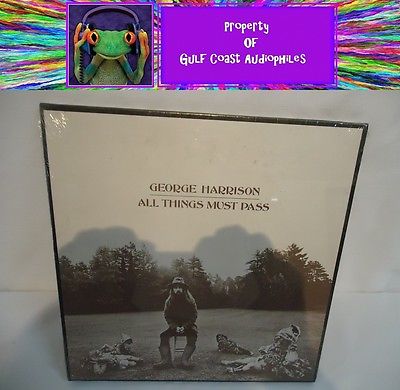
George Harrison All Things Must Pass 1970 Rare Promotional copy LP Vinyl Record Album Vintage and Original Sealed Never Opened Unopened Mint * Note: Album is being sold as a sealed collectible! This items value is in the fact that it has never been opened! No refunds no returns if you have opened sealed albums!
If you want an LP to play on your turntable, you may want to buy a open mint copy.
More interesting things to note about George Harrison: Given his own studio, his own canvas, and his own space, Harrison did what no other solo Beatle did: He changed the terms of what an album could be. Rock historians mark All Things Must Pass as the first “true” triple album in rock history, meaning three LP's of original, unreleased material; the Woodstock concert LP, released six months before, is its only only spoiler antecedent. But in the cultural imagination, it is the first triple album, the first one released as a pointed statement. With its grave, formidable spine, it’s symbolically freighted photo of Harrison in the country, pointedly surrounded by three toppled garden gnomes, it still sits like a leather-bound book, a pop-music King James Bible on any shelf of records it occupies. It is one of the first such objects in pop music history, the unwieldy triple album that spilled out oceans of black vinyl, printed thousands of sheets of lyrics, traversed multiple sides and made you get up and sit back down again five times, walking half a mile between your couch and your stereo to experience it all. It was the heaviest and the most consequential Beatles solo album, the first object from the Beatles fallout to plummet from the sky and land with a clunk in a generation of living rooms. It is a paean to having too much ambition, too much to say, to fit into a confined space, and for this reason alone it remains one of the most important capital-A Albums of all time.
It was also massively popular, despite its hefty retail tag; All Things Must Pass spent seven weeks at No. 1, and its’ lead single, “My Sweet Lord,” occupied the same slot on the singles chart, marking the first time a solo Beatle had occupied both spots. The success was sweet vindication for Harrison; his triumph was so resounding that his former partners could not pretend to ignore it. “Every time I turn on the radio, it’s ‘Oh my lord,’” John Lennon joked dryly to Rolling Stone. Rumors have it that John and Paul reacted with chagrin at hearing the bounty of material spilling forth on the album, finally grasping the depth of talent they had been slow to recognize. Their solo albums would be considered successes to various degrees, in their own ways, but only George had the wind of true surprise at his back.
All Things Must Pass had the quality of a broken-off conversation picked up years later; there were gorgeous songs here that Harrison had brought to the group, only to be met with to varying degrees of indifference. “Isn’t It a Pity” had been rejected from Revolver, while “All Things Must Pass” was passed over for Abbey Road. In hindsight, it is impossible to imagine these songs having half the impact if they had appeared sandwiched between, say, “Don’t Pass Me By” and “Why Don’t We Do It in the Road.” Taken together, they have their own cumulative weight and depth; you can even imagine their demos perhaps sounding too patient or too plodding to the other three. Reviewing it in Rolling Stone at the time, Ben Gerson compared it to the Germanic Romanticism of Bruckner or Wagner, composers who were unafraid of risking a little ponderousness to reach grandiose heights. Harrison might have been nursing resentments, but his former band mates did him a perverse favor by leaving him with this material: This is music of contented solitude, and it only makes sense by itself.
Besides John, George was the only Beatle unafraid of writing from anger or negativity—his early Beatles tunes, like “Think For Yourself” and “Taxman” are almost startling in their bile. But where John thrashed and sometimes wallowed, George gently explored; when John Lennon pounded his fist, hollering that he was “sick and tired of hearing things from uptight, short-sighted, narrow-minded hypocrites,” George simply noted it was a “pity” that “not too many people/ Can see we’re all the same.” The biting “Wah-Wah,” produced by Phil Spector and layered with so many different guitar tracks it feels like three guitar rock songs fighting each other, is possibly Harrison’s most pointed missive as a solo artist, addressed to his increasingly alienated former band mates. But even here he seems more bemused than pissed-off; the swoop and dip of the melodies and antic main riff resemble chuckling rather than shouting, and the most resonant lyric (“And I know how sweet life can be/ If I keep myself free”) is the sound of a tentative soul allowing himself a measured yawp of freedom, however provisional and careful.
Harrison’s music from this era embraced the Eastern philosophy that he had discovered studying with the Maharishi and would diligently follow throughout the ‘70s. When asked about these ideas in interviews, he could come off in print like a somewhat-tiresome scold, and his Beatles-era explorations in mysticism sometimes had a student’s overcompensating sternness. But All Things Must Pass, though it is easily the most spiritual statement by any Beatle, is a wiser work, made by someone whose hard ideas have been softened and tenderized by a series of salutary body blows. There’s a song called “Let It Down” and a song subtitled “(Let It Roll)”—simple expressions of surrender from someone who’s learned exactly what they do and don’t control. The title track turned on a phrase that sounded as much like “It’s not always gonna be this grey” as it did “it’s not always gonna be this great”; both interpretations are equally valid (even though the actual lyric is “grey”). “It’s time to start smiling/What else should we do?” he inquired on the shimmering country-rock of “Behind That Locked Door.”
And, of course, there was “My Sweet Lord,” the song that, purposefully or not, followed directly in the footsteps of The Chiffon’s “He’s So Fine.” Harrison was eventually sued for what a judge called “unconscious plagiarism,” which could be a good euphemism for “pop songwriting.” The situation was doubly ironic considering Harrison’s intrinsic generosity as an artist. The album was a collaborative party in itself, a gathering in which Eric Clapton, Ringo, Billy Preston, future Yes drummer Alan White, and even a young Phil Collins, playing bongos on “Art of Dying,” were given space. Having been elbowed out of a room too many times before, it seemed, he was staunchly unwilling to do the same to others.
John and Paul were their songs, and you couldn’t cover them without invoking some sort of impression of them. George’s songs had room for others—other interpretations, other viewpoints, other voices. It’s fitting that he invokes Dylan twice on All Things Must Pass—first on “I’d Have You Anytime,” co-written with Dylan, and “If Not For You,” which Dylan himself included on New Morning. Like Dylan, Harrison saw songs like common goods, favors to be traded or plates to be shared. You could always visit George’s songbook, like a village well, and bend it towards whatever personal ends you needed. He’d have you anytime.
Several generations have taken him up on his implicit invitation, as his best songs go from artist to artist—Britt Daniel and Jim James; David Bowie and Dave Davies. Elliott Smith would arguably never have written a single song on Either/Or or XO without this music. The Beatles obsession of late-90's indie rock—the Elephant 6 bands, Guided by Voices—and the Britpop bands Oasis and Blur were channeling George as often as anything. Soul and jazz artists were drawn by the clean profundity of his simple lyrics and his languorous melodies; Nina Simone’s 11-minute version of “Isn’t It a Pity” turns the song into a small dead planet with herself as the only inhabitant, and she brought “My Sweet Lord” into the black church; James Brown’s “Something” drenches the humble love note in anguished sweat. Ella Fitzgerald took the tricky rhythms of “Savoy Truffle” for a jazzy spin.
As for the third disc, called Apple Jam; it doesn’t exactly yield new revelations with time. No one’s ever listened to the stuff clogging up the back half of the last side, just like no one remembers what they said at last call and wishes they'd left the bar an hour earlier the next day—“Plug Me In” and “I Remember Jeep” and “Thanks for the Pepperoni” are the sound of a contented artist happily forgetting you are there. Harrison arguably knew exactly what he was doing with this last slab of vinyl; there has to be a reason you don’t encounter “Thanks For the Pepperoni” sandwiched in between “Isn’t It a Pity” and “What Is Life.” If you stick around for this party, it’s because you know exactly what you’re getting; they are the deluxe cuts and alternate takes of their day. Even those little pieces and scraps have a role to play in All Things’ inheritance to future generations, for better and for worse: When The Clash filled up the third LP of Sandinista! with children’s versions of their best-known songs, there was only one precedent to reach for.
Sometimes, it seems as if the Beatles invented everything worth knowing about pop recordings. The process of making them, the process of venerating them, the idea that albums could be Ahab-like pursuits swallowing their creators nearly whole: We carry these notions in our heads because the Beatles put them there. With its sheer size and heft and gravitational pull, All Things Must Pass reinforced that the album could be an epic novel for a different sort of age. Today, “albums” exist largely as ideas rather than objects, shadow puppets we throw up against the wall to remind ourselves of the forms they represent. The language of physical media still haunts our vocabulary. Streaming services debut playlists that get dubbed “mix tapes”; we pull music from the available air and pipe them through our phones like water from a tap, and we still call use quaint words like “LP” and “EP” to describe them. For that legacy, we have artifacts like All Things Must Pass to thank. Today, albums like this are a bit like old ruins: They are important to keep around, even if they mostly remind us of what has changed. This dichotomy is the kind of thing that Harrison, who exited the earth in 2001, would probably have appreciated. All Things Must Pass is a monument to impermanence that has never once, even for a moment, left us.
Here are just a few testimonials from some of our vintage Vinyl & electronic gear collectors!
Booyah68 Marantz 6300 Silver edition, Turntable, Excellent condition!! New stylus
Quick delivery. Item as described. Would do business again. Recommended!!!
sstk100 Marantz 2270, Works , but needs minor repair Super Ebay user
stone4001 Marantz 2270 Receiver, Just serviced, Led upgrade, New Cabinet As advertised, beautiful receiver in pristine condition!!!
jamiehoward1 1974, Bob Dylan Blood on the tracks Sealed 42 year old Album!!! Great seller - Exactly as described - fast shipping.
Tangerine1959 1970 Leon Russell self titled seal album Perfectly smooth transaction. Excellent quality…very pleased. Thanks!
Cpalle 1970 Janice Joplin ( PEARL ) sealed album, 46 years old, very nice!!!!!!!! Thank you 4 offering this Fabulous, rare LP. Great price. Fast, safe shipping
cpalle 1967 Arlo Gruthrie, Alices Resturant Sealed 49 year old album!!! Fabulous, rare LP. Great price. Fast, safe shipping. Excellent Member. Thanks!
Marine1960brenda Marantz 6300 turntable manual Awesome and honest Seller. Can be trusted! Thank You
ukfan4sure! sony STR-GX80es and STR-GX90es manual Exactly as advertised! Lightning fast delivery! Thanks!
Blueocean2477 Marantz original remote control Model RC 2000 Very nice remote thank you so much
Look at photos
Ask any questions.
call me Dean at
251-213-1388
gulfcoastaudiophile at gmail
Please look at photos.
We do have these listed in other local venues, therefor they are subject to end at any time.
Look at photos & ask any questions. Best wishes with your collecting. Please view all photos and feel free to contact me with any questions!Check out our other listing we have a lot of Vintage Electronics, Music, Manuals and Guides as well as ton's of other great stuff for sale!
Check out my other items! Please note any item over $100 must be signed for! If you choose to waive the signature you are agreeing to no claim against this seller due to damage or loss!Buyers before your purchase please note:
That if you use a global shipping center to ship an item that we do not ship out of the country to, we are not liable for damage or missing items. Therefore we are not responsible and are not Liable.
* Note: Album is being sold as a sealed collectible! This items value is in the fact that it has never been opened! No refunds no returns if you have opened sealed albums!
All items are insured and any claims due to damage should be filed with the carriers.
I package all items with utmost care and I am not responsible for carrier damage.
All items are shipped as seen in photos if there is damage please photograph packaging and item and forward pictures to me. Shipping information will be sent to you for postal claims.
Please feel free to contact me with any questions!
price rating