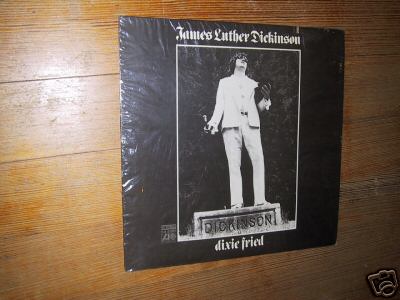
JAMES LUTHER DICKINSON Dixie Fried LP Big Star psych
$
34


Favourite Auctions
To save auctions to your favourites, please login
If you don't have an account, please register
Description
JAMES LUTHER DICKINSON Dixie Fried LP - 1972 US ATLANTIC LP, NM/NM condition, still in shrink !!! What do you have to know about James Luther Dickinson ? well, check out this page below, where this lp is associated with many other impressive Big Star related albums: http://www.morningsiderecords.dk/features/children_by_the_million.asp Here's what this page says: Jim Dickinson produced Big Star’s third album and Alex Chilton’s weird and wonderful ”Like Flies on Sherbert”. He’s also responsible for the piano on ”Wild Horses” – the Rolling Stones version – and for backing up Aretha Franklin and Sam and Dave on some of their sixties recordings with his band The Dixie Flyers. Supposedly he’s also a very sharp dresser, which is definitely not a bad thing if you are playing the rock game. Dickinson released his only album of the seventies in 1972 (the album was actually recorded in 1970) on Atlantic Records and had a bunch of really cool Memphis cats help him out (a lot of the people that can also be heard on Big Star’s ”Third/Sister Lovers”). He may not have the greatest voice in the world, but the overall devil-may-care attitude of this project makes it quite an interesting listening experience. This is music to listen to when Saturday night becomes Sunday morning. You should also check out his other band – Mud Boy and the Neutrons – that released a couple of great albums in the eighties and nineties.". Here's now a longer information about Jim Dickison.. ready ? here we go: "The name James Luther Dickinson may not be well known but the sound of his piano and organ certainly are. Together with his group, the Dixie Flyers, house-band at Atlantic-owned Criteria Recording Studios in Miami, Florida, Dickinson accompanied such stellar artists as Aretha Franklin, Carmen McRae, Delaney & Bonnie, Dee Dee Warwick, Jerry Jeff Walker, Ronnie Hawkins, Sam and Dave, Sam the Sham, Brook Benton, Lulu and (Little) Esther Phillips. His piano playing was also heard on recordings by the Flaming Groovies, Albert King, Ronnie Milsap, Eric Quincy tate, Petula Clark, Maria Muldaur and Duane Allman. Dickinson has been equally effective as a producer. Since making his production debut with Dan Penn's Emmet the Singing Ranger Live In The Woods, he's gone on to oversee recordings by Ry Cooder, Alex Chilton, Jason and the Scorchers, Green On Red, the Replacements, Primal Scream, Mudhoney and Rocket From The Crypt. Dickinson has maintained a much lower key as a recording artist. His debut solo album, Dixie Fried, which featured Dr. John on piano and an un-credited Eric Clapton on guitar, was released in 1972. Although he and Dixie Fried guitarist/vocalist Charlie Freeman formed a new group, Mud Boys and the Neutrons in the early-1980s, they were unsatisfied with their intended debut album and refused to have it released. They didn't release their first album, Known Felons In Drag, until 1986. While they quickly followed it with their second release, They Walk Among Us, the next year, it took another seven years before their third album, Negro Street At Dawn, was released in 1993. A native of Memphis, Tennessee, Dickinson launched his career as a session player in the city's recording studios. Working with producer Sam Phillips, he played on Tony Joe White's Continued and Betty LaVette's He Made A Woman Out Of Me. Asked by Atlantic to form a resident band for its newly-acquired Criteria Recording Studios. Dickinson recruited keyboardist Mike utley, bassist Tommy McClure, drummer Sammy Creason and ex-Mar-Keys guitarist, Charlie Freeman. Although they performed on a lengthy list of recordings, they fell victim to the move towards self-contained bands. Leaving the studio, in late 1970, they toured as backup band for Rita Coolidge and Kris Kristofferson until disbanding in the mid-1970s. Their farewell concert, on October 1, 1978, at Memphis' Orpheum Theater, was recorded and released as Beale Street Saturday Night. Recording his debut solo album, shortly before the Dixie Flyers left Critera, Dickinson continued his relationship with Atlantic. Serving as an assistant to Atlantic producer Jerry Wexler, he eventually rose to the position of vice-president. By the early 1970s, with the 60s a flaming wreck, Woodstock Nation had pretty much retreated to the idealized dream of an earlier, rural, communal America. Musical icons like the Band’s second album and the Byrds' Sweetheart of the Rodeo were signposts on a utopian journey into re-imagined roots Americana. It seems ironic that it might have been a mostly unknown producer and musician from Memphis who best gathered the deep strains of Southern music and produced a forgotten masterpiece that stared down and confronted the era’s Nixon White House dread and paranoia, while singing and celebrating a rich musical heritage. James Luther Dickinson is a mysterious and enigmatic musical figure who, while remaining in relative obscurity, has managed to be part of a lot of essential creation, from Aretha Franklin sessions to Sleepy John Estes, to Ry Cooder, Alex Chilton and beyond. His legendary (and until now, long out of print) 1972 epic Dixie Fried might be among the most appropriately titled albums in rock history: it’s a sometimes scary, often emotional, and always funky amalgam of Memphis soul, country , blues and rock, poetry and personal catharsis. There are boogie rave-ups here, like the over-the-top version of the Nightcat’s “Wine” that starts the record; all barrel-house piano, raw vocals, shredded-speaker guitars. But that cut is followed by a deeply soulful “The Strength of Love”, sung with conviction over fat, rich organ and celestial gospel choir. Singer-songwriter Paul Siebel’s “Louise”, about the lonely death of an aging, loose-loving good-time woman, is best known through sad and touching versions by Bonnie Raitt and Leo Kottke. Dickinson plays the tale as a wild and drunken country anthem, driven by fiddle and pedal steel. Somehow his delivery, callous-sounding at first, turns the song into a celebration of a woman who lived life completely on her own terms; it’s as though Louise’s corpse, riding south on the mail train, is letting out a last “F*ck You” to the living left behind. And the intensity goes up on the next track, a talking blues version of Dylan’s scathing anti-war, anti-jingoist “John Brown.” Over a funky Memphis groove that might have served as a template for Dylan’s later Muscle Shoals Jesus phase, Dickinson, intoning like some sort of Delta Jim Morrison, recites the almost unbearable story of a mother’s sick pride in her war-ruined son, while soprano sax and ghostly pedal steel keen out desolate obbligatos. Much of the rest of the album focuses on channeling and re-tooling Memphis musical history: gospel, country blues, and Beale Street jazz march in the proud procession, as in the impassioned Book of Revelations sermon of “The Judgement", or the rolling, rollicking “Casey Jones” that takes out the album. Every track here is perfect in its own strange and evocative way. There were only a few other albums in the 1970s roots movement that even attempted to go this deep – the Flying Burrito Brother’s Gilded Palace of Sin and Gene Clark’s forgotten No Other come to mind – but none of them were such true products of the real roots they purported to spring from. Indeed, with a new Americana revival at hand, and the clouds of a possible Apocalypse on the horizon once again, James Luther Dickinson’s album seems both prescient and timeless. Maybe we’re ready for it this time. By Kevin Macneil Brown". Payment by paypal prefered, see my other auctions and save on shipping ($9 within Europe, $12 rest of the world).
price rating
![BLANK/SET ME FREE ?? - ?? *MATRIX # FEDERAL 6211 [SKA] 7](https://www.popsike.mobi/php/thumbnail.php?url=https://www.popsike.pics/pix/20151219/301829607422.jpg)


![The Who: Love, Reign O'er Me / Water [Unplayed Copy]](https://www.popsike.mobi/php/thumbnail.php?url=https://www.popsike.pics/pix/20180622/123205693196.jpg)




![DERRICK/BABYLON TRAP THEM - D. BROWN [ROOTS REGGAE] 7](https://www.popsike.mobi/php/thumbnail.php?url=https://www.popsike.pics/pix/20180417/302707498502.jpg)

![PINK FLOYD PINK IS THE COLOUR [STUDIO & LIVE RARITIES 1968-1973] LP RECORD](https://www.popsike.mobi/php/thumbnail.php?url=https://www.popsike.pics/pix/20150903/311434141980.jpg)