Janos Starker BACH Cello Sonatas Mercury LIVING PRESENCE SR 90480 RF1 PROMO
$
89


$ 89
Sold For
Sep 2, 2013
Sold Date
Aug 26, 2013
Start Date
$ 10
Start price
8
Number Of Bids
USA
Country Of Seller
eBay
Auctioned at
Favourite Auctions
To save auctions to your favourites, please login
If you don't have an account, please register
Description
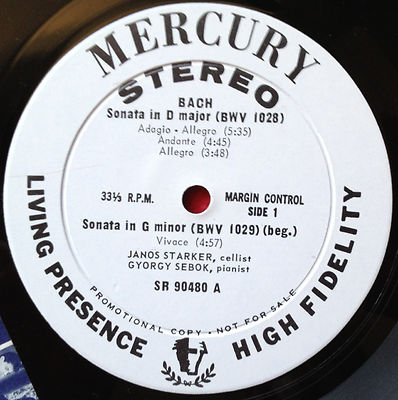
Janos Starker/Gyorgy Sebok- Bach: Three Sonatas For Cello And Piano LP (Mercury Stereo SR90480)
White promo label original first pressing/first stamper of János Starker and Gyorgy Sebok's Three Sonatas For Cello And Piano LP.LP is VG+/Cover is VG+ (light shop wear, promo ink stamp on the back cover).
Side 1 matrix says: SR-90480-A
RFR-1
MR (in tiny letters)
Side 2 matrix says
SR-90480-B
RFR-2
MR (in tiny letters)
Tracks are
Sonata In D Major, S. 1028
A1. Adagio - Allegro 5:35
A2. Andante 4:45
A3. Allegro 3:48
Sonata In G Minor, S. 1029
A4. Vivace 4:57
B1. Adagio 5:20
B2. Allegro 3:36
Sonata In G Major, S. 1027
B3. Adagio 3:25
B4. Allegro Ma Non Tanto 3:14
B5. Andante - Allegro Moderato 5:09
Cello – János Starker
Piano – Gyorgy Sebok
Engineer [Recording] – Robert Eberenz
Liner Notes - Carol Francis Brown
Producer – Wilma Cozart Fine
Recording Supervisor – Harold Lawrence
W iki pe di a says of Janos Starker:
János Starker (Hebrew: ????? ???????, Hungarian: Starker János; July 5, 1924 – April 28, 2013[1]) was a Hungarian-American cellist. From 1958 until his death, he taught at the Indiana University Jacobs School of Music, where he held the title of Distinguished Professor.
Starker was born in Budapest to a father of Polish descent and a mother who had immigrated from Ukraine, both Jewish. His two older brothers were violinists, and the young János (named for the hospital in which he was born) was given a cello before his sixth birthday. A child prodigy, Starker made his first public performances at ages six and seven. He entered the Franz Liszt Academy of Music in Budapest to study with Adolf Schiffer and made his debut there at age 11. Starker began teaching other children at age eight, and by the time he was 12, he had five pupils. Starker counts among his strongest influences Leo Weiner, a composer who taught chamber music. Zoltán Kodály, Béla Bartók and Ern? Dohnányi were also members of the Liszt Academy faculty.
Starker made his professional debut at age 14, playing the Dvo?ák concerto with three hours' notice when the originally scheduled soloist was unable to play. He left the Liszt Academy in 1939 and spent most of the war in Budapest. Because of his youth, Starker escaped the tragic fate of his older brothers, who were pressed into forced labor and eventually murdered by the Nazis. Starker nevertheless spent three months in a Nazi internment camp.
After the war, Starker became principal cellist of the Budapest Opera and the Budapest Philharmonic Orchestras. Starker, who had never been granted Hungarian citizenship, left the Soviet-occupied country in 1946.
He gave a successful concert in Vienna, then remained there to prepare for the Geneva Cello Competition, held in October 1946. He lost to his student, Eva Janzer.
After observing a horrific concert by the former child prodigy Yehudi Menuhin, Starker had an epiphany. He describes himself as becoming physically ill from the realization that he had little idea, from a technical standpoint, how he really played the cello. "I played like a blind man", he has said. "What happens to the bird who flies and doesn't know how it flies? That's what happens to child prodigies."[2] Starker spent a year analyzing all aspects of his technique. By October of the following year, he had regained his confidence. His studies and exercises he wrote for his friend George Bekefi ultimately resulted in his famous essay and published cello method, "An Organized Method of String Playing".
Starker, still in visa limbo, went from Geneva to Paris, where he spent a year. There he made his first recording of Kodaly's monumental Solo Cello Sonata, Op. 8,[3] a work which some people considered technically unplayable before that time. The recording earned him the Grand Prix du Disque and cemented his fame. He went on to make three more recordings of the work.
Starker emigrated to the United States in 1948 to become principal cellist of the Dallas Symphony Orchestra under Antal Doráti. In 1949, he moved to New York to become principal cellist of the Metropolitan Opera under Fritz Reiner. It was in New York that Starker made the first of his acclaimed recordings of the Bach Cello Suites. Starker's technical mastery led some to suspect, incorrectly, that the recordings were electronically altered; his experiments with microphone placement and recording techniques drew the attention of engineers at the MIT.
In 1952, Starker became principal cellist of the Chicago Symphony Orchestra when Fritz Reiner became the music director. In 1958, Starker moved to Bloomington, Indiana, where he settled for the rest of his life. At the Indiana University Jacobs School of Music he became a professor and resumed his solo career, giving hundreds of concerts on every continent.
W ik i pe dia says of György Seb?k :
György Seb?k (November 2, 1922 - November 14, 1999) was an internationally renowned pianist and Distinguished Professor at the Indiana University School of Music in Bloomington USA.
He was known worldwide as a soloist with major orchestras, a recitalist on four continents, a recording artist, and for his master classes, visiting professorships, and the Swiss music festival he organized in Ernen.
He was born in Szeged, Hungary on November 2, 1922.
Seb?k gave his first solo piano recital at age 11. At 14, he played Beethoven's Piano Concerto No. 1 under conductor Ferenc Fricsay- a performance upon which he would reflect many years later.
He enrolled in the Franz Liszt Academy at the age of 16, under the guidance of Zoltán Kodály and Leo Weiner. After graduating, he gave concerts for ten years throughout Eastern and Central Europe and the former Soviet Union.
He won the Grand Prix du Disque in 1957. Seb?k was listed in Who's Who in America, Who's Who in Music, the National Register of Prominent Americans, and other biographical dictionaries. He received numerous honors, including the Cross of Merit of the Hungarian Government, La Medaille de la Ville de Paris, Echelon Vermeille, and, in 1996, Kulturpreis des Staates Wallis, (Prix de Consecration). Also in 1996, the French Government bestowed on him the decoration Chevalier de L'Ordre des Arts et des Lettres.
A quick note about changes to the US Postal Services international postage rates for packages: I'm sorry to say that as of 2013 the US Postal Service has significantly raised the cost of shipping packages (even to Canada). Unfortunately this is affecting all US sellers and international buyers. My shipping prices reflect the new shipping costs and the eBay fees for the shipping you pay as well as packaging material (I do try to recycle when I can but that's not too often). If the US Postal Service reduces rates, I will adjust them to reflect fair postage for international buyers.
I accept payments through Paypal. I also accept payment by mail in US currency and Checks drawn on US banks (Checks require 10 days to clear the bank). Please do not send cash by postal mail, I cannot be responsible for cash sent by mail.
Buyer pays shipping:
Media Mail to US: $4.25
Air Mail to Europe/UK/Asia/NZ/Australia: $19.25
Air Mail to Canada: $12.75
Air Mail to Mexico: $17.50
I need to be clear that I can provide proof of shipping on any package mailed, but I cannot be responsible for packages lost in the post (Italy and parts of South America have been a problem with some other sellers). In order to minimize the likelihood of lost packages I print the address from your paypal payment address and give you the opportunity to correct the address if necessary. If you pay by postal mail, I ask that you email me your address so that I can print a label from your email. If you desire international postal insurance, please inquire with me on the costs.
price rating


