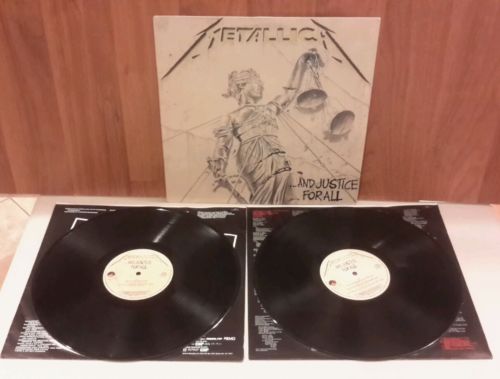
Metallica And Justice for All Vinyl lp original pressing
$
85


Favourite Auctions
To save auctions to your favourites, please login
If you don't have an account, please register
Description
...And Justice for All is the fourth studio album by American heavy metal band Metallica, released on August 25, 1988 by Elektra Records. It was the band's first studio album to feature bassist Jason Newsted after the death of Cliff Burton in 1986. ...And Justice for All is musically progressive, with long and complex songs, fast tempos, and few verse-chorus structures. The album is noted for its sterile production, which producer Flemming Rasmussen attributed to his absence during the mixing process. The lyrics feature themes of political and legal injustice seen through the prisms of censorship, war, and nuclear brinkmanship.
The album's front cover, designed by Stephen Gorman on a scheme by James Hetfield and Lars Ulrich, features a representation of Lady Justice. The phrase "...And Justice for All" appears spray-painted in the lower right corner. The album title is derived from the American Pledge of Allegiance. Originally released on one vinyl disc, the album was quickly re-released as a double album without additional tracks. Three songs from the album were released as singles: "Harvester of Sorrow", "Eye of the Beholder", and "One", while the title track was released as a promotional single.
...And Justice for All was acclaimed by music critics. It was included in The Village Voice?'?s annual Pazz & Jop critics' poll of the year's best albums, and the single "One" earned Metallica its first Grammy Award for Best Metal Performance in 1990. The group's best-selling album at the time, it was the first underground metal album to achieve chart success in the United States. The album was certified 8× platinum by the Recording Industry Association of America (RIAA) in 2003 for shipping eight million copies in the US, making it Metallica's second-best-selling al...And Justice for All was Metallica's first full-length studio album to feature bassist Jason Newsted after the death of Cliff Burton in 1986. Newsted had previously played on Metallica's The $5.98 E.P.: Garage Days Re-Revisited, an extended play released in 1987. The band intended to record the album earlier, but was sidetracked by the large number of festival dates scheduled for the summer of 1987, including the European leg of the Monsters of Rock festival. Another reason was frontman James Hetfield's arm injury in a skateboarding accident. The band's previous studio album, Master of Puppets, marked the end of Metallica's contract with the Music for Nations label. Manager Peter Mensch wanted the band to sign with British record distributor Phonogram Records, and Phonogram chairman Martin Hooker was keen to obtain the band's contract. To persuade Metallica to choose his label over Q Prime, who was also interested in the band, Hooker offered them a bigger deal, "worth well over £1 million, which at that time was the biggest deal we'd ever offered anyone". His explanation was that the final figure for combined British and European sales of all three Metallica albums was more than 1.5 million copies. The album title was revealed in April 1988: ...And Justice for All, after the final words of the Pledge of Allegiance. The artwork was created by Stephen Gorman, based on a concept developed by Hetfield and drummer Lars Ulrich. It depicts a cracked statue of a blindfolded Lady Justice, bound by ropes with her breasts exposed and her scales overflowing with dollar bills. The title appears graffiti-style in the lower right corner.
Production and recording
...And Justice for All was recorded from January to May 1988 at One on One Recording Studios in Los Angeles. Metallica produced the album with Flemming Rasmussen. Rasmussen was initially unavailable for the planned start on January 1, 1988, and the band brought in Mike Clink, who had caught their attention for producing Guns N' Roses' debut album Appetite for Destruction (1987). Things did not work out as planned, and three weeks later Rasmussen became available after Ulrich gave him a call. Rasmussen listened to Clink's demos for the album on his February 14 flight to Los Angeles, and upon his arrival Clink was fired. Hetfield explained that recording with Clink did not work out so well, and Rasmussen came over as a last-minute replacement. However, Clink is credited with engineering the drums on two of the album's tracks: "The Shortest Straw" and "Harvester of Sorrow". While waiting for Rasmussen to arrive, the band recorded two cover songs—"Breadfan" and "The Prince"—to "fine?tune the sound while they got into the studio vibe" Both were released as B-sides of the "Harvester of Sorrow" CD single, as separate B-sides for "Eye of the Beholder" and "One" respectively, and were included on the compilation Garage Inc. (1998).
Rasmussen's first task was to adjust and arrange the guitar sound with which the band was dissatisfied. A guide track for the tempos and a click track for Ulrich's drumming were used. The band played in a live room, recording the instruments separately. Each song used three reels: one for drums, a second for bass and guitars and a third for anything else. Hetfield wrote lyrics during the recording sessions; these were occasionally unfinished as recording began, and Rasmussen said that Hetfield "wasn't really interested in singing" but instead "wanted that hard vibe". Metallica's recording process was new to Jason Newsted, who questioned his impact on the overall sound and the lack of discussion with the rest of the team. Newsted had a different experience with his previous band,Flotsam and Jetsam, describing their style as "basically everybody playing the same thing like a sonic wall". He recorded his parts separately from the rest of the band, with only the assistant engineer present. The bassist noted that his parts were at the sameaudio frequency as Hetfield's guitar parts, and this created a "[battle] for the same frequency".
Steve Thompson, who mixed the album, claims that Lars Ulrich was squarely to blame for the inaudible bass and drum sound character. Thompson wanted to be relieved of his mixing duties when Ulrich presented his instructions but Thompson's managers would not let him and Thompson claimed to have received criticism for the poor sound quality of the record.
We took the Ride the Lightning and Master of Puppets concept as far as we could take it. There was no place else to go with the progressive, nutty, sideways side of Metallica, and I'm so proud of the fact that, in some way, that album is kind of the epitome of that progressive side of us up through the '80s.
—Lars Ulrich, on the band's direction for the albumThis is completely sublimated rock, on a quest for a purity of form, light years beyond raunch or blues rock. Metallica turn heavy metal's melodrama into algebra. This isn't thrash, but thresh: mechanized mayhem. There's no blur, no mess, not even at peak velocity, but a rigorous grid of incisions and contusions.
—Simon Reynolds, on the album's music...And Justice for All is a musically progressive album featuring long and complex songs, fast tempos and few verse-chorus structures.Metallica decided to broaden its sonic range, writing songs with multiple sections, heavy guitar arpeggios and unusual time signatures. Hetfield later explained: "Songwriting-wise, [the album] was just us really showing off and trying to show what we could do. 'We've jammed six riffs into one song? Let's make it eight. Let's go crazy with it.'" Music critic Simon Reynolds noted the riff changes and experimentation withtiming on the album's epically constructed songs: "The tempo shifts, gear changes, lapses, decelerations and abrupt halts".
BBC Music's Eamonn Stack wrote that ...And Justice for All sounds different from the band's previous albums, with longer songs, sparser arrangements, and harsher vocals by Hetfield.According to journalist Martin Popoff, the album was less melodic than its predecessors because of its frequent tempo changes, unusual song structures and layered guitars. He argued that the album is more of a progressive metal record because of its intricately performed music and bleak sound. Music writer Joel McIver called the album's music aggressive enough for Metallica to maintain its place with bands "at the mellower end of extreme metal". According to writer Christopher Knowles, Metallica took "the thrash concept to its logical conclusion" on the album.
The album was noted for its "dry, sterile" production. Rasmussen said that was not his intention, as he tried for an ambient sound similar to the previous two albums. He was not present during the album's mixing, for which Steve Thompson and Michael Barbiero had been hired beforehand. Rasmussen felt that, in his absence from the mixing process, Thompson and Barbiero ended up using only the close microphones on the mix and none of the room microphones, thus causing the "clicking", thin drum sound. Popoff noted that because of the strange production, the bass guitar was nearly inaudible, while the guitars sounded "strangled mechanistic". He saw the "synthetic" percussion as another reason for the album's compressed sound.
The sound has nearly-inaudible bass guitar, which Rasmussen claims was ordered by Hetfield and Ulrich after hearing the initial mixes, resulting in his belief that "Jason Newsted, [engineer] Toby Wright and I are probably the only people who know what the bass parts actually sounded like on that album". In their defence, Hetfield and Ulrich said that most of Newsted's bass lines closely followed the rhythm guitar lines to the point of being indiscernible from each other. A lack of direction is also partly to blame; since the album was largely produced by the band, there was no one present in the studio to guide the band's new bassist and tell him what was expected of him, something a producer would typically do. Newsted was not satisfied with the final mixes: "The Justice album wasn't something that really felt good for me, because you really can't hear the bass."
Lyrics
...And Justice for All has a lyrical material featuring a conceptual uniformity around notions of political and legal injustice as seen through the prism of war, censored speech, and nuclear brinkmanship. The majority of the songs raise issues that differ from the violent retaliation of the previous releases. Editor Tom King wrote that for the first time the lyrics dealt with political and environmental issues. He named contemporaries Nuclear Assault as the only other band who "applied ecological lyrics to thrash metal songs" rather than singing about Satan and Egyptian plagues. McIver noted that the band's main lyricist, James Hetfield, wrote about topics that he had not addressed before, such as his revolt against The Establishment.
Ulrich described the songwriting process as their "CNN years", with him and Hetfield watching the channel in search for song subjects—"I'd read about the blacklisting thing, we'd get a title, 'The Shortest Straw,' and a song would come out of that." Concerns about the environmental plight of the planet ("Blackened"), corruption ("...And Justice for All"), and blacklisting and discrimination ("The Shortest Straw") are emphasized with traditional existential themes. Issues such as freedom of speech and civil liberties are presented from a grim and pessimistic point of view. "One" was unofficially entitled "antiwar anthem" because of the lyrics which portray the suffering of a wounded soldier. "Dyers Eve" is a lyrical rant from Hetfield to his parents.
Cliff Burton received co-writing credit on "To Live Is to Die" as the bass line was a medley of unused recordings Burton had performed prior to his death. Because the original recordings are not used on the track, the composition is credited as written by Burton and played by Newsted. The spoken word at the end of the song ("When a man lies, he murders some part of the world. These are the pale deaths which men miscall their lives.") was written by German poet Paul Gerhardt, but was erroneously attributed to Burton in the liner notes. The second half of the speech ("All this I cannot bear to witness any longer. Cannot the kingdom of salvation take me home?") was written by Burton.
price rating






![DAVID GATES & The Accents [JO-BABY/LOVIN' AT NIGHT] Robbins 1008 45 RPM](https://www.popsike.mobi/php/thumbnail.php?url=https://www.popsike.pics/pix/20160405/131772189215.jpg)