Neal Ramsay Saxophone Pat Ward Piano Handel Sonata Creston Vinyl LP Record VG+
$
25




Favourite Auctions
To save auctions to your favourites, please login
If you don't have an account, please register
Description
Neal Ramsay Saxophone Pat Ward Piano Handel Sonata Creston Vinyl LP Record VG+
Vinyl / Jacket Grade per Goldmine Standard: VG+ / VG+; Jacket still in shrink
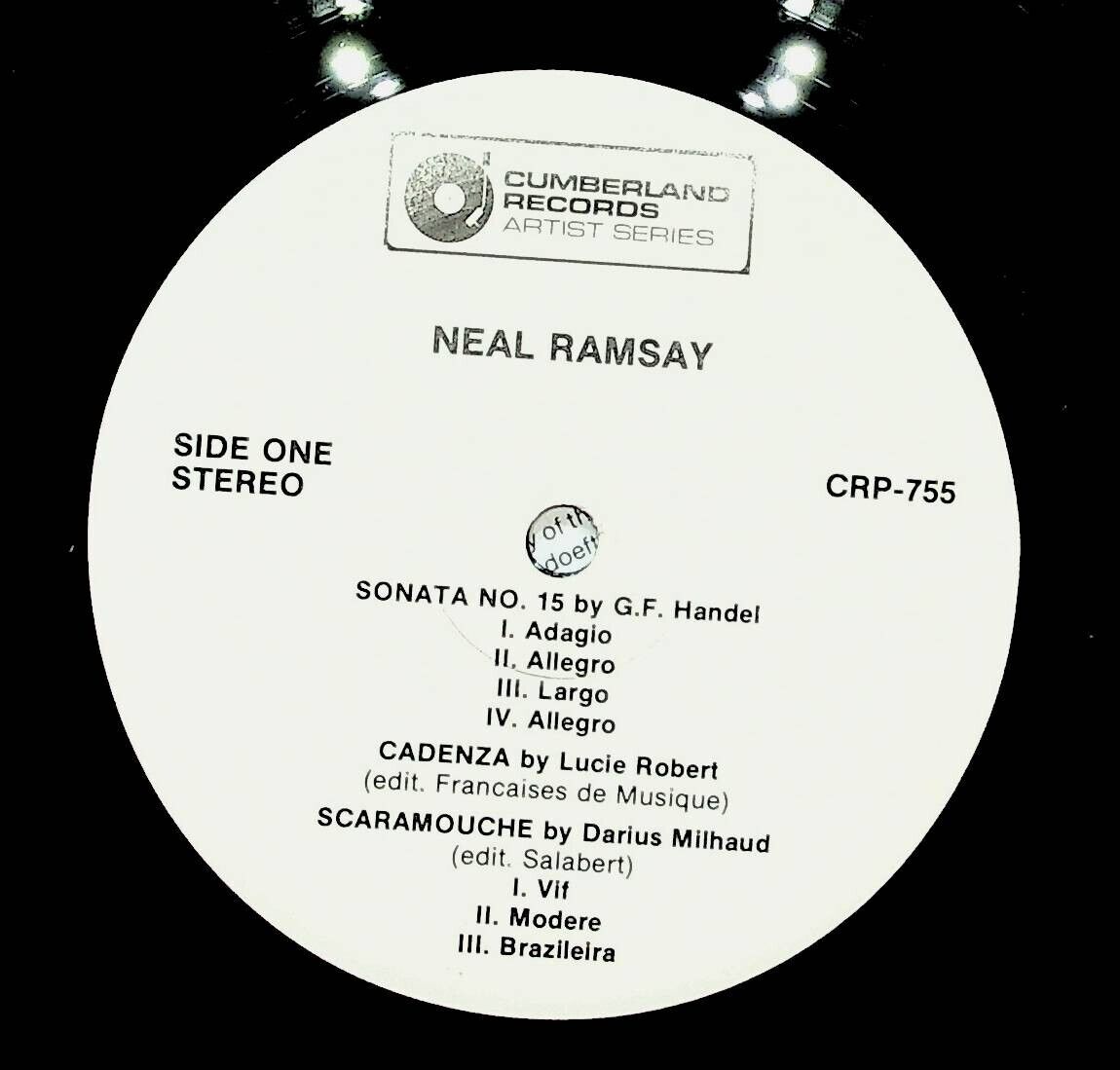
Side One Sonata Op. 1, No. 15 George Frideric Handel (1685-1759) Arr. by Neal Ramsay 8:13 I. Adagio; II. Allegro; III. Largo; IV Allegro When the music of Handel’s Opus 1 first appeared in print in 1722, the wording of the title "Sonatas for flute, violin, or oboe implied that the music was equally playable upon any solo instrument. Neal Ramsay has extended this original idea of Handel’s with a successful arrangement of the Sonata No. 15 for saxophone and piano. The contrapuntal voices of Handel's sonatas unite two principal streams of 18-century musical thought, the strength of polyphonic texture cultivated by the German organ school and the polished urbanity of Italian melody in which Handel had been indoctrinated during his travels before reaching England. Cadenza (1974) Lucie Robert published by Francaises de Musique 10:19 Lucie Robert currently teaches composition at the Paris Conservatory. She has written five solo works for saxophone in addition to Cadenza. Cadenza was premiered in 1974 at the World Saxophone Congress at Bordeaux, France. The composer has structured the piece by means of a single melodic cell and its related intervals. The effect is an urgent dialog between the saxophone and piano Each instrumentalist plays in his own tempo, the composition achieves completion as these two diverse parts are drawn together. Scaramouche (1936) Darius Milhaud published by Salabert, Paris / ASCAP 9:25 I. Vif; II. Modere; III Brazileira Darius Milhaud was probably the best known of the group of French composers called "Les Six." He wrote a large amount of music in all forms and for practically all instrumental combination. His style reflects music he encountered on his extensive travels, and this is particularly evident in Scaramouche. Scaramouche is famous as a suite written for two pianos. However, the work was originally written for solo saxophone and orchestra. It was premiered in 1936 with Marcel Mule as soloist and R. Charpentier conducting. Milhaud revised this version and it was again premiered by Marcel Mule in 1940; Paul Bastide directed the Radio-Paris orchestra The arrangement for piano and saxophone heard on this recording is a combination of the saxophone and orchestra and the two-piano version. Side Two Sonata, Op. 19 (1939) Paul Creston published by Shawnee Press I ASCAP 13:00 I. With Vigor; II. With Tranquility; III. With Vigor Paul Creston, a native of New York, is entirely self-taught in harmony, composition, and orchestration. In addition to an active career as a composer and organist his musical studies have included acoustics, music- therapy, Gregorian Chant, evolution of harmony and psychology of music. The Sonata for Saxophone and Piano is one of four major works for saxophone written by Creston, and was premiered by Vincent Abato in 1939. Since then it has become one of the most important pieces written for the saxophone. The first movement (With Vigor) is in a free sonata-allegro form. The second movement (With Tranquility) is based on a simple, song-like theme, which is introduced by the piano and developed by both instruments. The third movement (With Vigor) is a rondo form. Within the 2/4 meter are incorporated various rhythmic meters (5/8, 3/8, 6/8). Each reappearance of the theme is varied in its development. “Music from the Golden Age of the Saxophone” The golden age of the saxophone in the United States extended from about 1916 to the late 1920’s. The popularity of the saxophone during this period was due to the efforts of primarily one composer-saxophonist, Rudy Wiedoeft. Wiedoeft was the first recording and concert artist of the saxophone and became an interna- tionally known performer. Danse Hongroise Ring Hagar Arr. Rudy Wiedoeft (1923), Robbins Music I ASCAP 4:42 Wiedoeft prepared this arrangement of Danse Hongroise to provide himself with literature for the concert hall and as a demonstration of his virtuoso technique. Valse Vanite (1923) Rudy Wiedoeft published by Robbins Music / ASCAP 2:53 Valse Vanite is one of several dozen waltzes written by Rudy Wiedoeft. This is an elegant little waltz written in three part form. Saxophobia (1918) Rudy Wiedoeft published by Robbins Music I ASCAP 1:41 The most popular pieces performed by Rudy Wiedoeft were his novelty pieces and Saxophobia is the most popular of these. This work is a good sample of Wiedoeft’s style of ragtime that provided a transition to jazz. THE RECORDING Rarely does a performer leave the security of the recording studio for the production of an album. However, when the artist is Neal Ramsay the results are very exciting. Through this recording you can share the experience of hearing Neal give performances of the great works of the saxophone literature as recorded live in the concert hall. Neal Ramsay Saxophone Neal Ramsay’s career has involved all aspects of musical performance including concerts, recitals, workshops, recordings, radio and television. He concertizes extensively as the artist representative of Buffet- Crampon saxophones of Paris and as a touring artist for the Tennessee Arts Commission. Currently Neal is the Artist-Teacher of Saxophone of Blair School of Music of Vanderbilt University. He is also active in bringing new literature to the saxophone through his publication with Shawnee Press. Pat Ward Piano Pat Ward began her musical studies at age five and became an accompanist at age seven. As well as accompanying Neal Ramsay in numerous recitals, Pat has accompanied other prestigious solo artists, such as Philip Farkas, Larry Skinner and Don Butterfield. Pat is also active as a private piano instructor in Murfreesboro, Tennessee.
lp5461-BB
price rating