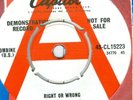
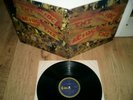
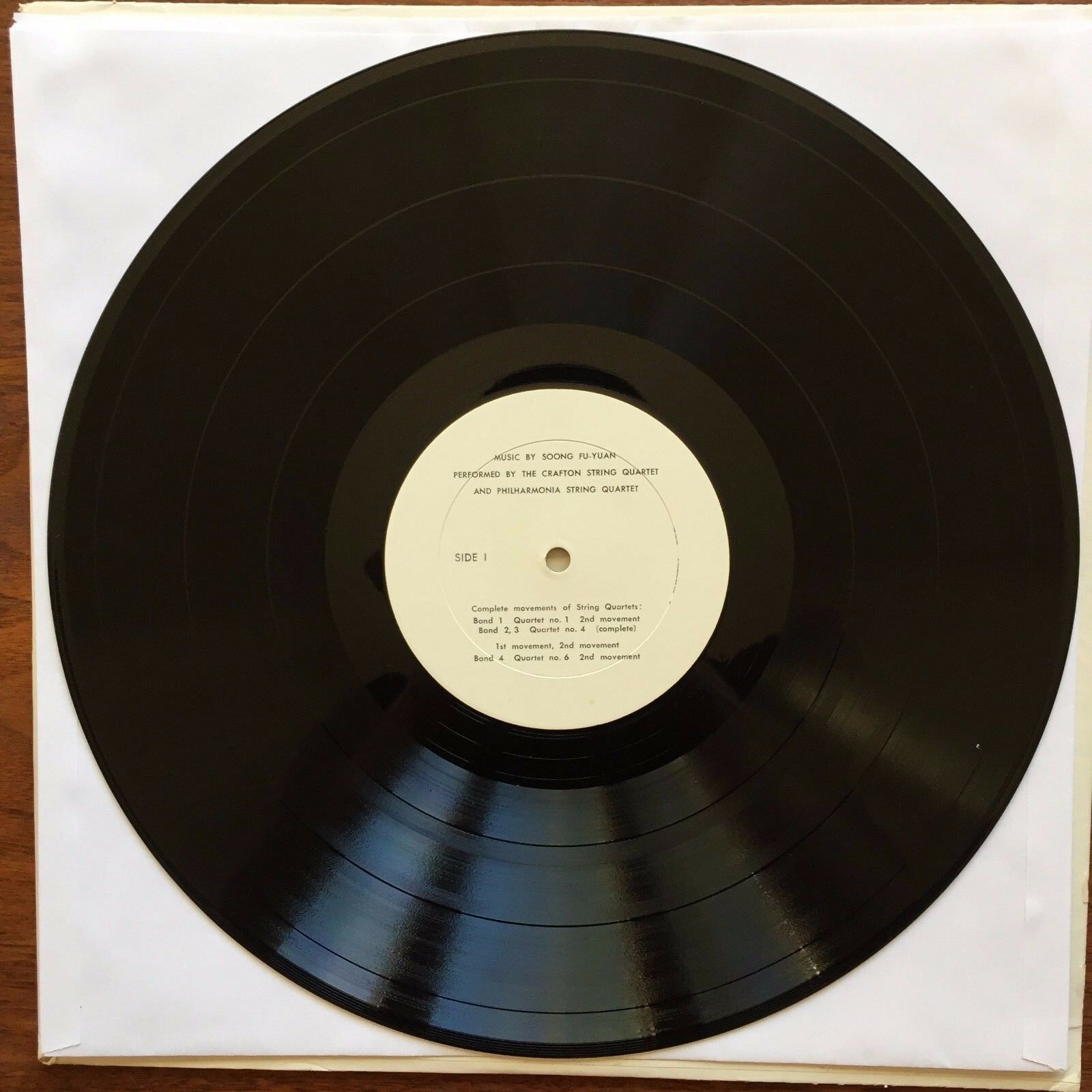
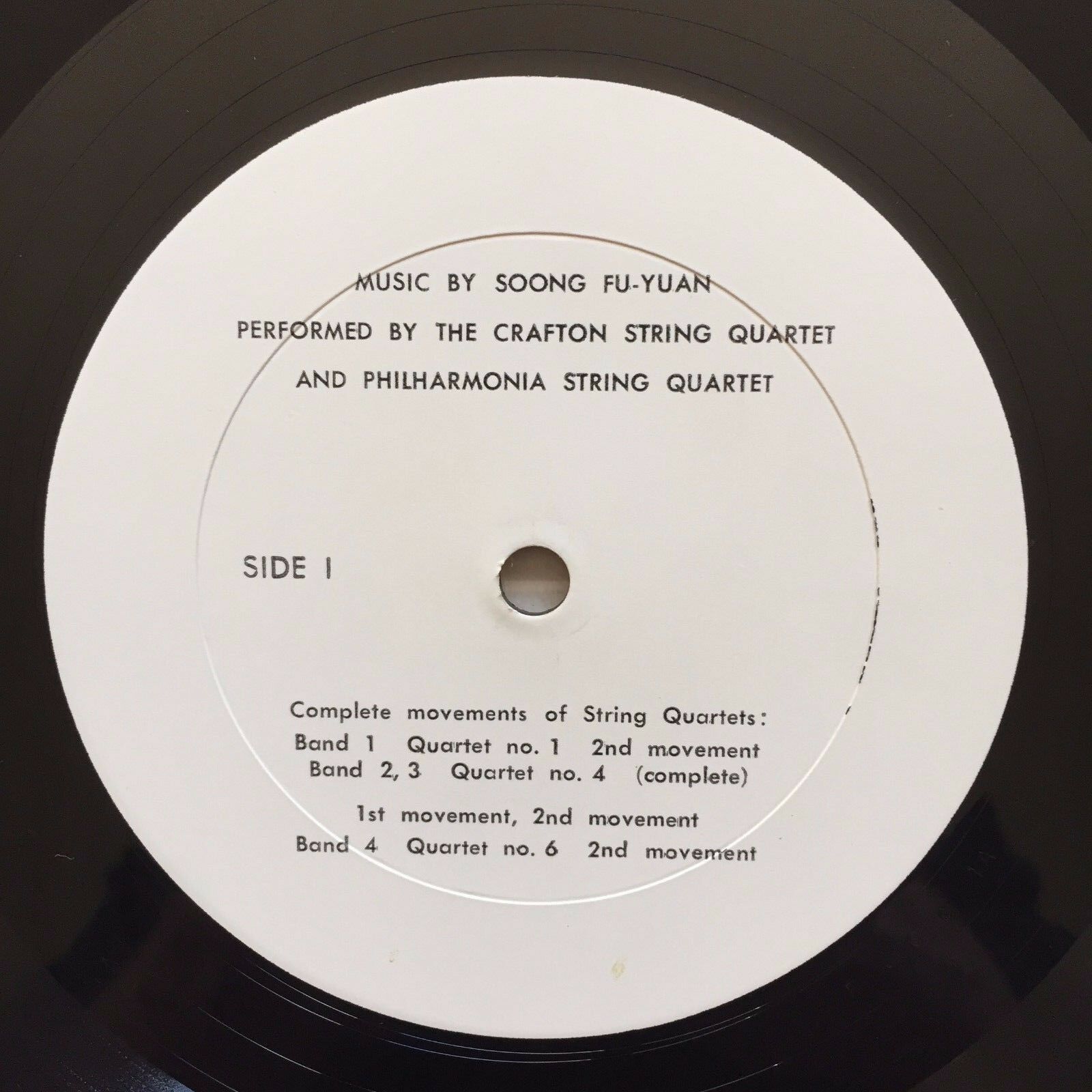
PRIVATE PRESSING Soong Fu-Yuan LP 1967 Philharmonia String Quartet classical OG
$
20


Favourite Auctions
To save auctions to your favourites, please login
If you don't have an account, please register
Description
Rare Private Press LP of original compositions by Soong Fu-Yuan. "Music By Soong Fu-Yuan Performed By Th Crafton String Quartet And Philharmonia String Quartet"
Very scarce limited pressing. Not many of these could have been pressed. Limited information, see bio at bottom.
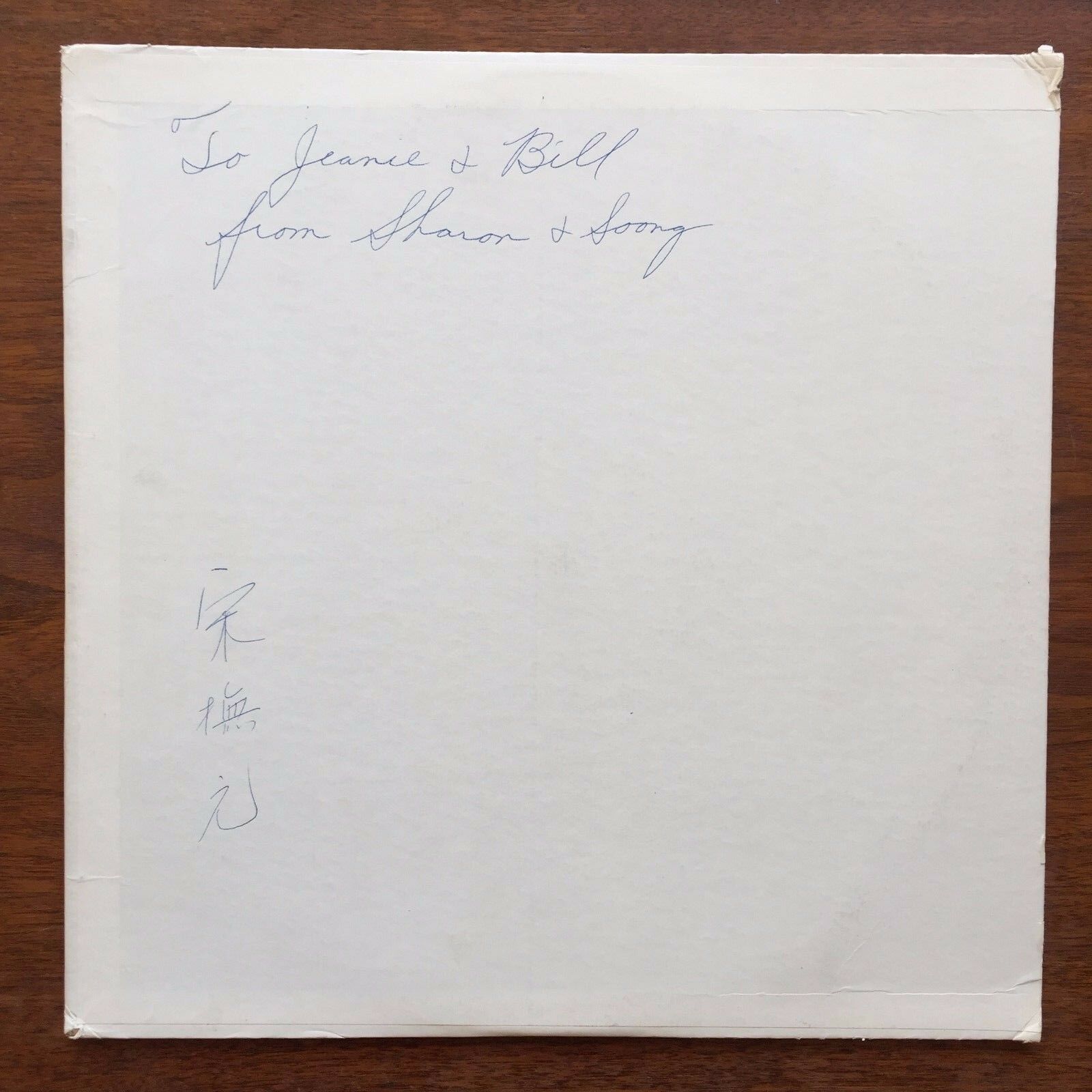
Vinyl is clean VG+. A few light hairlines and shadow scuffs. Minimal surface noise may be heard in quieter passages. White labels clean. Personalized signed white cover is clean, light corner/edge-wear and handling. Please zoom in on photos!
Please feel free to message me with any questions or concerns! I am not a professional grading vinyl records but do my best to describe each record honestly and accurately.
Although Soong Fu-Yuan evolved his compositional style and technique primarily from Western classical music, his poetic inspiration springs for the most part from the ancient Chinses tradition. Born in China of a well-known general who was also a scholar of classical Chinese literature and a mother who was a concert pianist, Soong memorized from childhood such classics as the Analects of Confucius, the complete Mencius, and the poems of the Tang Dynasty. This practice was rather common in China for almost 2000 years, but has become very rare in modern times. Soong studied piano with his mother and began composing at an early age. His music represents a natural combination of his dual heritage.
Soong Fu-Yuan was born in Nanjing, China in 1933. His family was originally from Hunan and his father, Song Xilian, was a famous general during the Japanese invasion of China. He studied piano with his mother, Leng Lanqin, who taught in two conservatories in Shanghai before her marriage. Soong began composing at an early age. His twin loves were ancient Chinese poetry and Western Classical music. At the age of 18, he went to the United States to begin studies in composition. As a freshman at Northwestern University near Chicago, he bypassed all harmony and ear-training through placement tests and took compositions seminars with graduate students.
At the time of his arrival, however, Western new music was entering a period of domination by serialism and the avant-garde schools that lasted for decades. Soong believed these were artificial constructs, devoid of musical substance. In a word, his music was out of step with the times. Though he composed many piano, chamber, and orchestral works, his music could find few outlets.
There were exceptions. In 1966, an ensemble from the Chicago Symphony collaborated with Soong in three concerts of his newly composed works for string quartet. And in 1967, when he moved to Woodstock, New York, a quartet from the New York Philharmonic performed a concert of his music in New York City’s Town Hall. In 1983, his play with music, Tao Yuan, was presented by the Bel Canto Opera in New York City in five performances. The following year, he was awarded a grant from the National Endowment for the Arts to further develop Tao Yuan.
Then, in 1989, the Tchaikovsky Competition Laureate pianist Paul Rutman discovered Soong’s 9-piece set, Poems for Piano. Rutman’s recording of the pieces on the Musical Heritage Society label received surprisingly quick acceptance and praise when it was released in 1990. Over time, the new music world had abandoned strict dogmatism and begun to accept diversity. With this change, it finally became possible for Soong’s music to be judged on its own merits rather than on stylistic grounds.
After the release of the CD, Soong’s works met with increasing demand. Selections were broadcast over many classical music stations across the U.S., including WQXR, then the radio station of the New York Times. After airing his music, the well-known radio host Robert Sherman asked Soong to compose music for The Little Fox, a favorite narrative of his. There were several performances each year of his compositions, works such as The Little Fox, Poems for String Quartet, and selections from his newly composed opera, Return to Paradise. The first act of that opera was presented in concert form at the Taipei Theatre in New York City in 1993. In 1994, the Chinese-American Arts Council of New York presented a concert of Soong’s works at the Kennedy Center in Washington, D.C. In 1995, he was invited to participate in a tour of three concerts in China, highlights of which were telecast by the Central Broadcasting Company nationally several times. On that same tour, he was invited by the Central Conservatory in Beijing and the Shanghai Conservatory to talk about his music. His music was widely welcomed and his comments about himself and the state of contemporary music were thought-provoking, generating many questions and much free voicing of opinion.
Thus, with the many changes in music world, as well as the geo-political one, Soong’s music was finally able to surface. His music, which came from his inner hearing, was lauded for its poetic substance and his originality was confirmed on all sides.
In 2002, Soong’s Three Poems for Chamber Orchestra was performed by the New York Chamber Symphony at Lincoln Center. In September 2002, Soong’s opera Return to Paradise, a story concerning the September 11 tragedy, was performed once as a memorial in Dicapo Opera Theatre in New York City. The following year, the world-renowned pianist, Fou Ts’song, performed four of Soong’s Poems for Piano on a world-wide 70th Birthday concert tour. How fitting that this icon of the piano should find resonance in Soong’s music, which seeks to introduce the beauty of ancient Chinese poetry through music. The concerts took place in several cities across Europe, North America, and Asia.
In 2004, Soong was invited by the Taipei Sinfonia and Philharmonic Orchestra to be the featured composer of its Festival of Poems and Painting in Music, and to compose a piece for that occasion, A Symphony of Poems.
In December of 2004, Soong developed a serious health problem. Although he was able to complete his symphony and participate in the May 2005 Festival in Taipei, where his symphony was performed twice, he passed away at the end of the year. He left behind his wife of 24 years, Darcy Hector, and his son Corey Ming-Sheng Soong, born in 1996.
price rating