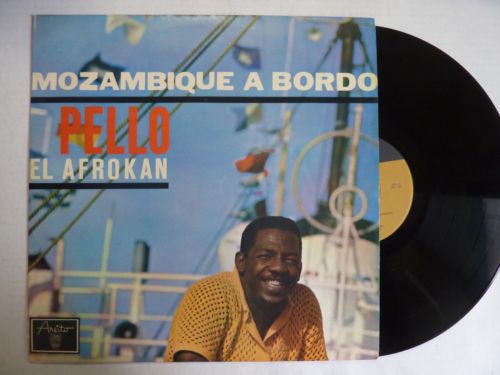
Pello El Afrokan - Mozambique A Bordo - Areito LPA 1043
$
30



Favourite Auctions
To save auctions to your favourites, please login
If you don't have an account, please register
Description
Pello El Afrokan - Mozambique A Bordo - Areito LPA 1043 Pello El Afrokan - Mozambique A Bordo - Areito LPA 1043
Pello El Afrokan - Mozambique A Bordo - Areito LPA 1043
Sleeve in excellent condition - rarely turns up in this condition anymore. Two clean labels, nice shiny vinyl. EX/EX.
A1 Maria Caracoles A2 Lo Bailo Solo A3 Pancho Eso No Lo Se A4 Mozambique Fenomenal A5 Ahora Si A6 Coja El Paso B1 Camina Como Comico B2 Feliciano Reformado B3 El Mozambique De La Rampa B4 Amelcochao B5 Oye No Volvere Contigo B6 El Mozambique Llego A Paris"Mozambique (pron.: mo.sam.'?i.ke) is a vigorous style of Cuban music and dance derived, like the conga, from music of Cuban street carnivals or comparsas. It was invented or developed by Pello el Afrokan (Pedro Izquierdo) in 1963.
Although the rhythm shares many characteristics with Sub-Saharan African music traditions, it does not have anything to do with music from the African nation of Mozambique. The Cuban mozambique features conga drums, bombos (bass drums), cowbells and trombones. Afrokan), and "Mozambique Rhythm from Cuba" Pello's composition "María Caracoles" was later recorded by Carlos Santana.
Pello's rhythm made its début in 1963 in Havana on the television programme Ritmos de Juventud, with the presenter surrounded by drummers so in tune with each other that they created a piano-like sound, while simultaneously performing the Mozambique dance."
The dance consists of bending the knee and lowering the body at the same time as lifting up a foot while returning the body to its normal upright position, continuing to bend the knees, and lowering the body. The dance looks like a cross between the "timeless" Afro-Cuban rumba and son, and the African-American twist, which was popular in the States during the early 1960s.
Mozambique peaked in 1965, when Pello took a group to the Olympics in Paris, then was quickly discarded.Despite its short time in the spotlight, first Pello, and later his son, have kept the mozambique alive through recordings and live performances. Mozambique was the first new genre of post-revolution Cuba, and the first popular band music to systemically use rumba clave.The mozambique began a new trajectory in band rhythms, which can be heard in its descendants—songo and timba.
No Cuban records are graded Mint or Near Mint. Most Cuban records after 1970, mainly on Areito, have some degree of ring wear due to their paper like sleeves. GRADING:
All records are strictly graded. Sleeves are graded first followed by the vinyl. Example: EX/VG. I have used both the Record Collector and Goldmine magazines standards to grade my records. Where indicated records are play graded (especially those of higher value) otherwise they are inspected under a strong light.
Pre-revolution labels like Panart, Puchito,Seeco, Duarte,Velvet Records and others from the 1950's as well as the post-revolution 1960's EGREM records were pressed using thick vinyl and generally will sound better than the 1970's and later Areito recordings. The pre-revolution records will often play better than they look.
M= Mint: refers to a brand new unplayed vinyl record.
NM = Near Mint: Record played only a few times with care. May have a few light marks when examined under a bright light otherwise appears new.
EX = Excellent: The record has some signs of being played but there is very little lessening in sound quality. The cover and packaging may have slight wear and/or small creasing. EX(-) is somewhere between VG and EX. A record with an EX(+) grade can be described as better than EX but not quite Near Mint.
VG = Very Good. The record has obviously been played many times but displays no major deterioration in sound quality despite noticeable surface marks and light scratches. Normal wear on the cover or extra items without any major defects is acceptable. VG(-) signifies a record has more surface noise as well as visual marking than a VG while VG(+) is not quite in the EX category.
GOOD: The record has been played so much that the sound quality has noticeably deteriorated and a lot of surface noise can be heard. The cover and contents suffer from folding, scuffing of edges, ring wear, spine splits, discolouration, etc.
FAIR: The record is only just playable and has not been taken care of. There is considerable surface that impacts on the playback, The record may jump or skip. The cover and contents will be torn, stained, water damaged and/or defaced.
Poor: The record will not play properly and skip and/or jump throughout many tracks. The cover will be badly damaged and/or partly mussing.
Bad: The record is unplayable and may be broken. This type of record is used only as a collection filler and I will only sell such a record if it is extremely rare to obtain.
ABOUT ME:
I have been selling vinyl records on E-Bay since 2000 and prior via mail-order. In all over 30 years experience. My work in the record and radio industries and music reviewer for a major newspaper has allowed me to accumulate a lot of vinyl records. In 2011, I started buying used Cuban vinyl records in Havana and I am currently one of the biggest resellers in North America. I employ several purchasing agents whom I have trained to provide me with quality vinyl.
WHY BUY CUBAN RECORDS FROM ME:
- Good quality/reasonable pricing.
- I pay more to obtain quality Cuban vinyl and resell at competitive prices.
- I am helping several Cuban people (my buyers) whose lives have improved since working for me.
- Strict grading.
- No hassle 30 day money back no questions asked guaranty.
- I only use strong quality mailers to ensure goods arrive undamaged.
- All Cuban records are washed using a professional cleaning system and are inspected before being listed.
I COMBINE SHIPPING COSTS.
price rating