Rare Jazz 78 Bernie Cummins & his Orchestra Gennett 5641 Poplar Street Blues Pie
$
100


Favourite Auctions
To save auctions to your favourites, please login
If you don't have an account, please register
Description
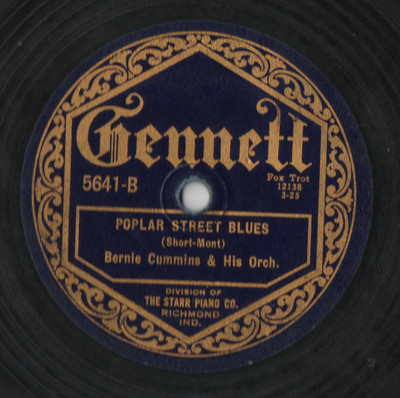
Bernie Cummins & His Orch – Gennett 5641
(I Like Pie, I Like Cake, But) I Like You Best of All / Poplar Street Blues
Very rare jazz record
I'm not too familiar with 78 record grading, but it looks to be in very good shape. Some light markings here and there, but no deep scratches or anything that seems glaring. I'd give it a VG+ if it were a 45...
Richmond, Indiana Starr Gennett
Please note that shipping is not $4. eBay does not allow shipping to be higher on records, but I cannot afford shipping and packing materials in the US for $4. US shipping will be $8. International rates are available. Payment by Paypal.
UPDATE: a watcher has asked me to upload pictures of the whole record. If you are also interested in seeing the full record, please see new pics. Thanks.
My Grading Key: (records are visually graded)
Everybody tends to grade differently so here’s what my abbreviations mean:
G – rough copy. May have scratches, or has some flaw that affects playability or causes skipping
VG – record may play with some noise, and has some visual marks on record, but should play without skips
VG+ – a very clean record with only a few light surface marks here and there
VG++ – same as NM. Looks almost like a new record with lots of shine and no scratches
For years I worked at an archive here in Indiana and once a year our librarian weeded through the collections and sorted out the duplicates. We then held a sale, which I attended two years ago (this is not likely to happen ever again, btw). I usually collect 45s and LPs, with an emphasis on honky-tonk and rockabilly music, but the archive’s sales are usually dominated by 78s. At the last sale, I was blown away by what I found. No country, but some amazing music. In the first box I found dozens of early jazz, hot jazz (whatever you want to call it) 78s on Victor, Puritan, Okeh, Paramount, Vocalion, Blue Note, Folkways, Asch, Bluebird, Columbia, Brunswick as well as numerous one-offs and smaller independent labels. I was stunned! In that first box were 78s by Charlie Johnson and his Paradise Band, King Oliver and his Orchestra, Connie’s Inn Orchestra, Clarence Williams’ Blue Five, Jelly Roll Morton’s Red Hot Peppers, Ma Rainey, New Orleans Rhythm Kings, the Louisiana Sugar Babes, Dixieland Jug Blowers, Napoleon’s Emperors, Ed Lang, Bessie Smith, etc. There were also numerous blues 78s by Blind Willie Johnson, T-Bone Walker, Leadbelly, Big Bill Broonzy and even “atomic” gospel recordings by the Golden Gate Quartet. Then of course there were the amazing recordings of the usual early jazz suspects: Duke Ellington and his Cotton Club Orchestra, Benny Goodman, Oran “Hot Lips” Page, Original Dixieland Jazz Band, Fats Waller, Hoagy Carmichael (our local hero), Fletcher Henderson, Johnny Dodds’ Black Bottom Stompers, Louis Armstrong and his Orchestra and also with his Hot Five. In later boxes I even found some Blue Note 78s, some Folkways recordings as well as some field recordings by John A. Lomax.
The sad news? I couldn’t buy it all. The great news? I bought a lot of it. The sadder news? I’m broke and have to sell it. A few amazing things about these records: 1.) Since their arrival in the archive (usually a donation from a well-known jazz collector), they have been stored in upright position, in sleeves, in a temperature-controlled environment (I believe in the 60 degrees range). 2.) Once in control of the archive, these records are never played more than once (to transfer the files digitally), using the most up-to-date audio equipment to meet preservation standards. 3.) Most of these records, because they were donated by serious collectors, have been kept in amazing condition and come in their original sleeves! (or at least a company matching the label that I believe was probably the original sleeve). My thanks to redhotjazz.info for much of the accompanying information.
I do not own a proper needle to play these and thus, the 78s listed here are visually graded. Records will be carefully packaged and bounded by cardboard for padding and safe shipping. Due to the fragility of 78s, insurance is required. After the auction closes I will inform you of the insurance price (whatever the USPS charges) based on your total purchase price. Please do not pay for your item until you have received an invoice from me. I do offer combined shipping for multiple purchases. For overseas bidders, please ask for shipping quotes before bidding. Payment by Paypal only…Domestic USPS Media Mail is $8.00 and $1.00 for each additional item purchased (plus insurance).
Please also see my other auctions as I am also selling many more Jazz 78s.
more on Bernie:
Bernie Cummins (March 14, 1900 – September 22, 1986) was an American jazz drummer and bandleader.
Bernie Cummins was born in Akron, Ohio as Bernard Joseph Cummins. Cummins was in his youth a boxer, besides playing drums in local bands in Ohio. In 1919 he created a small ensemble of his own, which debuted in Indiana and which grew gradually into a larger dance band. Singers in the band included Dorothy Crane,Jerry Lang, Bernie's brother Walter Cummins and Scottee Marsh, which sang later with Tommy Dorsey. A female singing trio known as the Sophisticates was hired by Bernie in the mid 1930's out of Minneapolis Marshall HS about the time the Andrew Sisters from Minneapolis North HS became popular and in demand. Charlie Callas and Randy Brooks also played with the band, as did Tommy Dorsey for a time. The orchestra's theme song was "Dark Eyes". Besides his activities as bandleader, Cummins was briefly also the manager of The Wolverines.
The Bernie Cummins Orchestra recorded frequently for such labels as Brunswick, Columbia, Victor, Decca, Gennett, Vocalion and Bluebird. The band had many appearances in the Mid-West and was well known for its live performances; its smooth style was much loved in larger hotels and ballrooms. They played many times at the Biltmore Hotel and the Hotel New Yorker in New York City, the Trianon, Aragon, Blackstone and the Edgewater Beach Hotel and Palmer House in Chicago, as well as further appearances in Dallas, Kansas City, New Orleans, Denver, San Francisco and Saint Paul. Cummins' band also played on radio shows including the Spotlight Dance Program sponsored by Coca Cola, and the Fitch Bandwagon.
In the late 1950s it became increasingly difficult for the band to find gigs, but the band continued to play clubs in Las Vegas, playing at such places as The Flamingo, El Rancho and Last Frontier, before it dissolved it 1959. Cummins retired to Boca Raton, Florida.
More info on Gennett from Wikipedia:
Gennett records was founded in Richmond, Indiana by the Starr Piano Company, and released its first records in October 1917. The company took its name from its top managers: Harry, Fred and Clarence Gennett.[1] Earlier, the company had produced recordings under the Starr Records label. The early issues were vertically cut in the gramophone record grooves, using the hill-and-dale method of a U-shaped groove and sapphire ball stylus, but they switched to the more popular lateral cut method in April 1919.
Gennett set up recording studios in New York City and later, in 1921, set up a second studio on the grounds of the piano factory in Richmond, Indiana under the supervision of Ezra C.A. Wickemeyer. The sides recorded in New York are generally of about typical audio fidelity for a minor label of the time, and some masters were leased from other New York area firms. The sides recorded in Richmond are decidedly below average in audio fidelity, and sometimes have a crude sound and show problems of inconsistent speed of the turntable while the master was being recorded, problems which the major labels had solved some 20 years earlier.[citation needed]
Gennett is best remembered for the wealth of early jazz talent recorded on the label, including sessions by Jelly Roll Morton, Bix Beiderbecke, The New Orleans Rhythm Kings,[1] "King" Joe Oliver's band with the young Louis Armstrong, Lois Deppe's Serenaders with the young Earl Hines[2], Hoagy Carmichael, Duke Ellington, The Red Onion Jazz Babies,The State Street Ramblers, Zach Whyte and his Chocolate Beau Brummels, Alphonse Trent and his Orchestra and many others. Gennett also recorded early blues artists such as Thomas A. Dorsey, Sam Collins, Jaybird Coleman, and Big Boy Cleveland and early "hillbilly" or country music performers such as Vernon Dalhart, Bradley Kincaid, Ernest Stoneman, Fiddlin' Doc Roberts, and Gene Autry. Many early religious recordings were made by Homer Rodeheaver, early shape note singers and others.
Gennett issued a few early electrically recorded masters recorded in the Autograph studios of Chicago in 1925. These recordings were exceptionally crude, and like many other Autograph issues are easily mistaken for acoustic masters by the casual listener. Gennett began serious electrical recording in March 1926, using a process licensed from General Electric. This process was found by to be unsatisfactory, for although the quality of the recordings taken by the General Electric process was quite good, there were many customer complaints about the wear characteristics of the electric process records. The composition of the Gennett biscuit (record material) was of insufficient hardness to withstand the increased wear that resulted when the new recordings with their greatly increased frequency range were played on obsolete phonographs with mica diaphragm reproducers. The company discontinued recording by this process in August 1926, and did not return to electric recording until February 1927, after signing a new agreement to license the RCA Photophone recording process. At this time the company also introduced an improved record biscuit which was adequate to the demands imposed by the electric recording process. The improved records were identified by a newly designed black label touting the "New Electrobeam" process.
From 1925 to 1934, Gennett released recordings by hundreds of "old-time music" artists, precursors to country music, including such artists as Doc Roberts and Gene Autry. By the late 1920s, Gennett was pressing records for more than 25 labels worldwide, including budget disks for Sears, Roebuck's catalog. In 1926, Fred Gennett created Champion Records as a budget label for tunes previously released on Gennett. [3]
The Gennett Company was hit severely by the Great Depression in 1930, and massively cut back on record recording and production until it was halted altogether in 1934. At this time the only product Gennett Records produced under its own name was a series of recorded sound effects for use by radio stations. In 1935 the Starr Piano Company sold some Gennett masters, and the Gennett and Champion trademarks to Decca Records. Jack Kapp of Decca was primarily interested in some jazz, blues and old time music items in the Gennett catalog which he thought would add depth to the selections offered by the newly organized Decca company. Kapp also attempted to revive the Gennett and Champion labels between 1935 and 1937 as specialists in bargain pressings of race and old-time music with but little success.
The Starr record plant soldiered on under the supervision of Harry Gennett through the remainder of the decade by offering contract pressing services. For a time the Starr Piano Company was the principal manufacturer of Decca records, but much of this business dried up after Decca purchased its own pressing plant in 1938 (the Newaygo, Michigan plant that formerly had pressed Brunswick and Vocalion records). In the years remaining before World War II, Gennett did contract pressing for a number of New York-based jazz and folk music labels, including Joe Davis, Keynote and Asch.
With the declaration of war in December 1941, the War Industries Board[dubious – discuss] declared shellac a rationed commodity, and newly organized record labels were forced to purchase their shellac allocations from existing companies.[4] Joe Davis purchased the Gennett shellac allocation, some of which he used for his own labels, and some of which he sold to the newly organized Capitol Records. Harry Gennett intended to use the funds from the sale of his shellac ration to modernize this pressing plant after Victory, but there is no indication that he did so, Gennett sold increasingly small numbers of special purpose records (mostly sound effects, skating rink, and church tower chimes) until 1947 or 1948, and the business then seemed to just fade away.
Brunswick acquired the old Gennett pressing plant for Decca. After Decca opened a new pressing plant in Pinckneyville, Illinois in 1956, the old Gennett plant in Richmond, Indiana was sold to Mercury Records in 1958.[5] Mercury operated the historic plant until 1969 when it moved to a nearby modern plant later operated by Cinram.[6] Located at 1600 Rich Road, Cinram closed the plant in 2009.[7]
The Gennett company produced the Gennett, Starr, Champion, Superior, and Van Speaking labels, and also produced some Supertone, Silvertone, and Challenge records under contract. The firm pressed most Autograph, Rainbow, Hitch, KKK, Our Song, and Vaughn records under contract.
price rating




![South of Heaven [LP] [PA] by Slayer (Vinyl, Oct-2013, American) Black Vinyl](https://www.popsike.mobi/php/thumbnail.php?url=https://www.popsike.pics/pix/20170227/292039669363.jpg)