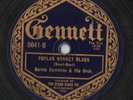
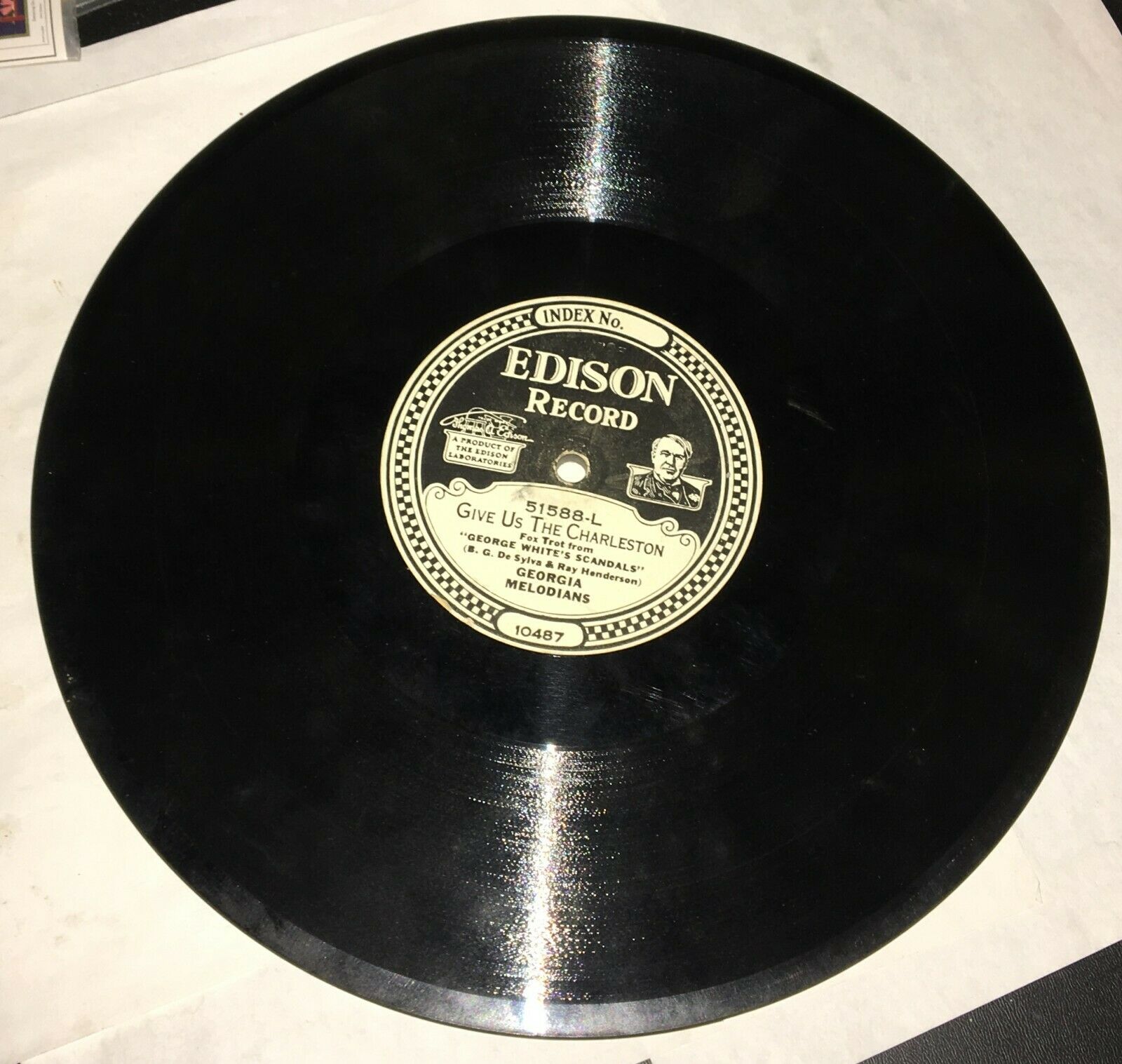
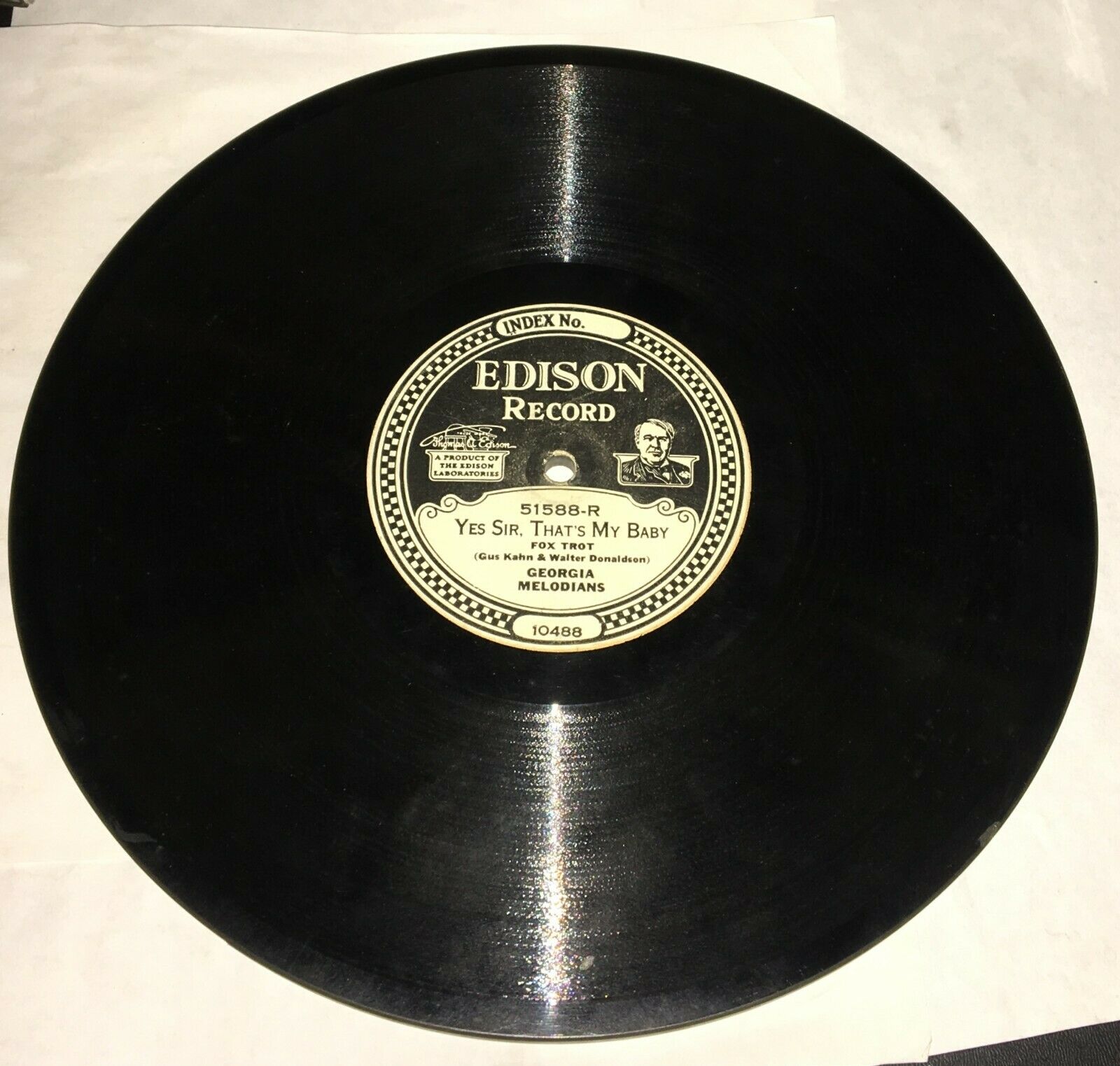
Georgia Melodians That's My Baby Charleston 1925 Edison 51588 Diamond Hot Jazz
$
100


Favourite Auctions
To save auctions to your favourites, please login
If you don't have an account, please register
Description
Georgia Melodians ?– Yes Sir, That's My Baby / Give Us The Charleston Label: Edison Records ?– 51588 Format: Edison Disc Country: US Released: 1925 Genre: Jazz Style: R Yes Sir, That's My Baby Written-By – Gus Kahn, Walter Donaldson L Give Us The Charleston Written-By – B. G. De Sylva*, Ray Henderson Notes Side L - Fox Trot from "George White's Scandals". Barcode and Other Identifiers Matrix / Runout (Side R): 10488 Matrix / Runout (Side L): 10487
The Georgia Melodians were an early jazz band that was active in the 1920s and recorded for Edison Records. They were from Savannah, Georgia and the joint leaders were Ernie Intelhouse (cor) and Hill Hutchins (cl, ts, bsx). After being together for a few years, they worked their way up the east coast to New York, where they arrived in February 1924. After some changes in personnel, they were playing opposite the Paul Van Loan Orchestra at the Cinderella Ballrom on 48th and Broadway. Around this time they started to record and throughout 1924 they made 26 sides that were released on Edison Diamond Discs. The band broke up towards the end of 1924 and left their regular gig at the Strand Roof. Their last booking was a New Year's Eve Ball at the Hotel Alamac
Yes Sir, That's My Baby is a song that Walter Donaldson (music) and Gus Kahn (lyrics) wrote and published in 1925.
When Gus Kahn visited Eddie Contor in Greak Neck (Long Island), he played with a wind-up toy pig that belonged to a daughter of Cantor. The rhythm of the toy gave the songwriter the idea for the opening sequence of the song Yes Sir, That's My Baby , written in E major ; Walter Donaldson added the other music (in the form of AABA ), which is minimalist. Each A section of the chorus only takes place within two notes; the harmonies are also simple, as is the lyrics.
First recordings The song had great success in the United States with the cover versions of Eddie Cantor, Lillian Roth , Gene Austin and Ben Bernie . [1] One of the first musicians who took up the song from 1925, belonged Ace Brigode & His Fourteen Viginians, the Studio lineup Varsity Eight (by Tommy and Jimmy Dorsey , Adrian Rollini and Stan King ), The Georgia Melodians , Sara Martin , Blossom Seeley and Coon-Sanders Original Nighthawks Orchestra , in Berlin Bela Dajosand Bernard Etté , in London Jean Wiener and Clément Doucet .
George White's Scandals were a long-running string of Broadway revues produced by George White that ran from 1919–1939, modeled after the Ziegfeld Follies.[1] The "Scandals" launched the careers of many entertainers, including W. C. Fields, the Three Stooges, Ray Bolger, Helen Morgan, Ethel Merman, Ann Miller, Eleanor Powell, Bert Lahr and Rudy Vallée.[1] Louise Brooks, Dolores Costello, Barbara Pepper, and Alice Faye got their show business start as lavishly dressed (or underdressed) chorus girls strutting to the "Scandal Walk." Much of George Gershwin's early work appeared in the 1920–24 editions of Scandals. The Black Bottom, danced by Ziegfeld Follies star Ann Pennington and Tom Patricola, touched off a national dance craze.
George White's Scandals is also the name of several movies set within the Scandals, all of which focus primarily on the show's acts, with a thin backstage plot stringing them all together. The best known of these was 1934's George White's Scandals written by Jack Yellen, which marked the film debut of Alice Faye.[2] Flapper-era cartoonist and designer Russell Patterson worked on Broadway in various capacities; for George White's Scandals of 1936, he served as scenic designer.[3] George White's Scandals of 1920 was featured in an episode of the television series The Young Indiana Jones Chronicles
price rating