SXL DECCA 1958 STEREO 1st PRESS "HANS KNAPPERTSBUSCH"
£
205
$
272


Favourite Auctions
To save auctions to your favourites, please login
If you don't have an account, please register
Description
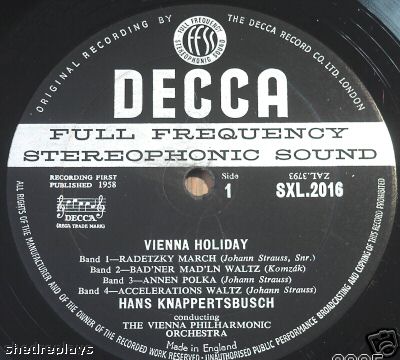
You're looking at one of the very first stereo pressings of 1958 from Decca on the SXL label.
titled
VIENNA HOLIDAY
with
HANS KNAPPERTSBUSCH
conducting
THE VIENNA PHILHARMONIC ORCHESTRA
Hans Knappertsbusch is one of the most gifted of German conductors.
Originally a student of philosophy, he turned his attention to music in 1908, and two years later became conductor at the theatre of Muhlheim. After appointments at Elberfeld, Leipzig and Dessau, he became musical director of the Munich Opera in 1922, and in 1938 took over the Vienna State Opera. He has appeared at Salzburg and Bayreuth, and also conducts regularly at the Munich Festival. Particularly famous for his interpretations of the music of Wagner, Bruckner and Richard Strauss, he is also well known as a wit, his bons mots at rehearsal having an almost Beechamesque quality.
SIDE NO. I
1. Radetzky march (Johann Strauss, Sr.)
2. Bad’ner Mad’In waltz (Karel Komzak)
3. Annen polka (Johann Strauss)
4. Accelerations waltz (Johann Strauss)
SIDE NO. 2
1. Tritsch-Tratsch polka (JOha11l1 Strauss)
2. Wiener Biirger waltz (Carl Ziehrer)
3. Leichtes Blut polka (Johann Strauss)
4. Tales from the Vienna Woods waltz (Jor.mm S;
The music of Vienna possesses an accent that makes it stand out in performance as clearly as the accent of an Austrian nobleman at an English hunt ball. The distinctive lilt is given by playing the waltz almost as if it were a mazurka, which results in an equalizing of the three beats, and consequently a much lighter effect is obtained than when there is a too heavy accentuation of the first beat. The spreading of the accents applies equally to other rhythms. There is also the subtle change in the balance of the phrases at which Johann Strauss was so adept, so that the waltzes have a constantly varying character, and monotony is cleverly avoided. These qualities of Viennese music are well illustrated in the music on this record.
Johann Strauss, Sr. has been rather overshadowed by his illustrious son particularly in the sphere of the waltz. But one work, his Radetzky march, will never be forgotten. It remains a” vital expression of the spirit of Europe in the mid-19th century, a militant symbol of the strife and high political idealism that one does not connect with the smooth sophistication of the waltz. This march has been jostled in its career from one political post to another and ends up today by symbolizing neither the composer’s original intentions nor what the hot-heads made it out to mean. Strauss was not politically-minded. When he dedicated his work to the aged and then popular general, it was to celebrate the victories of the Hapsburg army over the Italians. At the time this was nothing but a glorious skirmish, a sentimental victory for a beloved figure in which quite a few Viennese fighting men were involved. It was unfortunate that the political temper of Vienna was to undergo such a sudden change, and almost before the old Army officers and reactionaries had lost their warm glow of national pride as they heard Strauss and his orchestra perform the march in the Wasserglacis, the revolutionary spirit was about. There were risings which were brutally quelled by the reactionary armies and Strauss found himself hated by the masses of people who had previously worshipped and feted him. A saddened man, he left the city only to meet with the same hostility throughout Europe: only in England did he find any sort of peace and quiet. Strauss never recovered from this blow, and although all was forgiven and forgotten when he returned to Vienna near the end of his life, he died in misery and poverty.
The career of the younger Johann Strauss was less eventful. He had a longer and richer life; it was largely a story of success, although he too had unwilling brushes with the political fanatics, particularly over the performance of his Blue Danube waltz, which was first performed with some verses of political doggerel attached. Johann Strauss, Jr. was a genius of the first order who added a magic touch to what is essentially simple and folkish music, to make it inevitably rich and exciting. His Annen polka (Strauss, Sr. also wrote a work of the same name and dedication) was written for his mother, Anna Strauss. This rather sad woman, who spent most of her married life separated from her husband, had a kind of spiritual revenge in carrying out her determination that Johann the younger should eventually overshadow his improvident father as a composer. While Johann’s pedantic teacher tried to canalize his efforts into church music, Anna made sure that he should follow in the family waltz tradition, and wrote down his early waltz compositions for him, the first of which was written when he was six.
The exciting and tumultuous Accelerationen waltzes were written in, 1860 while Strauss was professionally engaged at the Sofiensiile, a daring piece of architecture originally planned by one Franz Morawetz as a swimming pool. A waltz had been promised for the next evening’s Concordia; it was already dawn after the feverish activities of the night before; Strauss sat with a half-empty glass of champagne before him; Morawetz demanded his waltz; and, with his head humming, Strauss composed his music, full of fiery energy-writing it out on old menu cards-and it was performed the next night.
In this whirl of activity Strauss produced countless waltzes, and such light and entrancing works as the Tritsch-Tratsch polka and the Lekhtes Blut polka were written, the first in 1858, the second in 1867. And in between the routine composing came the great moments of inspiration to produce such masterpieces as Geschichten aus dem Wienerwald (Tales from the Vienna Woods) written in 1868. In this work, even more clearly than in most, Strauss acknowledges the inspiration of his father’s works. There is a theme in Strauss Sr.’s Op. 208 with the same delicate rise of a minor seventh. Strauss Jr. originally stole it fcir his Morgenblatter waltz in 1864, used it again in the Vienna Woods waltz, and yet again, a year later, in his Wein, Weib und Gesang. He would have used it purposely (there was no lack of inspiration) and it is probable that this waltz is something of a tribute to his father and the major part he played in establishing the Viennese waltz tradition.
This record is dominated by the Strauss family, as any Viennese excursion should be
But there were other fine composers in Vienna and have been many since; and many who were not Viennese but who have been drawn to the tradition for their inspiration. Karl Komzak was a Czech composer born in Prague in 1850, his life very much a parallel to Johann Strauss’s in that he too had a father of the same name who was an illustrious conductor and composer before him. He became a bandmaster in the Austrian Army and was a prolific composer of marches, waltzes and polkas in the Viennese tradition-his Bad’ner Mad’ln waltz being one of the best known. He died at Baden, near Vienna, in 1905.
Carl Michael Ziehrer was born in Vienna in 1843 and died there in 1922 and was a composer positively soaked in the Viennese musical tradition. He wrote some 600 dances, including the well-known Wiener Burger waltz and 22 operettas, perhaps the best known being Die Landstreicher, produced in Vienna in 1899.
PETER GAMMOND
The Decca Record Co. Ltd., London, 1958
..............................................................
VINYL CONDITION IS EXCELLENT AS IS THE COVER & ORIGINAL INNER SLEEVE, ALL IN ALL THIS IS A RARE AND BEAUTIFUL ALBUM.
I USE THE "RECORD COLLECTOR'S" GRADING SYSTEM TO GRADE ALL RECORDS . MINT: THE RECORD ITSELF IS IN BRAND NEW CONDITION WITH NO SURFACE MARKS OR DETERIORATION IN SOUND QUALITY. THE COVER AND ANY EXTRA ITEMS SUCH AS THE LYRIC SHEET, BOOKLET OR POSTER ARE IN PERFECT CONDITION. RECORDS ADVERTISED AS SEALED OR UNPLAYED SHOULD BE MINT. EXCELLENT: THE RECORD SHOW SOME SIGNS OF HAVING BEEN PLAYED, BUT THERE IS VERY LITTLE LESSENING IN SOUND QUALITY. THE COVER AND PACKAGING MIGHT HAVE SLIGHT WEAR AND/OR CREASING. VERY GOOD: THE RECORD HAS OBVIOUSLY BEEN PLAYED MANY TIMES, BUT DISPLAYS NO MAJOR DETERIORATION IN SOUND QUALITY, DESPITE NOTICEABLE SURFACE MARKS AND THE OCCASIONAL LIGHT SCRATCH. NORMAL WEAR AND TEAR ON THE COVER OR EXTRA ITEMS, WITHOUT ANY MAJOR DEFECTS, IS ACCEPTABLE.
price rating