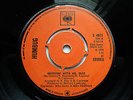
"Sgt. Pepper's Lonely Hearts Club Band" 45 rpm Canadian record by The Beatles
$
27


Favourite Auctions
To save auctions to your favourites, please login
If you don't have an account, please register
Description
FREE Shipping to the USA and CANADA!
45rpm record and picture sleeve by "The Beatles"!
The record is in excellent condition, has been test played and sounds wonderful with no scratches or background noise.
The colorful picture sleeve is in perfect shape with no rips, tears or writing on it.
Now for some background information regarding the song "Sgt. Pepper's Lonely Hearts Club Band":
"Sgt. Pepper's Lonely Hearts Club Band" is a song written by Paul McCartney (credited to Lennon–McCartney), and first recorded and released in 1967.
In November 1966, on the flight back to England after a holiday, McCartney conceived an idea in which an entire album would be role-played, with each of The Beatles assuming an alter-ego in the "Lonely Hearts Club Band", which would then perform a concert in front of an audience. The inspiration is said to have come when roadie Mal Evans innocently asked McCartney what the letters “S” and “P” stood for on the pots on their in-flight meal trays, and McCartney explained it was for salt and pepper. This then led to the Sgt. Pepper's Lonely Hearts Club Band concept, as well as the song.
The group's road manager Neil Aspinall suggested the idea of Sgt. Pepper being the compère, as well as the reprise at the end of the album. According to his diaries, Evans may have also contributed to the song. John Lennon attributed the idea for Sgt. Pepper to McCartney, although the song is officially credited to Lennon–McCartney. The song was recorded in Abbey Road's number 2 studio, with Martin producing, and Geoff Emerick engineering. Work on the song started on 1 February 1967, and after three further sessions the recording was complete on 6 March 1967.
On the Sgt. Pepper's Lonely Hearts Club Band album, the song opens to the sound of a chattering audience, and an orchestra tuning up, which was taken from the 10 February orchestra session for "A Day in the Life". The crowd sounds edited into the song were recorded in the early '60s by Martin, during a live recording of the stage show Beyond the Fringe. When the song itself begins, the band introduces its members. The song's structure is:
- Introduction (instrumental)
- Verse
- Bridge (instrumental)
- Refrain
- Bridge
- Verse
- Instrumental bridge and transition into "With a Little Help from My Friends".
The song is in G major, with a 4/4 meter. A horn quartet was used to fill out the instrumental sections. It may be considered in the chromatic-minor system, using dominant seventh chords built on every step of the natural minor scale and a tonic major chord. (for example, in G, IV7: C-E-G-D, with E being chromatic)
It was originally released in the UK on 1 June 1967, and in the US on 2 June 1967 on the Sgt. Pepper's Lonely Hearts Club Band LP.
When The Beatles' recording contract with EMI expired in 1976, EMI was free to re-release music from The Beatles' catalogue, and in 1978 – 11 years after the original album release – released "Sgt. Pepper's Lonely Hearts Club Band"/"With a Little Help from My Friends" as the A-side of a single with "A Day in the Life" as the B-side. The single was released on Capitol in the US on 14 August (closely following the US release of the Sgt. Pepper's Lonely Hearts Club Band film), reaching #71 on 30 September 1978 where it stayed for 2 weeks. The single was released on Parlophone in the UK in September.
Country
Chart
Rank
UK
Music Week
63
US
Billboard Hot 100
71
US
Cash Box
92
US
Record World
103
"A Day in the Life" is a song by The Beatles. Credited to Lennon–McCartney, the song comprises distinct segments written independently by John Lennon and Paul McCartney, with orchestral additions. While Lennon's lyrics were inspired by contemporary newspaper articles, McCartney's were reminiscent of his youth. The decisions to link sections of the song with orchestral glissandos and to end the song with a sustained piano chord were made only after the rest of the song had been recorded.
According to Lennon, the inspiration for the first two verses was the death of Tara Browne, the 21-year-old heir to the Guinness fortune who had crashed his Lotus Elan on 18 December 1966 in Redcliffe Gardens, Earls Court. Browne had been a friend of Lennon and McCartney. Lennon's verses were adapted from a story in the 17 January 1967 edition of The Daily Mail, which reported the coroner's verdict into Browne's death.
"I didn't copy the accident," Lennon said. "Tara didn't blow his mind out, but it was in my mind when I was writing that verse. The details of the accident in the song—not noticing traffic lights and a crowd forming at the scene—were similarly part of the fiction."
The second verse contains the line "The English Army had just won the war"; Lennon was making reference to his role in the movie How I Won the War, released on 18 October 1967. In Many Years from Now, McCartney said about the line "I'd love to turn you on", which concludes both verse sections: "This was the time of Tim Leary's 'Turn on, tune in, drop out' and we wrote, 'I'd love to turn you on.' John and I gave each other a knowing look: 'Uh-huh, it's a drug song. You know that, don't you?'."
McCartney provided the middle section of the song, a short piano piece he had been working on independently, with lyrics about a commuter whose uneventful morning routine leads him to drift off into a dream. John said: "I had the bulk of the song and the words, but he contributed this little lick floating around in his head that he couldn't use for anything." McCartney had written the piece as a wistful recollection of his younger years, which included riding the bus to school, smoking, and going to class. The orchestral crescendos that link the verses and this section were conducted by McCartney and producer George Martin.
The final verse was inspired by an article in the Daily Mail in January 1967 regarding a substantial number of potholes in Blackburn, a town in Lancashire. However, Lennon had a problem with the words of the final verse, not being able to think of how to connect "Now they know how many holes it takes to" and "the Albert Hall". His friend Terry Doran suggested that they would "fill" the Albert Hall.
The Beatles began recording the song, with a working title "In the Life of ...", on 19 January 1967. The two sections of the song are separated by a 23-bar bridge. At first, the Beatles were not sure how to fill this transition. Thus, at the conclusion of the recording session for the basic tracks, this section solely consisted of a simple repeated piano chord and the voice of assistant Mal Evans counting the bars. Evans' guide vocal was treated with gradually increasing amounts of echo. The 23-bar bridge section ended with the sound of an alarm clock triggered by Evans. The original intent was to edit out the ringing alarm clock when the missing section was filled in; however it complemented McCartney's piece well; the first line of McCartney's song began "Woke up, fell out of bed", so the decision was made to keep the sound. Martin later said that editing it out would have been unfeasible in any case. The basic track for the song was refined with remixing and additional parts added at recording sessions on 20 January and 3 February. Still, there was no solution for the missing 24-bar middle section of the song, when McCartney had the idea of bringing in a full orchestra to fill the gap. To allay concerns that classically-trained musicians would not be able to improvise the section, producer George Martin wrote a loose score for the section. It was an extended, atonal crescendo that encouraged the musicians to improvise within the defined framework.
The orchestral part was recorded on 10 February 1967, with McCartney and Martin conducting a 40-piece orchestra. The recording session was completed at a total cost of £367 for the players, an extravagance at the time. Martin later described explaining his improvised score to the puzzled orchestra:
What I did there was to write ... the lowest possible note for each of the instruments in the orchestra. At the end of the twenty-four bars, I wrote the highest note ... near a chord of E major. Then I put a squiggly line right through the twenty-four bars, with reference points to tell them roughly what note they should have reached during each bar ... Of course, they all looked at me as though I were completely mad.
McCartney noted that the strings were able to keep themselves in the designated time, while the trumpets were "much wilder".McCartney had originally wanted a 90-piece orchestra, but this proved impossible; the difference was made up, as the semi-improvised segment was recorded multiple times and eventually four different recordings were overdubbed into a single massive crescendo. The results were successful; in the final edit of the song, the orchestral bridge is reprised after the final verse. It was arranged for the orchestral session to be filmed by NEMS Enterprises for use in a planned television special. The film was never released in its entirety, although portions of it can be seen in the "A Day in the Life" promotional film, which includes shots of studio guests Mick Jagger, Marianne Faithfull, Keith Richards, Donovan, Pattie Boyd and Michael Nesmith. Reflecting the Beatles' taste for experimentation and the avant garde at this point in their careers, the orchestra players were asked to wear or were given a costume piece on top of their formal dress. This resulted in different players wearing anything from fake noses to fake stick-on nipples. Martin recalled that the lead violinist performed wearing a gorilla paw, while a bassoon player placed a balloon on the end of his instrument.
Due to the multiple takes required to perfect the orchestral cacophony and the final chord, as well as their considerable procrastination in composing the song, the total duration of time spent recording "A Day in the Life" was 34 hours. In contrast, the Beatles' earliest work, their first album Please Please Me, was recorded in its entirety in only 10 hours.
Following the final orchestral crescendo, the song ends with one of the most famous final chords in music history. Lennon, McCartney, Starr, and Evans shared three different pianos, with Martin on the harmonium, and all played an E-major chord simultaneously. The final chord was made to ring out for over forty seconds by increasing the recording sound level as the vibration faded out. Towards the end of the chord the recording level was so high that listeners can hear the sounds of the studio, including rustling papers and a squeaking chair.
The piano chord was a replacement for a failed vocal experiment: on the evening following the orchestra recording session, the four Beatles had recorded an ending of their voices humming the chord, but after multiple overdubs they wanted something with more impact. This final E chord represents a VI to the song's tonic G major, although it has been argued that the preceding chord shifts from F ("them all") to Em ("Now they know") Em7 ("takes to fill") C ("love to turn you") and B ("on") followed by the chromatic ascent, shifts our sense of the tonic from G to E; creating a feeling of tragic inevitability instead of the usual hopeful uplift associated with a VI modulation.
The song became controversial for its supposed references to drugs. The BBC announced that it would not broadcast "A Day in the Life" due to the line "I'd love to turn you on," which, according to the corporation, advocated drug use. Other lyrics allegedly referring to drugs include "found my way upstairs and had a smoke / somebody spoke and I went into a dream". A spokesman for the BBC stated, "We have listened to this song over and over again. And we have decided that it appears to go just a little too far, and could encourage a permissive attitude to drug-taking."
Lennon and McCartney denied that there were drug references and publicly complained about the ban at a dinner party at the home of their manager, Brian Epstein. Lennon said that the song was simply about "a crash and its victim," and called the line in question "the most innocent of phrases." McCartney later said "This was the only one in the album written as a deliberate provocation. A stick-that-in-your-pipe ... But what we want is to turn you on to the truth rather than pot." George Martin later commented that he had always suspected that the line "found my way upstairs and had a smoke" was a drug reference, recalling how the Beatles would "disappear and have a little puff", presumably of marijuana, but not in front of him. "When [Martin] was doing his TV program on Pepper," McCartney recalled later, "he asked me, 'Do you know what caused Pepper?' I said, 'In one word, George, drugs. Pot.' And George said, 'No, no. But you weren't on it all the time.' 'Yes, we were.' Sgt. Pepper was a drug album."
When Sgt. Pepper's Lonely Hearts Club Band was released in South Asia, Malaysia and "A Day in the Life" became one of the Beatles' most influential songs. Paul Grushkin in his book Rockin' Down the Highway: The Cars and People That Made Rock Roll, called the song "one of the most ambitious, influential, and groundbreaking works in pop music history". In "From Craft to Art: Formal Structure in the Music of The Beatles", the song is described thus: ""A Day in the Life" is perhaps one of the most important single tracks in the history of rock music; clocking in at only four minutes and forty-five seconds, it must surely be among the shortest epic pieces in rock".
The song appears on many top songs lists. It placed twelfth on CBC's 50 Tracks. .It placed first in Q Magazine's list of the 50 greatest British songs of all time, and was at the top of Mojo Magazine's 101 Greatest Beatles' Songs, as decided by a panel of musicians and journalists. "A Day in the Life" was also nominated for a Grammy in 1967 for Best Arrangement Accompanying Vocalist Or Instrumentalist. In 2004, Rolling Stone ranked "A Day in the Life" at number 26 on the magazine's list of "The 500 Greatest Songs of All Time", and in 2010, the magazine deemed it to be The Beatles' greatest song. It is listed at number 5 in Pitchfork Media's The 200 Greatest Songs of the 1960s.
On 27 August 1992 Lennon's handwritten lyrics were sold by the estate of Mal Evans in an auction at Sotheby's London for $100,000 (£56,600). The lyrics were put up for sale again in March 2006 by Bonhams in New York. Sealed bids were opened on 7 March 2006 and offers started at about $2 million. The lyric sheet was auctioned again by Sotheby's in June 2010. It was purchased by an anonymous American buyer who paid $1,200,000 (£810,000 ).
FREE Shipping to the USA and CANADA!
price rating



![Yo-Yo Ma & Friends - Songs of Joy & Peace [Used Vinyl LP] Holland - Import](https://www.popsike.mobi/php/thumbnail.php?url=https://www.popsike.pics/pix/20190524/264334751917.jpg)