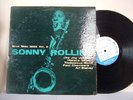
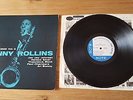
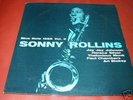
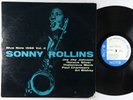
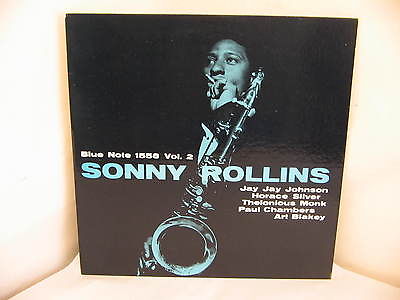
Sonny Rollins Volume 2 1957 Blue Note LP BLP 1558 Mono RVG Side 2 Ear EX/EX
$
148


Favourite Auctions
To save auctions to your favourites, please login
If you don't have an account, please register
Description
Sonny Rollins Volume 2 1957 Blue Note LP BLP 1558 Mono RVG Ear EX/EX "Volume 2" is a jazz album by Sonny Rollins that was released on Blue Note Records in 1957. This is the mono version (BLP 1558), RVG & ear mark stamped on both sides, Microgroove, Also 9M hand written in side 1 deadwax, The Blue Note address on back cover is 43 West 61st St. NY - I believe an early 1960s pressing.
Other musicians on the album: Jay Jay Johnson, Horace Silver, Thelonius Monk, Paul Chambers, Art Blakey.
Grade on this vinyl EX The vinyl is in EX with light spindle marks on both sides. Also very light sleeve marks from going in and coming out of sleeve.
Grade on this Jacket is EX Has price in pencil on back cover. Minut corner dings. Has original Blue Note Inner Sleeve in VG+ condition. ( has some yellowing )
I am posting an incredible vinyl collection in the coming days, so please check out my other auctions. Thanks
All records will be cleaned on a record doctor machine prior to shipping.
NO BUY IT NOW IS OFFERED ON THIS ITEM. PLEASE BID. Thanks
Shipping: I will shipin a heavy duty lp record boxes
with a new inner MFSL static free sleeve.
I will include the old sleeve if the record has one as well.
$3.95 Media Mail, Priority mail is available
International Shipping: $13.95 for First Class Mail. please ask on multiple albums.
I use Goldmine's grading standards. See Below
MINT (M)
These are absolutely perfect in every way. Often rumored but rarely seen, Mint should never be used as a grade unless more than one person agrees that the record or sleeve truly is in this condition. There is no set percentage of the Near Mint value these can bring; it is best negotiated between buyer and seller.
NEAR MINT (NM OR M-)
A good description of a NM record is “it looks like it just came from a retail store and it was opened for the first time.” In other words, it’s nearly perfect. Many dealers won’t use a grade higher than this, implying (perhaps correctly) that no record or sleeve is ever truly perfect.
NM records are shiny, with no visible defects. Writing, stickers or other markings cannot appear on the label, nor can any “spindle marks” from someone trying to blindly put the record on the turntable. Major factory defects also must be absent; a record and label obviously pressed off center is not Near Mint. If played, it will do so with no surface noise. (NM records don’t have to be “never played”; a record used on an excellent turntable can remain NM after many plays if the disc is properly cared for.)
NM covers are free of creases, ring wear and seam splits of any kind.
VERY GOOD PLUS (VG+or E)
A good description of a VG+ record is “except for a couple minor things, this would be Near Mint.” Most collectors,
especially those who want to play their records, will be happy with a VG+ record, especially if it toward the high end
of the grade (sometimes called VG++ or E+).
VG+ records may show some slight signs of wear, including light scuffs or very light scratches that do not affect the
listening experience. Slight warps that do not affect the sound are OK. Minor signs of handling are OK, too, such as
telltale marks around the center hole, but repeated playing has not misshapen the hole. There may be some very
light ring wear or discoloration, but it should be barely noticeable.
VG+ covers should have only minor wear. A VG+ cover might have some very minor seam wear or a split (less than
one inch long) at the bottom, the most vulnerable location. Also, a VG+ cover may have some defacing, such as a
cut-out marking. Covers with cut-out markings can never be considered Near Mint.
Very Good (VG)
Many of the imperfections found on a VG+ record are more obvious on a VG record. That said, VG records —
which usually sell for no more than 25 percent of a NM record — are among the biggest bargains in record
collecting, because most of the “big money” goes for more perfect copies. For many listeners, a VG record or
sleeve will be worth the money.
VG records have more obvious flaws than their counterparts in better shape. They lack most of the original gloss
found on factory-fresh records. Groove wear is evident on sight, as are light scratches deep enough to feel with a
fingernail. When played, a VG record has surface noise, and some scratches may be audible, especially in soft
passages and during a song’s intro and ending. But the noise will not overpower the music otherwise.
Minor writing, tape or a sticker can detract from the label. Many collectors who have jukeboxes will use VG records
in them and not think twice. They remain a fine listening experience, just not the same as if it were in better shape.
VG covers will have many signs of human handling. Ring wear in the middle or along the edges of the cover where
the edge of a record would reside, is obvious, though not overwhelming. Some more creases might be visible.
Seam splitting will be more obvious; it may appear on all three sides, though it won’t be obvious upon looking.
Someone might have written or it or stamped a price tag on it, too.
Good (G),
Good Plus (G+)
or Very Good Minus (VG–)
These records go for 10 to 15 percent of the Near Mint value, if you are lucky.
Good does not mean bad! The record still plays through without skipping, so it can serve as filler until something
better comes along. But it has significant surface noise and groove wear, and the label is worn, with significant ring
wear, heavy writing, or obvious damage caused by someone trying to remove tape or stickers and failing miserably.
A Good to VG– cover has ring wear to the point of distraction, has seam splits obvious on sight and may have even
heavier writing, such as, for example, huge radio station letters written across the front to deter theft.
price rating