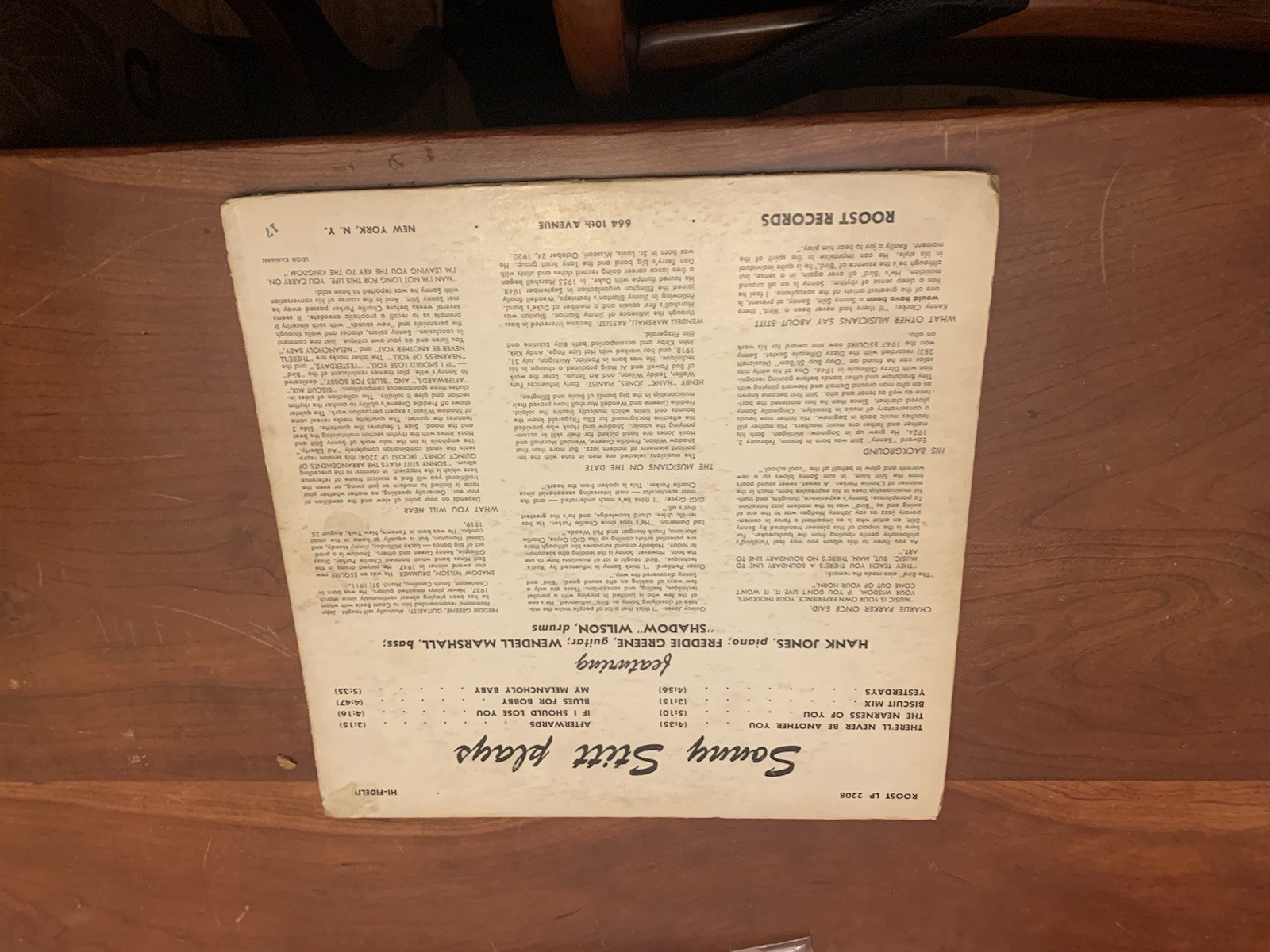
Sonny Stitt Self Title Savoy 2208 DG Mono Royal Roost 1957 Rare VG
$
50




Favourite Auctions
To save auctions to your favourites, please login
If you don't have an account, please register
Description
Sonny Stitt – Sonny Stitt Sonny Stitt Sonny Stitt Sonny Stitt
Label: Royal Roost – ROOST LP 2208, Royal Roost – RLP 2208 Format: Vinyl, LP, Album, Mono Country: US Released: 1956 Genre: Jazz Style: Bop A1 There'll Never Be Another You 4:35 A2 The Nearness Of You 5:10 A3 Biscuit Mix 3:15 A4 Yesterdays 4:56 B1 Afterwards 3:15 B2 If I Should Lose You 4:16 B3 Blues For Bobby 4:47 B4 My Melancholy Baby 5:35 Manufactured By – Roost Records, Inc. Bass – Wendell Marshall Drums – "Shadow" Wilson* Guitar – Freddie Greene* Piano – Hank Jones Saxophone – Sonny Stitt
Sonny Stitt (born Edward Hammond Boatner Jr.; February 2, 1924 – July 22, 1982) was an American jazz saxophonist of the bebop/hard bop idiom. Known for his warm tone, he was one of the best-documented saxophonists of his era, recording over 100 albums. He was nicknamed the "Lone Wolf" by jazz critic Dan Morgenstern because of his tendency to rarely work with the same musicians for long despite his relentless touring and devotion to the craft. Stitt was sometimes regarded as a Charlie Parker mimic early in his career, but gradually developed his own sound and style, particularly when performing on the tenor saxophone and even occasionally baritone saxophone.
Early life Edward Hammond Boatner Jr. was born in Boston, Massachusetts,[1] and grew up in Saginaw, Michigan. He had a musical background: his father, Edward Boatner, was a baritone singer, composer, and college music professor; his brother was a classically trained pianist, and his mother was a piano teacher.[1] He was placed for adoption in 1924 by his father and adopted by the Stitt family in Saginaw.[2] He later began calling himself "Sonny". While in high school in Saginaw, he played in the Len Francke Band, a local popular swing band.
In 1943, Stitt met Charlie Parker. As he often recalled, the two men had similar styles. Parker is alleged to have remarked, "Well, I'll be damned, you sound just like me", to which Stitt responded, "Well, I can't help the way I sound. It's the only way I know how to play."[3] Kenny Clarke said of Stitt, "Even if there had not been a Bird, there would have been a Sonny Stitt."[4]
During the 1940s, he played alto saxophone as a member of Tiny Bradshaw's big band, Billy Eckstine's big band with Gene Ammons and Dexter Gordon, and Dizzy Gillespie's big band.[5] Stitt was a leader of Bebop Boys and Galaxy in 1946 and 1948, respectively.[6]
When playing tenor saxophone Stitt seemed to break free from some of the criticism that he was imitating Parker's style, and began to develop a far more distinctive sound.[1] He played with other bop musicians including Horace Parlan,[7] Bud Powell, and Eddie "Lockjaw" Davis, a fellow tenor with a distinctly tough tone in comparison to Stitt, in the 1950s, and recorded a number of sides for Prestige Records as well as albums for Argo, Verve, and Roost. Stitt experimented with Afro-Cuban jazz in the late 1950s, and the results can be heard on his recordings for Roost and Verve, on which he teamed up with Thad Jones and Chick Corea[8] for Latin versions of such standards as "Autumn Leaves".
In 1952, Stitt played with pianist Jimmy Jones, and the next year performed orchestral music with Johnny Richards. Under Quincy Jones's guidance in 1955, he played uptempos and ballads such as "My Funny Valentine" and "Star Dust" and the same year performed "Afterwards" and "There Will Never Be Another You" with Hank Jones. Stitt joined Dolo Coker in 1957 to perform "Blues for Yard" and "Blue Moon" before returning to Hank to perform "Cherokee".[3]
Stitt joined Miles Davis briefly in 1960, and recordings with Davis's quintet can be found only in live settings on the tour of 1960.[9] Concerts in Manchester and Paris are available commercially and also a number of concerts (which include sets by the earlier quintet with John Coltrane) on the record Live at Stockholm (Dragon), all of which featured Wynton Kelly, Jimmy Cobb, and Paul Chambers. However, Miles fired Stitt due to the excessive drinking habit he had developed, and replaced him with Hank Mobley.[10] Later in the 1960s, Stitt paid homage to Parker on the album Stitt Plays Bird, which features Jim Hall on guitar.[11]
Stitt recorded several times with his friend Gene Ammons in sessions that were interrupted by Ammons's own imprisonment for narcotics possession. The records recorded by these two saxophonists are regarded by many as some of both Ammons’s and Stitt's best work. The Ammons/Stitt partnership went down in posterity as one of the best dueling partnerships in jazz, alongside Zoot Sims and Al Cohn, and Johnny Griffin with Eddie "Lockjaw" Davis.
Stitt ventured into soul jazz and recorded with fellow tenor saxophonist Booker Ervin in 1964 on the Soul People album. Stitt also recorded with Duke Ellington alumnus Paul Gonsalves in 1963 for Impulse! on the Salt and Pepper album in 1964. Around that time, he appeared regularly at Ronnie Scott's in London, and a live 1964 encounter with Ronnie Scott, The Night Has a Thousand Eyes, eventually surfaced. Stitt recorded at Ronnie Scott's again in 1966 with resident guitarist Ernest Ranglin and British tenor saxophonist Dick Morrissey. Stitt was one of the first jazz musicians to experiment with the Selmer Varitone amplification system, as heard on the albums What's New!!! in 1966 and Parallel-a-Stitt in 1967.[12]
price rating