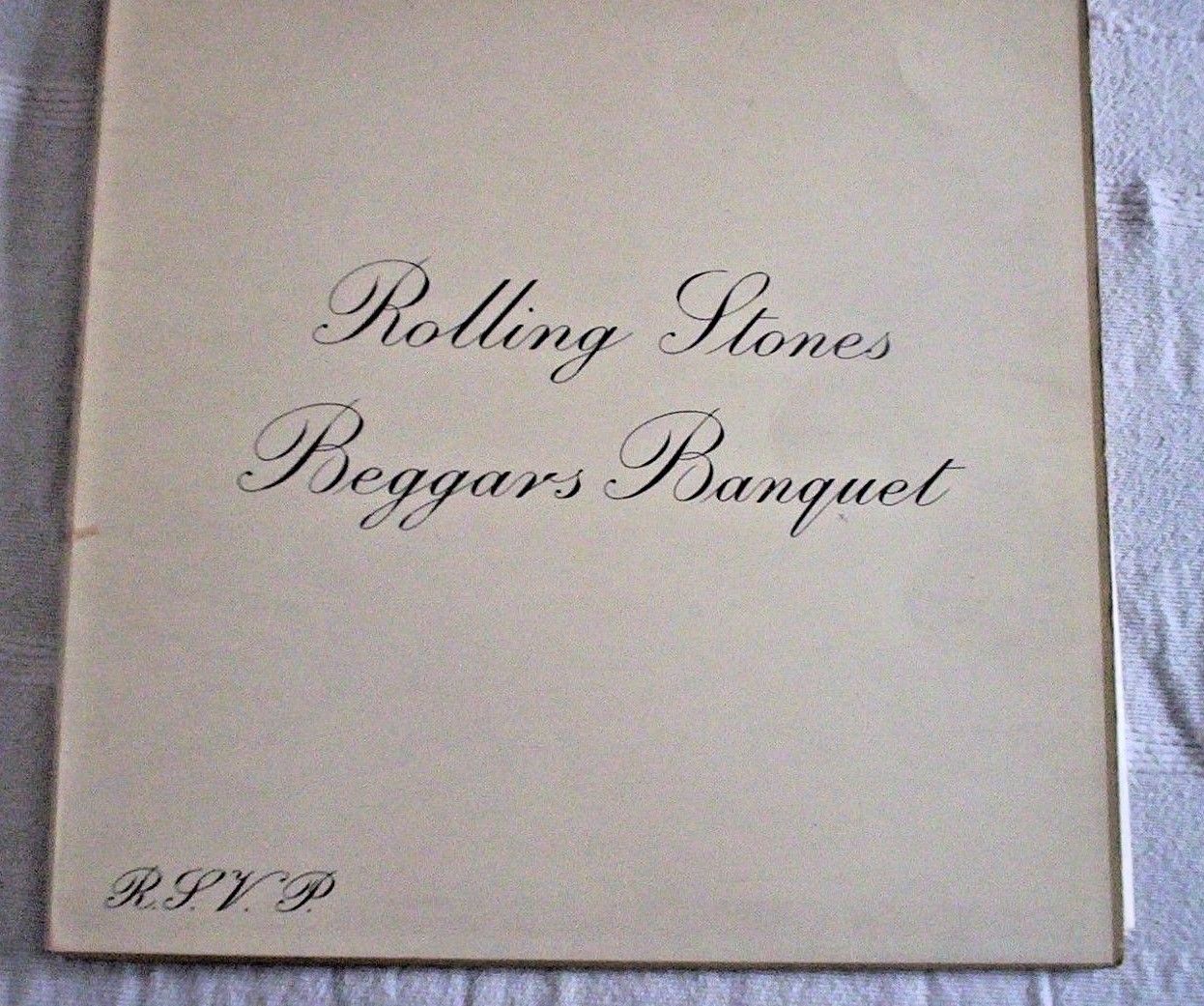
THE ROLLING STONES - BEGGARS BANQUET - RARE EARLY MONO PRESSING - DECCA LK4955
£
77
$
102


Favourite Auctions
To save auctions to your favourites, please login
If you don't have an account, please register
Description
- THE ROLLING STONES - "BEGGARS BANQUET" - RARE EARLY DECCA 1968 "MONO" PRESSING - WITH RED LABEL - LK4955
- MATRIX
- SIDE 1 - XARL-8476-4A - RUNOUT MARKS - OO JT
- SIDE 2 - XARL-8477-3A - NO RUNOUT MARKS VISIBLE
- DISC
- IN EXCELLENT CONDITION WITH ONLY A FEW MINOR HAIRLINE BLEMISHES - IT PLAYS WITH VIRTUALLY NO MORE SURFACE BACKGROUND NOISE THAN IT DID WHEN NEW, 50 YRS AGO - IT'S ONLY SOUND FAULT IS A MINOR JUMP ON ONE WORD IN TRACK 5 - SIDE 1. MY CHRISTIAN NAME IS WRITTEN SMALL IN PEN ON BOTH SIDES OF THE RED DISC LABEL AS IT WAS PART OF MY COLLECTION.
- COVERS
- OUTER - EXCELLENT CLEAN CONDITION WITH ONLY A FEW MINOR AGE MARKS - NO SCUFFS TO EDGES OR SPINE WHICH IS STILL STIFF AND INTACT.
- INNER - EXCELLENT PLAIN INNER PROTECTIVE COVER WITH POLYTHENE PROTECTIVE INSERT.
- Beggars Banquet is the seventh British and ninth American studio album by English rock band The Rolling Stones. It was released in December 1968 by Decca Records in the United Kingdom and London Records in the United States. The album was a return to roots rock for the band following the psychedelic pop of their 1967 album Their Satanic Majesties Request.[2] It was the last Rolling Stones album to be released during Brian Jones' lifetime, but he also played on two songs on their next album Let It Bleed, which was released after his death.
-
Background[edit]
Glyn Johns, the album's recording engineer and longtime collaborator of the band, said that Beggars Banquet signaled "the Rolling Stones' coming of age ... I think that the material was far better than anything they'd ever done before. The whole mood of the record was far stronger to me musically."[6] Producer Jimmy Miller described guitarist Keith Richards as "a real workhorse" while recording the album, mostly due to the infrequent presence of Brian Jones. When he did show up at the sessions, Jones behaved erratically due to his drug use and emotional problems.[6] Miller said that Jones would "show up occasionally when he was in the mood to play, and he could never really be relied on:
When he would show up at a session—let's say he had just bought a sitar that day, he'd feel like playing it, so he'd look in his calendar to see if the Stones were in. Now he may have missed the previous four sessions. We'd be doing let's say, a blues thing. He'd walk in with a sitar, which was totally irrelevant to what we were doing, and want to play it. I used to try to accommodate him. I would isolate him, put him in a booth and not record him onto any track that we really needed. And the others, particularly Mick and Keith, would often say to me, 'Just tell him to piss off and get the hell out of here'.[6]
Jones played sitar[7] and tanpura on "Street Fighting Man",[8] slide guitar on "No Expectations",[9][10][11] harmonica on "Parachute Woman", "Dear Doctor" and "Prodigal Son",[12] and Mellotron on "Jig-Saw Puzzle" and "Stray Cat Blues".[13] Jones is sometimes mistakenly credited for playing the slide guitar on "Jig-Saw Puzzle"; both guitars are played by Keith Richards.[14][15] The basic track of "Street Fighting Man" was recorded on an early Philips cassette deck at London's Olympic Sound Studios, where Richards played a Gibson Hummingbird acoustic guitar, and Charlie Watts played on an antique, portable practice drum kit.[16] Richards and Mick Jagger were mistakenly credited as writers on "Prodigal Son", a cover of Robert Wilkins's Biblical blues song.[6] According to Keith Richards the name Beggars Banquet "comes from a cat called Christopher Gibbs".[17]
On 7 June 1968, a photoshoot for the album, with photographer Michael Joseph, was held at Sarum Chase, a mansion in Hampstead, London.[18] Previously unseen images from the shoot were exhibited at the Blink Gallery in London in November and December 2008.[19] The album's original cover art, depicting a bathroom wall covered with graffiti, was rejected by the band's record company, and their unsuccessful dispute delayed the album's release for months.[6]
On 11–12 December 1968 the band filmed a television extravaganza titled The Rolling Stones Rock and Roll Circus featuring John Lennon, Eric Clapton, The Who, Jethro Tull and Marianne Faithfull among the musical guests.[20][21] One of the original aims of the project was to promote Beggars Banquet, but the film was shelved by the Rolling Stones until 1996, when their former manager, Allen Klein, gave it an official release.[22]
-
Track listing[edit]
All songs written by Mick Jagger and Keith Richards, except "Prodigal Son" by Robert Wilkins.
Side one No. Title Length 1. "Sympathy for the Devil" 6:18 2. "No Expectations" 3:56 3. "Dear Doctor" 3:28 4. "Parachute Woman" 2:20 5. "Jigsaw Puzzle" 6:06 Total length: 22:08 Side two No. Title Length 6. "Street Fighting Man" 3:16 7. "Prodigal Son" 2:51 8. "Stray Cat Blues" 4:38 9. "Factory Girl" 2:09 10. "Salt of the Earth" 4:48 Total length: 17:42Personnel[edit]
Sources:[51] [52][53][54][55]
The Rolling Stones
- Mick Jagger – lead vocals (all tracks), backing vocals (1, 3), harmonica (4), maracas (6,8)
- Keith Richards – electric guitars (1, 4, 5, 8, 9), acoustic guitars (2-7, 9, 10), bass guitar (1, 6), backing vocals (1, 3), co-lead vocals (10)
- Brian Jones – acoustic guitar, backing vocals (1), slide guitar (2), harmonica (3, 4, 7), Mellotron (5, 8), sitar (6), tambura (6)
- Bill Wyman – backing vocals (1), maracas (1), bass guitar (2-5, 8-10), double bass (3), synthesizer (5)
- Charlie Watts – drums (1, 3-8, 10), backing vocals (1), claves (2), tambourine (3), tabla (9)
Additional personnel
- Nicky Hopkins – piano (1-3, 5, 6, 8, 10)
- Rocky Dijon – congas (1, 8, 9)
- Ric Grech – fiddle (9)
- Dave Mason – shehnai on (6), Mellotron (mandolin setting) (9)
- Jimmy Miller – backing vocals (1)
- Watts Street Gospel Choir – backing vocals (10)
price rating


