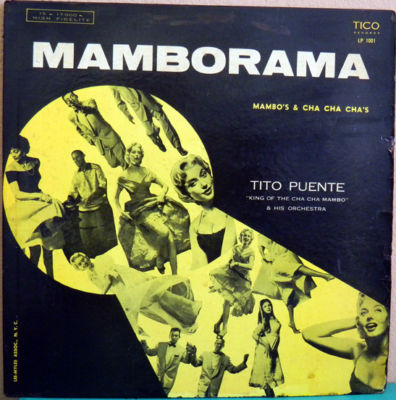
TITO PUENTE 1ST LP: TICO#1001 (Black) "MAMBORAMA" HEAR
$
56


Favourite Auctions
To save auctions to your favourites, please login
If you don't have an account, please register
Description
ARTIST : TITO PUENTE & HIS ORQUESTA
TITLE : MAMBORAMA
LABEL & RECORD #: TICO #1001 (1955) VINYL CONDITION: HEAR !! : STRONG VG++ Some NM!!!! LABELS CONDITIONS: SEE SCAN : OK with some "AGE" wrinkles COVER CONDITION : SEE SCAN : Some Edge wear.....Top Seam Ok, Bottom Seam two 2" strips of clear tape, Front OK, Back "AGE" Stains over white!!!....WITH ULTRA HARD TO FIND TICO INNER PLASTIC SLEEVE!!!REMARKS: LATIN RECORD COLLECTOR HOLY GRAIL! ORIGINAL!!!!
LA LEYENDA....MR. TITO PUENTE:
THE BEGINNING: (1st paragraphs with an "Eye Witness" the Great Frankie Colon:)
Before the year ended, Colón and Chinky began their first of three years of percussion studies, under the tutelage of Poppy Pagani. Through Poppy, Colón met Chano Pozo while the conguero was making a guest appearance with the Miguelito Valdés orchestra at the Triboro Theatre in 1948. It was bongocero Johnny "La Vaca" Rodríguez who introduced Colón to Tito Puente, timbalero and contractor for the Pupi Campo orchestra while it appeared at the Carnival Room, Hotel Capitol, corner of 49th Street and 8th Avenue.
"One night," recalled Colón, "after the Campo band finished playing a tune, johnny invited me to sit in. I remember Johnny looking at Tito who nodded approval of my playing. Around the month of March, 1949, Johnny mentioned that Tito was going to leave Pupi to form a band that would open that summer at El Patio Club in Atlantic Beach, Long Island. Johnny had a commitment so he recommended me.
"Tito and I discussed the job at LaSalle Cafeteria. He suggested I attend the first rehearsal the following week at Louie Varona's mother's music school, the Marizuerite LeCompte Music Studio, at 116th Street between Park and Lexington. At this rehearsal was the original Tito Puente band, which consisted of Jimmy Frisaura and Chino González on trumpets, Angel Rósa as the vocalist, Luis Varona on piano, Manuel Patot (Pa-cho) on bass, Puente on timbales and me on congas. They didn't rehearse Latin music, just American pop tunes. The following week I sat in on conga. Whenever Tito switched to vibes I felt terrified...he left me alone to carry the rhythm section."
"On july 4, 1949," continued Colón, "the seven piece Tito Puente orchestra made its debut at El Patio. Puente did not use the arrangements he had written for Campo because they were for three trumpets and saxes. Instead, he used the arrangements he had written for the Picadilly Boys plus other tunes with two trumpets added. We played more American pop music than Latin."
One week after the Patio gig ended on Labor Day, the Puente orchestra was enlarged to fill a Palladium appearance. Trumpeter Tony DiRisi and bongocero Chino Pozo were added. Weeks later, on the Palladium bandstand, Colón remembers seeing Vicentico Valdés for the first time.
"He climbed on stage with maracas. He sang a bolero (Tus Ojos). He was so good we had to repeat it. Tito told him to stay so Vicentico ended the night singing coro to out lead vocalist Paquito Sosa. That same week Sosa left the band to fill other commitments and Vicentico became Puente's vocalist."
It was either in October or November of 1949 that Puente utilized three trombones, four trumpets, four saxes and a full rhythm section for a Tico recording session at the WOR studios on 48th Street and 7th Avenue.
"After recording three sides in three hours," said Colón, "Tito surprised us by dismissing the trombonists and saxophonists and passing out his charts of Abaniquito to the remaining musicians which were Chino Pozo on bongos, Manuel Patot on bass, Luis Varona'on piano, trumpeters Jimmy Frisaura, Tony De Risi, Chino González and Mario Bauza, and vocalists Graciella (Machito's sister), Vicentico and me. We played it once so the engineer could get a balance level. We were familiar with the number since it was part of our repertoire. But this version was incredible. Vicentico was outstanding with his ad-libs and Mario blew his ass off on the solo. After the take, we listened to it and Tito wanted a second take. He changed his mind when Mario convinced hun not to, that another take would not come out as fiery."
Puente has been credited with introducing the timbal and the vibraphone to Afro-Cuban music, Puente also played the trap drums, the conga drums, the claves, the piano, and occasionally, the saxophone and the clarinet.
While Puente was perhaps best known for his all-time best-selling 1958 mambo album Dance Mania, his eclectic sound has continued to transcend cultural and generational boundaries. As a testament to his popularity with a younger audience, Puente has recorded with rocker Carlos Santana and has performed regularly at college concerts throughout the country. He has also appeared in several films, received a Star on the Hollywood Walk of Fame, and performed on television’s The David Letterman Show.
1. Mambo Tipico
2. Mambo Inn
3. Mambolino
4. Mamba Rumbon
5. Mambo Rama
6. Mambo Lenka
1. Ran Kan Kan
2. Mambo With Me
3. Mambo Gallego
4. Que Lindo El Mambo
5. Mambiando
6. Titoro
PERSONNEL:
WEB REMARKS: TITO & TICO: Of Course Tito Recorded About eight 10" LPs (& 78 RPMs) containing most of the records listed here (Early 50s) But when the labels switched to the 12" LP this was TICO's 1st!!!!!
By far the most of George Goldner's LPs were issued on the Tico label, which was the earliest (formed 1948) and longest lasting of his labels. Despite the fact that Goldner sold his interests in the Roulette, Rama, Gee, and Tico labels in 1957, he produced some Tico recordings into the late 1960s. Major producers of Tico's recordings until 1974 were Teddy Reig, Pancho Cristal, Miguel Estivill, Art Kapper and Joe Cain. Tico mostly used the A&R Studios and Broadway Studios in New York for their recordings. One of Tico's favorite sound engineers was Fred Weinberg, well known in Latin Music in New York City.
The early artists on Tico were some of the giants of the genre. These included the so-called Mambo Kings, Tito Puente, Tito Rodriguez, and Machito, all veteran dance band leaders by the time they began recording for Goldner in the early days. Tito Puente (Ernesto Antonio Puente, Jr.) is a virtuoso multi- instrumentalist whose performing career has spanned five decades. He was the mainstay of the Tico label for its first ten years, then left for RCA, only to return to Tico in the 1960s. The albums Puente recorded for various labels over the years number a hundred or more. The rock group Santana covered Puente's "Oye Como Va" virtually note-for-note, running the song up to #13 on the U.S. popular music charts in 1971. Tito Rodriguez (singer, timbales, vibes, arranger, composer) began his career in Puerto Rico before he finished High School, recording with Conjunto Tipico Lali at the age of 13. Before signing with Tico in 1948, he had already worked with Enric Madriguera, Xavier Cugat, and Noro Morales. He recorded many albums for Tico and other labels before his death in February, 1973. Machito (Frank Raul Grillo) was born in 1912 in Cuba, where his father manufactured cigars. His early experience included singing and dancing with his father's employees, and by 1928 he was working with bands professionally. He had a stellar carrer before his death in 1984, including some sought-after albums recorded for Tico.
The initial Tico label was black with silver print; at the top is the word "TICO" (on the top of two drums, or "tumbadoras"), with a banner going across it saying "KING OF THE CHA CHA MAMBO". On later pressings this banner read "HI-FIDELITY". More recent labels had a yellow background. Almost 40 albums were pressed in the late '60s by Alegre Recording Corporation with the Tico label. (The Alegre code is "LPA 8xx" for mono and "SLPA 8xx" for stereo.)
Please Follow The Shipping Rates Below:
LPs
1 Item
Xtra Item
Air Mail Media U.S.A
$4.00 (Delivery Confirmation Included)
Add $0.25
Air Mail Priority U.S.A
$7.50 (Delivery Confirmation Included)
Add $1.00
Air Mail Canada
$6.75
Add $2.00
Air Mail Europe
$13.50
Add $2.50
Air Mail Asia
$13.50
Add $3.00
Air Mail Caribbean
$12.00
Add $2.00
Air Mail South America
$12.50
Add $2.50
If Buying More Than 3 Records We Will Inform You The Shipping & Handling....We do combine shipping for multiple purchases.
Insurance Available If Requested - Domestic Only:
$1.75 ................ $0.01 to $50
$2.25 ................ $50.01 to $100
$2.75 ................ $100.01 to $200
* We offer a money back + shipping costs guarantee on our records (unless otherwise noted) if you feel the LP was not graded properly (in Grading “disputes” Return Shipping Not Included). We will issue a full refund upon its return, once our mistake has been verified.
Record Grading: Standard guidelines for grading records comes down to a subjective judgment that may vary from person to person. We grade records and LP covers visually AND (when possible) play-tested. We make every effort to give full disclosure (remember that the LP has at least 12 tracks and the grading may vary between each other) and your satisfaction is guaranteed. Don't assume that our vinyl determination of "Very Good+" is the same as yours!
RECORD OR COVER GRADED VG or LESS WILL BE "SOLD AS IS"
MINT: Unplayed, still sealed.
NM RECORDS: are shiny, with no visible defects, they might have one or 2 minor superficial scuff and they should play without any noise. Writing, stickers or other markings cannot appear on the label, nor can any “spindle marks” from someone trying to blindly put the record on the turntable. Major factory defects also must not be present; a record and label obviously pressed off center is not Near Mint. If played, it will do so with no surface noise. (NM records don’t have to be “never played”; a record used on an excellent turntable can remain NM after many plays if the disc is properly cared for.)
NM COVERS:
have no creases, ring wear or seam splits of any kind.
Picture Sleeves: should look as if they never housed a record. This is a great reason to remove your 45s from their picture sleeves and keep them separate. Just keeping the 45 inside the sleeve will cause damage than can reduce the grade of the sleeve.
VG++ (Excellent) RECORDS:
Barely noticeable play wear and background noise. May have surface scuffs and/or superficial marks, which will be inaudible or indiscernible from the background, no scratches. Very nice, flaws noted.
VG++ COVERS:
Artwork is still as close to perfect as can be. Some impression to the cover (minor outer ring wear) but no ink wear! Some slight creases to the corners, but not wrinkled and obtrusive to the eye. The corners can show white (where the artwork pasted slick was) meaning, slight wear. No seam splits or writing on the cover or taped repairs can make this grade.
VG+ RECORDS:
may show some slight signs of wear, including light scuffs or very light scratches that do not affect the listening experience. Slight warps that do not affect the sound are OK. Minor signs of handling are OK, too, such as telltale marks around the center hole, but repeated playing has not misshapen the hole. There may be some very light ring wear or discoloration, but it should be barely noticeable.
VG+ COVERS:
should have only minor wear. A VG+ cover might have some very minor seam wear or a split (less than one inch long) at the bottom, the most vulnerable location. Also, a VG+ cover may have some defacing, such as a cut-out marking. Covers with cut-out markings can never be considered Near Mint.
VG+ PICTURE SLEEVES:
might show some very light creasing where it is obvious that a record once resided (or still does reside). A VG+ picture sleeve might have some very minor seam wear or a split (less than one inch long) at the bottom, the sleeve’s most vulnerable location.
VG RECORDS:
They have more obvious flaws than their counterparts in better shape. They lack most of the original gloss found on factory-fresh records. Groove wear is evident on sight, as are light scratches deep enough to feel with a fingernail. When played, a VG record has surface noise, and some scratches may be audible, especially in soft passages and during a song’s intro and ending. But the noise will not overpower the music otherwise. Minor writing, tape, or a sticker can detract from the label. Many collectors who have jukeboxes will use VG records in them and not think twice. They remain a fine listening experience, just not the same as if it were in better shape.
VG COVERS and PICTURE SLEEVES:
will have many signs of human handling. Ring wear in the middle or along the edges of the cover where the edge of a record would reside, is obvious, though not overwhelming. Some more creases might be visible. Seam splitting will be more obvious; it may appear on all three sides, though it won’t be obvious upon looking. Someone might have written or stamped a price tag on it, too.
RECORDS GRADED VG OR BELOW WILL BE "SOLD AS IS"
Items are to be paid within 7 days (if not paid by that time it will be subject for relisting) of auction close and will be shipped within 48 hours of receipt of payment. Paypal is the preferred method of payment.
Carlos A. Flores 25830 Crippen Dr. Land O' Lakes, FL 34639
price rating