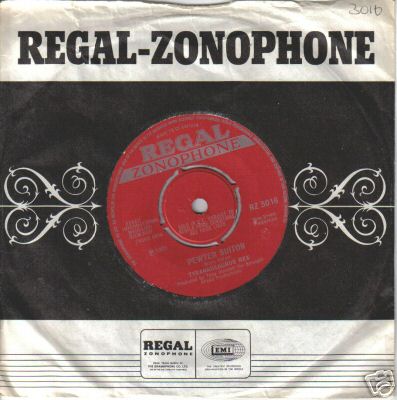
TYRANNOSAURUS REX PEWTER SUITOR REGAL ZONOPHONE T.REX
£
51
$
68


Favourite Auctions
To save auctions to your favourites, please login
If you don't have an account, please register
Description
YOU ARE BIDDING ON A MEGA RARE EXCELLENT CONDITION 7"
TYRANNOSAURUS REX
PEWTER SUITOR
WAR LORD OF THE ROYAL CROCODILES
RELEASED ON REGAL ZONOPHONE RZ 3016
THIS DISC IS IN TOTALLY FANTASTIC CONDITION . AS GOOD AS THE DAY IT WAS PRESSED I'VE NOT SEEN ONE IN SUCH GOOD CONDITION FOR OVER 20 YEARS
Before T. Rex assaulted the world with their glam rock party in the early '70s, there was the folk duo Tyrannosaurus Rex. Although both bands were fronted by flamboyant singer/guitarist/songwriter Marc Bolan, the earlier outfit was the polar opposite of the style of music that would later become synonymous with Bolan. Tyrannosaurus Rex originally formed in September of 1967 as a duo after Bolan split from his previous band, John's Children. Joining Bolan in the band was percussionist/bongo player Steve Peregrin Took, a gentleman that Bolan named after a character in The Lord of the Rings novel series. Bolan was so infatuated with Rings that most of the subject matter in Tyrannosaurus Rex songs came directly from the books as well.
The same month that the duo began, a fledgling producer by the name of Tony Visconti caught a show of their's at the UFO club in England, signing them right away to a subsidiary of EMI Records (in the U.S., Tyrannosaurus Rex's albums would issued via A&M) and producing their subsequent albums. The band enjoyed success straight away, with their debut single, "Debora," hitting the U.K. Top 40 as their debut full-length, My People Were Fair & Had Sky In Their Hair...But Now They're Content to Wear Stars on their Brows, hit number 15 on the U.K. charts in July of 1968. The next year saw several further releases, such as the albums Prophets Seers & Sages: The Angels of the Ages and Unicorn plus the singles "One Inch Rock" and "King of the Rumbling Spires," but Took would leave the band in October of 1969.
Undeterred since he was the main focal point of Tyrannosaurus Rex all along, Bolan recruited another percussionist, Mickey Finn, to take Took's place, issuing the new lineup's first album together in March of 1970, A Beard of Stars. By this time, Tyrannosaurus Rex's sound had begun to change; Bolan was now penning more succinct songs and had picked up the electric guitar (resulting in the group shortening their name to T. Rex later in the year), became a conventional rock quartet by adding a bassist and drummer, and helped touch off the glam rock movement (along with another former folk artist that had also recently rediscovered his desire to rock, David Bowie). Bolan and T. Rex went on to achieve massive success with a string of Top Ten singles and hit albums. But the hope of a reunion of the original Tyrannosaurus Rex lineup ever taking place became an impossibility on September 16, 1977, when Bolan died tragically in a car accident (Took would also pass away shortly thereafter, due to asphyxiation, on October 27, 1980).
Over the years, all of the Tyrannosaurus Rex albums have been repackaged in a variety of different configurations (the most popular being two-for-one deals in Europe), while 1995 saw the release of a Took collection titled The Missing Link to Tyrannosaurus Rex. A year later, A BBC History was issued — a collection of live "in the studio" tracks that Bolan and Took had laid down during the late '60s.
Singer/songwriter/guitarist Marc Bolan was one of the major glam rock figures of the early '70s, especially in England. After releasing his debut solo single, "The Wizard," and its follow-ups, "The Third Degree" and "Hippy Gumbo," on Decca Records in the U.K. in 1965-1966, he joined the band John's Children in 1967. The same year, he and percussionist Steve Peregine Took formed Tyrannosaurus Rex, an acoustic duo. They made three albums, My People Were Fair and Had Sky in Their Hair but Now They're Content to Wear Stars on Their Brows (1968), Prophets, Seers and Sages, the Angels of the Ages (1968), and Unicorn (1969), then split, with Bolan retaining the band name and teaming up with Mickey Finn on the electric Beard of Stars (1970).
By the end of 1970, with the name abbreviated to T. Rex, Bolan and Finn scored a U.K. hit with "Ride a White Swan," the first of ten straight Top Ten hits, and the album T. Rex. Adding bass player Steve Curry and drummer Bill Fifield, T. Rex expanded into a full-fledged rock & roll band, and scored a number one hit with "Hot Love" and another with "Get It On." (Under the title "Bang a Gong (Get It On)," the song became T. Rex's only substantial U.S. hit, making the Top Ten in 1972.) This was followed by the landmark album Electric Warrior (1971), which topped the U.K. charts and included the single "Jeepster." Then came "Telegram Sam," T. Rex's third U.K. number one. "Metal Guru" became T. Rex's fourth number one in May 1972. (During this period, with T.Rextasy hitting Britain, numerous reissues also charted.) The next new T. Rex album, The Slider, became a Top Ten hit in July 1972. T. Rex's seventh straight Top Ten single, "Children of the Revolution," peaked in the charts in September, followed by "Solid Gold Easy Action" in December. In March 1973 came "Twentieth Century Boy," the ninth T. Rex Top Ten single, and the Top Ten album Tanx. In June, "The Groover" became the band's tenth and final Top Ten single.
In August, Bolan tested the waters for using his own name on records, issuing the non-charting "Blackjack" single credited to Marc Bolan with Big Carrot, but then he retreated to the T. Rex rubric, though the original group was fragmenting. Bolan and T. Rex's commercial and critical fortunes declined afterwards, as they released Zinc Alloy and the Hidden Riders of Tomorrow (1974), Bolan's Zip Gun (1975), Futuristic Dragon (1976), and Dandy in the Underworld (1977). Bolan died in an automobile accident in 1977, and his work has been reissued frequently in the U.K.
price rating