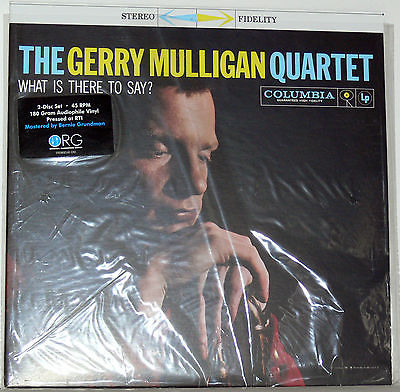
The GERRY MULLIGAN QUARTET What Is There To Say? ORG 45rpm AUDIOPHILE 180g 2 lps
$
40


$ 40
Sold For
Dec 21, 2014
Sold Date
Dec 9, 2014
Start Date
1
Number Of Bids
USA
Country Of Seller
eBay
Sold at
Favourite Auctions
To save auctions to your favourites, please login
If you don't have an account, please register
Description
The GERRY MULLIGAN QUARTET What Is There To Say? ORG 45rpm AUDIOPHILE 180g 2 lps
Original Recordings Group (ORG 111-45) Mastered by Bernie Grundman from the original analog master tapes
Tracklist
A1 What Is There To Say? A2 Just In Time B1 News From Blueport B2 Festive Minor C1 As Catch Can C2 My Funny Valentine D1 Blueport D2 Utter Chaos*(all photos are of the actual item)
- Baritone Saxophone – Gerry Mulligan
- Bass – Bill Crow
- Drums – Dave Bailey
- Trumpet – Art Farmer
Notes
Numbered limited edition of 2500 worldwideMastered by Bernie Grundman from the original masters and pressed at RTI
Michael Fremer Rated 9/10 Music, 9/10 Sonics!
Audio Beat Rated 4/5 Music, 4.5/5 Sound!
Mastered by Bernie Grundman from the Original Analog Master Tapes & Pressed at RTI!
Numbered Deluxe Laminated Gatefold Jackets! Only 2500 Numbered Limited Edition Copies Worldwide!
Originally released in 1959, this classic Jazz album contains eight tracks by the late great jazz saxophone player Gerry Mulligan. What Is There To Say? was the last of the piano less quartet albums that Gerry Mulligan recorded in the 1950s and is definitely one of his best! 14 years along in his storied career, Gerry Mulligan was at his first work as a leader for major-label, Columbia Records. At this time, Mulligan was just coming into his prime as a player, writer and arranger, this album is a slice of "Pure Mulligan... an insight into the man and his music."
"...the ORG LPs cream my near-mint six-eye pressings, and there's nothing more to say than that." - Marc Mickelson, theaudiobeat
"...flawlessly executed album that caught the high point of [Mulligan's] improvisatory lyricism." - Jerome Klinkowitz, An Aural Narrative in Jazz
"Virtually every selection is memorable, with "What Is There to Say," "Just in Time," "Festive Minor," "My Funny Valentine," and "Utter Chaos" being the high points. Highly recommended both to Mulligan collectors and to jazz listeners who are just discovering the great baritonist." - Scott Yanow, allmusic
"I am a jazz producer from Chicago. I reissue jazz somewhat as you do although we have a different target audience. I earlier heard you were putting out Mulligan's What Is There To Say? I think I even wrote someone at ORG how great this would be. Well I finally got my turntable set up and running and heard your 45rpm production and it is superb. Great, great job. You've captured that west coast sound and rhythmic drive beautifully. Well, this is a superb example of some of the best west coast jazz. And makes a perfect example of the driving steady beat used by many of the players of this type. Warne Marsh (the master of the Tristano school) wanted the rhythm section to do just this, lay out a steady beat and let him, the improviser, go to it. Contrast that with the seminal album Portrait in Jazz by Bill Evans where suddenly the rhythm section becomes on equal footing to the main instrument. This Mulligan would be the perfect example musically and sonically to contrast against the Evans. Anyway, I digress. You or whoever put this all together has done a superb job of letting the music come through. Fabulous." - Jonathan H., Jazz Producer, Chicago
"The album is sonically superior... Altogether a wonderful reissue cut by Bernie Grundman from either the master tape or a flat transfer of the master. Either way, great sound and ideal cocktail hour or late night "end of the day" music that's easy to recommend to both jazz aficionados and casual jazz enthusiasts alike. " - Michael Fremer analogplanet Music 9/10, Sound 9/10!
"[T]here is little doubt that Gerry Mulligan was the greatest baritone sax player. He could hang musically with just about everyone... This is one of the better-sounding late-'50s Columbia sessions... [T]he horns' up-close perspective provides a sense of vividness... The stereo Original Recordings Group reissue has two important technical advantages over either original pressing. The first is the faster playback speed, which makes for a less crowded groove and greater density of musical information. The horns sound both bigger and more complete, possessing a rounded fullness that neither original conveys, and the drums now anchor the center. The second advantage is the fact that the reissue was cut with the RIAA EQ curve instead of Columbia's house curve... [T]he reissue sounds well balanced and complete -- simply better. How much better? Well, no reissued CD, no SACD, will offer an equivalent level of improvement over an earlier version -- not even close, in fact. And while you can certainly change the sound with a different amp or speaker, you still won't retrieve the musically significant detail from the originals that this reissue makes plain. Put another way, the ORG LPs cream my near-mint six-eye pressings, and there's nothing more to say than that." - Mark Mickelson, theaudiobeat 4/5 Music, 4.5/5 Sound
price rating