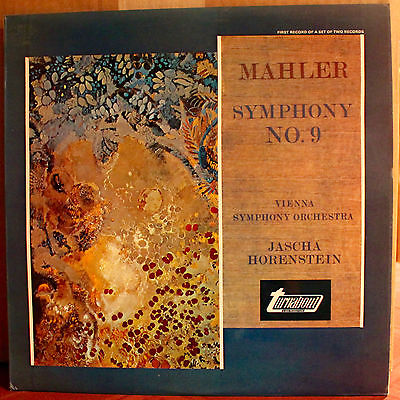
VOX Turnabout 2x12" LPs TV34332-33S: MAHLER - Sym No. 9 HORENSTEIN, 1952 UK
$
50


$ 50
Sold For
Jan 26, 2018
Sold Date
Jan 21, 2016
Start Date
1
Number Of Bids
USA
Country Of Seller
eBay
Sold at
Favourite Auctions
To save auctions to your favourites, please login
If you don't have an account, please register
Description
****Welcome to our listing, thanks very much for looking!
****See our own website! We have lots of out of print LPs and CDs! You can find us on the world wide web at -
hearthedifference.net
****Please see our other listings for more great LPs and CDs - new items added daily!
****To access our eBay store either click on the little red door at the top right section of any of our eBay listings or, click on -
http://stores.ebay.com/Hear-The-Difference
Background -
This stereo 2-LP set features symphonic music written by Gustav Mahler and performed by Jascha Horenstein conducting the Vienna Symphony Orchestra. Superb performances! The LPs were made in the UK, recorded in 1952 and issued on vinyl in the 1960s. The vinyl is in near mint minus condition, a gorgeous LP set! (see below for condition details).The Symphony No. 9 by Gustav Mahler was written between 1908 and 1909, and was the last symphony that he completed. It is actually his tenth symphonic work, as Mahler gave no ordinal number (nor the title 'symphony') to his symphonic song-cycle Das Lied von der Erde. Though the work is often described as being in the key of D major, the tonal scheme of the symphony as a whole is progressive. While the opening movement is in D major, the finale is in D-flat major. A typical performance takes about 75–90 minutes.
The symphony is in four movements:
- Andante comodo (D major)
- Im Tempo eines gemächlichen Ländlers. Etwas täppisch und sehr derb (C major)
- Rondo-Burleske: Allegro assai. Sehr trotzig (A minor)
- Adagio. Sehr langsam und noch zurückhaltend (D-flat major)
The symphony is scored for the following orchestra:
Woodwinds: piccolo, 4 flutes, 4 oboes (ob. 4 doubling cor anglais), E-flat clarinet, 3 clarinets in B-flat and A, bass clarinet, 4 bassoons (bsn. 4 doubling contrabassoon)
Brass: 4 horns, 3 trumpets, 3 trombones, tuba
Percussion: timpani, bass drum, snare drum, cymbals, triangle, tam-tam, 3 bells, glockenspiel
Strings: 2 harps, violins I & II, violas, violoncellos, double basses
The enjoyment of Mahler's Ninth Symphony prompted the essayist Lewis Thomas to write the title essay in his Late Night Thoughts on Listening to Mahler's Ninth Symphony.
Many Mahler interpreters have been moved to speak with similar profundity about the work:
- It expresses an extraordinary love of the earth, for Nature. – Alban Berg
- It is music coming from another world, it is coming from eternity. – Herbert von Karajan
- It is terrifying, and paralyzing, as the strands of sound disintegrate ... in ceasing, we lose it all. But in letting go, we have gained everything. – Leonard Bernstein
- I believe it to be not only his last but also his greatest achievement. – Otto Klemperer
- [Mahler's] Ninth is most strange. In it, the author hardly speaks as an individual any longer. It almost seems as though this work must have a concealed author who used Mahler merely as his spokesman, as his mouthpiece. This symphony is no longer couched in the personal tone. It consists, so to speak, of objective, almost passionless [fast leidenschaftslose] statements of a beauty which becomes perceptible only to one who can dispense with animal warmth [animalische Wärme] and feels at home in spiritual coolness [geistiger Kühle]. – Arnold Schoenberg
- Someday, some real friends of Mahler's will ... take a pruning knife and reduce his works to the length that they would have been if the composer had not stretched them out of shape; and then the great Mahler war will be over ... The Ninth Symphony would last about twenty minutes. – Deems Taylor
-
LPs made by VOX Turnabout // DECCA Records, in the UK / Great Britain / England
-
LPs released in the 1960s - recorded in 1952
-
LPs are in STEREO
-
Record Catalog Number: TV 34332S // TV 34333S
-
Record Labels are primarily SILVER and GREEN with inverse GREEN and SILVER lettering and has the record label logo at the 6 o'clock position of the label (see pictures for details).
Mahler // Horenstein
LP title and music on this rare item -
Symphony No. 9 in D Minor
Performers -
Vienna Symphony Orchestra
CONDITION Details:
The LPs come in separate, individual jackets. The jackets are both in near mint minus condition. The jackets are tight and clean, with no seam splits. It has no color foxing. The corners are solid. The colors on the jackets are sharp. The jackets are covered on the front with CLARIFOIL. The corners, spine and seams show just a bit of shelf wear due to the age of this set (see pictures with this listing as they are of the actual item).
The LPs are in near mint minus condition! There may be some very light marks on the vinyl, most of which are spider marks caused by sliding the LPs in and out of the inner sleeves. Some of these marks may sound on some audio systems, but this depends on the sensitivity of your audio gear. The LPs retain much of the original gloss and sheen. There are NO serious spindle marks on the record labels. That said, acquiring a vintage LP set like this is for the performance and rarity of the LP, not necessarily for the sound quality.A Short Note About LP GRADING -
- Mint = Only used for sealed items.
- Near Mint = Virtually flawless in every way.
- Near Mint Minus = Item has some minor imperfections, some audible.
- Excellent = Item obviously played and enjoyed with some noise.
- Very Good Plus = Many more imperfections which are noticeable and obtrusive.
For best results, always thoroughly clean your LPs before playing them.
LPs can be audiophile quality pressings (any collector of fine MFSL, half speeds, direct to discs, Japanese/UK pressings etc., can attest to the difference a quality pressing can make to an audio system).
Don't let this rarity slip by!!!