Wand/NDR SO: Beethoven Symphony No. 6 "Pastorale" - DHM 1C 067-EL-169561-1 (DDD)
$
25


Favourite Auctions
To save auctions to your favourites, please login
If you don't have an account, please register
Description
redgarnett Store ITEM DESCRIPTION:
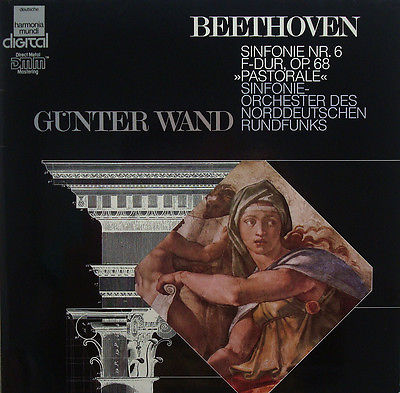
This handsome gatefold LP – a fine collector’s copy – from EMI / Deutsche Harmonia Mundi (1C 067-EL-169561-1, German pressing / DMM · Direct Metal Mastering, gold label, DDD stereo) features Günter Wand and the North German Radio Symphony Orchestra’s magnificent accounts of Beethoven’s Symphony No. 6 in F Major Op. 68 “Pastorale”.
The exact track list is as follows:
A-1
Allegro ma non troppo
13:15
A-2
Andante molto moto
12:03
B-1
Allegro
6:04
B-2
Allegro
3:41
B-3
Allegretto
9:32
Recorded at the Großes MusikStudio des NDR in September 1985, this remarkable recording was produced by Dr. Ulf Thomson and engineered by Johannes Kutzner
In his 10/10 review of the entire cycle, the wondeful critic and author David Hurwitz wrote for ClassicsToday:
“Since his death, Günter Wand’s reputation seems to have declined from being the Grand Old Man of the German classics to, well, yesterday’s news. This is a terrible shame. He was a stellar conductor, and this Beethoven cycle remains one of the reference versions. A reader wrote to us recently asking why it was that we haven’t reviewed it, although it always gets listed as a “reference recording” in articles on other Beethoven symphony editions. The reason is simply that it was issued originally in 1989, a decade before we existed, and has only reappeared once since, and then it was not released domestically. Indeed, this latest incarnation sort of crept back into the catalog unannounced.
“Wand recorded a few of the symphonies again after this set was released, but unlike Bruckner, or Brahms, this remains his only complete Beethoven cycle to achieve international distribution, a signal achievement that happily avoids the confusion caused by his multiple Bruckner Eighths and Ninths or triplicated Schubert “Great” Symphonies. This is one of the most consistent of all modern Beethoven editions, capped by a Ninth that stands among the select performances of that work on disc. Wand achieved superlative results the old fashioned way: by demanding extensive rehearsals before performances and recordings.
“You may well ask what he accomplished with the extra time, given that the music poses no special technical problems to modern players. Wand used to describe himself as “an old conductor of the new school.” In other words, he was a disciple of Toscanini, with that conductor’s belief in fidelity–never slavish–to the text, and a firm rhythmic underpinning coupled to relatively strict tempos. There are other ways to play Beethoven, of course, but as we all know this one works particularly well when the conductor achieves the ensemble discipline of the high order on display here. Let’s consider a few examples.
“Many conductors like to insert a pregnant pause before the start of the coda in the Ninth’s first movement. Beethoven did not ask for one, and Wand gets the feeling of “pregnancy” by making a slight ritard and then moving straight on. He then takes special care to clarify the creepy repeated bass line that slowly builds through the string section, balancing it against the principal melody in the oboe. The result has a thrilling inexorability that few other versions match. This attention to what is happening below the melodic surface also pays big dividends in the first movement of the Seventh Symphony, where a moderate tempo combines with unusual rhythmic precision to create an incredibly powerful forward momentum.
“As the above suggests, one of the things that makes these performance so special is Wand’s ability to create a truly athletic feeling of movement at any tempo, and in order to do that he has to pay attention not just to tiny details, but also to larger phrases and musical paragraphs. How many listeners hear the end of the scherzo of the Fourth Symphony as a final orchestral crash followed by a coda consisting of a two-note horn crescendo followed once again by the same final chord? But that is not what Beethoven wrote. What he wrote, and what Wand lets us hear, is that the horns play through that non-final, final chord with three more notes, piano, and the two-note crescendo is actually the continuation of their phrase. Listen for yourself. The result has such powerful logic. For once that tiny coda doesn’t sound like a mere appendix, but a delightful joke in which the full orchestra shouts down those misbehaving horns.
“These examples characterize the interpretations generally. I don’t have to spend more time describing how Wand integrates these small details into the larger whole–that the Fifth Symphony has all of the grit and grandeur that Beethoven intended; that the funeral march in the “Eroica” is one of the most noble on disc; or that the “Pastoral” captures the music’s earthiness and rusticity with memorable fidelity. This approach also elevates the “lesser” works—Symphonies 1, 2, and 8—in the sense that we hear how full of similarly rewarding detail they are, and thus how naturally they fit into the curve of Beethoven’s musical development.
“Exceptionally well recorded, this Beethoven cycle belongs in every serious collection, alongside, or even in preference to, those by Szell, Barenboim, and maybe a couple of others. It’s that special.”
There are fine liner notes on the interior panels of the gatefold jacket by Rolf-A. Dimpfel and the rear panel carries a brief biography of Wand by W.S. All texts are provided in German, English, French, and Italian. The striking cover design is credited to Michael Wiesinger.
CONDITION:
The gradations of condition I use are as follows: MINT, Near-Mint, Excellent, Very Good, Good, Fair, Poor.
The condition of the gatefold jacket is EXCELLENT. There is minor edgewear, more so at corners, as well as mild shelfwear. However, there are no seamsplits, bends, owners’ markings, or other defects, and the album remains solid, bright, glossy, and highly attractive – overall, an excellent collector's copy.
The condition of the LP is near-MINT and playback is superb – overall, a truly fine collector's copy.
PLEASE NOTE:
This LP has been carefully cleaned using a VPI cleaning machine. All LPs are provided with a new Nagaoka (or Nagaoka-style) inner sleeve. The images I've provided are of the actual item you are potentially bidding on - these are not stock images or images I've taken from other sites. Bid with confidence!
PAYMENT:
Payment by PayPal is greatly preferred. Payment should be made within 5 days.
SHIPPING:
Shipping is free to anywhere in the world; this is true regardless of the number of LPs you buy, be it 1 or a 100. All LPs will be sent via standard airmail (7-10 days delivery). Note: There is no tracking number provided with standard airmail. Should you wish to have your item(s) sent via certified airmail (i.e., with a tracking number), please contact me.
FEEDBACK:
I will promptly leave feedback for all buyers. Please do not leave negative, or even neutral, feedback without first giving me an opportunity to resolve any dissatisfaction you might have with an item or transaction. I do understand that, on occasion, a buyer might believe the item description to be inaccurate or that a buyer may be disappointed in some other way regarding the sale. I promise I will do my very best to resolve any unhappiness you've experienced in your buying experience with me to your complete satisfaction. Thank you.
REFUNDS:
Returns are honored, and any buyer you makes a return will be refunded in full. Please contact me before making a return.
Please see my other classical LP and CD auctions, and feel free to write with any questions, I'll be glad to help.
price rating