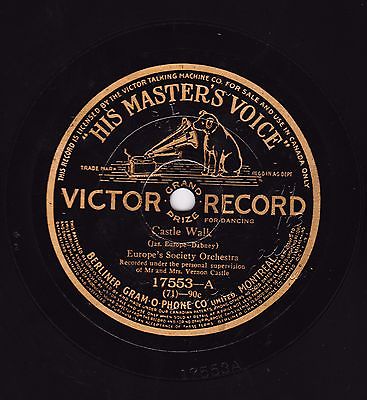
1914 78 rpm JAMES REESE EUROPE pioneer Afro-American leader Victor 17553 E/E-
$
41


Favourite Auctions
To save auctions to your favourites, please login
If you don't have an account, please register
Description
JIM EUROPE'S SOCIETY ORCHESTRA
-A: Castle Walk (Jas. Europe-Dabney)
-B: You're Here and I'm Here One Step (Jerome D. Kern)
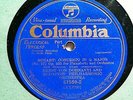
Canadian Victor 17553
Condition: E/E- some pops
Sounds great- well recorded
Labels are bright and clean.
from Wikipedia:
James Reese Europe (22 February 1880 – 9 May 1919) was an American ragtime and early jazz bandleader,arranger, and composer. He was the leading figure on the African-American music scene of New York City in the 1910s. Eubie Blake called him the "Martin Luther King of music.
n 1910 Europe organized the Clef Club, a society for African Americans in the music industry. In 1912 the club made history when it played a concert at Carnegie Hall for the benefit of the Colored Music Settlement School. The Clef Club Orchestra, while not a jazz band, was the first band to play proto-jazz at Carnegie Hall. It is difficult to overstate the importance of that event in the history of jazz in the United States — it was 12 years before the Paul Whiteman and George Gershwin concert at Aeolian Hall, and 26 years before Benny Goodman's famed concert at Carnegie Hall. The Clef Club's performances played music written solely by black composers, including Harry T. Burleigh and Samuel Coleridge-Taylor.[2] Europe's orchestra also included Will Marion Cook, who had not been in Carnegie Hall since his own performance as solo violinist in 1896. Cook was the first black composer to launch full musical productions, fully scored with a cast and story every bit as classical as any Victor Herbert operetta. In the words of Gunther Schuller, Europe "... had stormed the bastion of the white establishment and made many members of New York's cultural elite aware of Negro music for the first time".[3] The New York Times remarked, "These composers are beginning to form an art of their own"; yet by their third performance, a review in Musical America said Europe's Clef Club should "give its attention during the coming year to a movement or two of a Haydn Symphony".[4]
Europe was known for his outspoken personality and unwillingness to bend to musical conventions, particularly in his insistence on playing his own style of music. He responded to criticism by saying, "We have developed a kind of symphony music that, no matter what else you think, is different and distinctive, and that lends itself to the playing of the peculiar compositions of our race ... My success had come ... from a realization of the advantages of sticking to the music of my own people." And later, "We colored people have our own music that is part of us. It's the product of our souls; it's been created by the sufferings and miseries of our race."[4]
His "Society Orchestra" became nationally famous in 1912, accompanying theater headliner dancers Vernon and Irene Castle. The Castles introduced and popularized the foxtrot—"America learned to dance from the waist down."[citation needed] In 1913 and 1914 he made a series of phonograph records for the Victor Talking Machine Company. These recordings are some of the best examples of the pre-jazz hot ragtime style of the U.S. Northeast of the 1910s.[5] These are some of the most accepted quotes that are in place to protect the idea that the Original Dixieland Jass Band recorded the first jass (spelling later changed) pieces in 1917 for Victor. Unlike Europe's post-War recordings, the Victor recordings were not called nor marketed as "jazz" at the time, and were far from the first recordings of ragtime by African-American musicians.
Neither the Clef Club Orchestra nor the Society Orchestra were small "Dixieland" style bands. They were large symphonic bands to satisfy the tastes of a public that was used to performances by the likes of the John Philip Sousa band and similar organizations very popular at the time. The Clef Orchestra had 125 members[6]and played on various occasions between 1912 and 1915 in Carnegie Hall. It is instructive to read a comment from a music review in the New York Times from March 12, 1914: "... the programme consisted largely of plantation melodies and spirituals [arranged such as to show that] these composers are beginning to develop an art of their own based on their folk material ..."[7]
I know how to pack 78's so that they arrive safe and unbroken
Record can be returned for full refund if you feel that I have misrepresented the condition.
Shipping: I charge the actual cost for me to ship you the item, not including materials which are free.
>>>>>>Please wait for me to send you an invoice as shipping is NOT $4.00.
Please do not pay right away as I would have to send you a supplementary invoice for the rest of the shipping...
Shipping to the US is $6.00 via Media Mail mailed from the US. Shipping to Canada is around $17.00
Shipping to the rest of the world is around $22.00- Please wait for the invoice.
Buy more than one- I will calculate combined shipping based on the weight- way less for the second record...
price rating