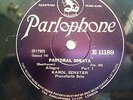
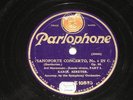
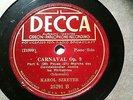
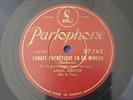
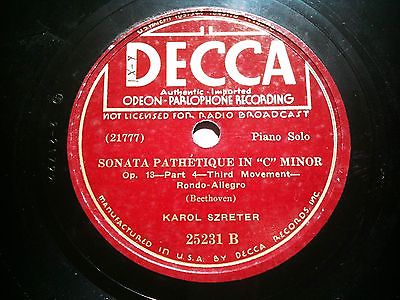
1930 KAROL SZRETER Berlin Beethoven Piano Sonata C Minor PATHETIQUE Op 13 78
$
25


Favourite Auctions
To save auctions to your favourites, please login
If you don't have an account, please register
Description
Welcome to my auctions of great records
WEEK 2 of 3 weeks of great auctions – this is the SECOND week of three weeks of great records.
As a default, I will not send you an invoice until the end of my sales cycle on September 27 – that way you can see my next listings and you can combine your wins into one parcel for a low postage.
International shipping: approx postage 1x10"=$25: 1x12"=$28: 10"Album 4 Rec=45$: 12" Album 2 Rec=45$
About 30% to Canada. Pls ignore international postage displayed in Ebay, rates are too high
Please wait for me to send you an invoice. DO NOT USE EBAY CHECKOUT if you want the lowest possible postage.
A series of great classical orchestral and instrumental performances by major conductors, composers and instrumentalists.
Great POLISH pianist KAROL SZETER who was the solo recording artist for Odeon as well as a member of many Berlin ensembles did prematurely from Leukemia in 1933. Here in one of his first electric recordings
Karol Szreter started out a child prodigy, making his first public appearance in his native Poland at about the age of 9. At age 13 he was awarded a scholarship to study piano at the St. Petersburg Conservatoire and he remained there until the outbreak of World War I. Afterwards Szreter completed his studies in Berlin with the great Egon Petri.
In 1926, Szreter made the first electrical recording of Beethoven's Piano Concerto No. 4, and by 1930 had recorded three of Beethoven's sonatas and a complete Schumann Carnaval, Op. 9.
Szreter lost his lifelong battle with leukemia at the age of about 34.
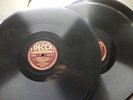
German Odeon on superb US ODEON 2x 12" 78 rpm record
Condition:
EXCELLENT Minus, shiny and unworn, but some rubs and scuffs, hint of graininess. Plays quiet, light crackle.
Born 1898 in Lodz
Died March 20, 1933 in Berlin
Country: Poland
Biography
Pianist Karol Szreter started out a child prodigy, making his first public appearance in his native Poland at about the age of 9. At age 13 he was awarded a scholarship to study piano at the St. Petersburg Conservatoire and he remained there until the outbreak of World War I. Afterwards Szreter completed his studies in Berlin with the great Egon Petri. While a meeting between Szreter and Petri's mentor Ferruccio Busoni has not been established as a matter of fact, it is more than likely that there was contact somewhere along the line, and Szreter's recorded performances bear certain recognizable pianistic traits that are held in common within the "Busoni Circle." At war's end Szreter began his career in earnest with a series of successful concerts given in Central and Eastern Europe.
Szreter recorded prolifically, beginning with acoustic records made for the German Vox label in the early 1920s. Around 1925 Szreter struck up a relationship with the German branch of the Parlophone label, and this firm would continue to engage Szreter's talents for the rest of his days. Parlophone is a pop label, and the vast majority of Szreter's many recordings would consist of popular melodies, usually backed by an orchestra. However, the upside of this arrangement was that on occasion Szreter was provided far more latitude to record serious literature than was allowed most of his contemporaries, even in comparison to labels more keenly focused on classical repertoire. In 1926, Szreter made the first electrical recording of Beethoven's Piano Concerto No. 4, and by 1930 had recorded three of Beethoven's sonatas and a complete Schumann Carnaval, Op. 9.
In 1930 Szreter made his first concert appearances in Britain, where his recordings had been well-received by both public and critics alike, and his concert tour was to be no disappointment. "Szreter's sense of tone gradation is of the subtlest," exclaimed a writer in the Daily Telegraph, "his rhythms as unfailing as his control of climaxes." In 1933 Parlophone planned to make Szreter the linchpin of a series of recordings of Brahms' chamber works in honor of the composer's centenary. But this series was barely underway when Szreter lost his lifelong battle with leukemia at the age of about 34.
price rating