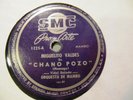
1946 CUBAN Miguelito Valdes Orquesta Rumba EL CUA CUA Casablanca MUSICRAFT 403-T
$
60


Favourite Auctions
To save auctions to your favourites, please login
If you don't have an account, please register
Description
Great Cuban Mambo
A series of great Latin, Spanish, Portuguese and Brazilian dance and folk songs
Check out more Latin recordings for sale by clicking the link below
Over 100 Latin recordings available now!
Great Cuban Rumba by Miguelito Valdes And His Orchestra
Miguelito Valdes And His Orchestra* – Casablanca / El Cuá Cuá
Sello:
Musicraft – 403
Please see top of the page for condition
Miguelito Valdés, born Miguel Ángel Eugenio Lázaro Zacarias Izquierdo Valdés Hernández (Havana, 6 September 1912 – Bogotá, 9 November 1978), also called Mr. Babalú, was a Cuban popular singer of high quality. His performances were characterized by a strong voice and a particular sense of cubanismo.
[edit] LifeIn origin, he was a white mestizo of a Spanish father and a Mexican Yucatec mother. He was born in the largely black barrio of Belén in La Habana Vieja, and moved to another barrio, Cayo Hueso (in Centro Habana), when his father died. In his youth he worked as an auto mechanic and was a good amateur boxer. In 1934 he won the Amateur Championship of Cuba at his weight. One of his closest friends from his days in the barrio was Chano Pozo, and in his singing style he has been called "as black a white guy as you would meet in Havana".[1]
[edit] CareerMiguelito began his musical career in the Sexteto Habanero Infantil, where he played, variously, the guitar, tres, double bass, timbal and sometimes sang. Soon, his capability as a singer was realized, and from that moment he was constantly in demand. After a brief spell with María Teresa Vera's Sexteto Occidente, he was one of the founding members of the Septeto Jóvenes del Cayo in 1929. In 1933 he moved to the charanga of Ismael Díaz, and then to the Charanga Gris, directed by the pianist and composer Armando Valdés Torres, and to the Orquesta Habana, directed by Estanislao Serviá.[2]
Miguelito as a boxerIn 1934 he made his first journey abroad, to Panama, and on his return joined the Orquesta Hermanos Castro, which was a leading band of the day. He was their lead singer until 1936. In 1937 he joined a group of top musicians who formed the Orquesta Casino de la Playa. He was now perhaps the top singer in Cuba, on the verge of international fame. In 1939 the La Playa toured South and Central America, and started a series of recordings for RCA Victor which would make them famous throughout the world.
In 1940 Valdés briefly joined the Orquesta Riverside (another of the big Cuban bands) before emigrating to New York, which became his home base for the rest of his career. In New York he worked for Orquesta Siboney de Alberto Iznaga, Xavier Cugat, Tito Rodríguez and Machito. He directed his own orchestra for a few years, and made some successful recordings with it in 1949/50.[3] He appeared in a number of films, and was known as 'Mr Babalu' after his performance of Marguerita Lecuona's Babalú. Miguelito recorded this number with three top orchestras: Casino de la Playa in Havana, and Xavier Cugat and Machito in New York. He was regarded as one of the greatest soneros and guaracheros[4] in Cuban music. Although a white singer, his interpretation of Afro-Cuban lyrics was remarkable. He died from a heart attack during a performance in Bogotá.[5]
Numbers he composed include Mondongo, Rumba rumbero, Loco de amor, Los tambores, Oh, mi tambó, Bongó, Dolor cobarde. Films he appeared in include Mi reino por un torero; Suspense, Panamericana, Imprudencia, Acapulqueña (with María Antonieta Pons), Copacabana, Mientras el cuerpo aguante, Canción para recordar and Nacido para amarte. Also listed is Bailando nace el amor (with Fred Astaire and Rita Hayworth) 1942, which may be the Spanish-language version of You Were Never Lovelier.
[edit] References
Machito performing at Glen Island Casino, New York, late 1940s
Machito (died April 19, 1984), born as Francisco Raúl Gutiérrez Grillo, was an influential Latin jazz musician who helped refine Afro-Cuban jazz and create both Cubop and salsa music.[1][2] He was raised in Havana alongside the singer Graciela, his foster sister.
In New York City, Machito formed the band the Afro-Cubans in 1940, and with Mario Bauzá as musical director, brought together Cuban rhythms and big band arrangements in one group. He made numerous recordings from the 1940s to the 1980s, many with Graciela as singer. Machito changed to a smaller ensemble format in 1975, touring Europe extensively. He brought his son and daughter into the band, and received a Grammy Award in 1983, one year before he died.
Machito's music had an effect on the lives of many musicians who played in the Afro-Cubans over the years, and on those who were attracted to Latin jazz after hearing him. George Shearing, Dizzy Gillespie, Charlie Parker and Stan Kenton credited Machito as an influence. An intersection in East Harlem is named "Machito Square" in his honor.
.price rating