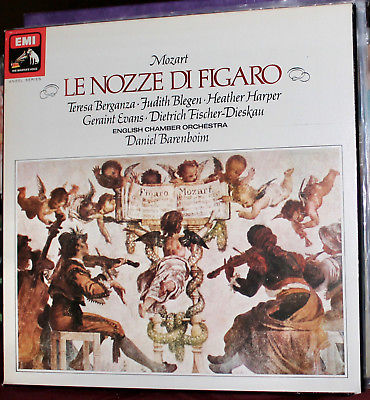
EMI 4-LPs SLS 995: MOZART - Figaro - BARENBOIM, Berganza, etc. - 1977 UK QUAD
C$
40
$
29


C$ 40
Sold For
Mar 19, 2018
Sold Date
Oct 25, 2017
Start Date
C$ 60
Start price
1
Number Of Bids
Canada
Country Of Seller
eBay
Sold at
Favourite Auctions
To save auctions to your favourites, please login
If you don't have an account, please register
Description
****Welcome to our listing, thanks very much for looking!
****See our own website! We have lots of out of print LPs and CDs! You can find us on the world wide web at -
hearthedifference.net
****Shipping cost is only an estimate - it depends on the actual weight and size of the package as well as the service required. We do not profit from shipping costs, so if we overcharge, we will refund the difference back to you. It's always best to wait for our invoice before paying for your item. We will combine shipping for multiple items purchased.
****Please see our other listings for more great LPs and CDs - new items added daily!
****To access our eBay store either click on the little red door at the top right section of any of our eBay listings or, click on -
http://stores.ebay.com/Hear-The-Difference
Background -
The Marriage of Figaro (Italian: Le nozze di Figaro), K. 492, is an opera buffa (comic opera) in four acts composed in 1786 by Wolfgang Amadeus Mozart, with an Italian libretto written by Lorenzo Da Ponte. It premiered at the Burgtheater in Vienna on 1 May 1786. The opera's libretto is based on a stage comedy by Pierre Beaumarchais, La folle journée, ou le Mariage de Figaro ("The Mad Day, or The Marriage of Figaro"), which was first performed in 1784. It tells how the servants Figaro and Susanna succeed in getting married, foiling the efforts of their philandering employer Count Almaviva to seduce Susanna and teaching him a lesson in fidelity.The opera is a cornerstone of the repertoire and appears consistently among the top ten in the Operabase list of most frequently performed operas.
Beaumarchais's earlier play The Barber of Seville had already made a successful transition to opera in a version by Paisiello. Beaumarchais's Mariage de Figaro was at first banned in Vienna; the Emperor, Joseph II, stated that "since the piece contains much that is objectionable, I therefore expect that the Censor shall either reject it altogether, or at any rate have such alterations made in it that he shall be responsible for the performance of this play and for the impression it may make", after which the Austrian Censor duly forbade performing the German version of the play. Mozart's librettist managed to get official approval for an operatic version which eventually achieved great success.
The opera was the first of three collaborations between Mozart and Da Ponte; their later collaborations were Don Giovanni and Così fan tutte. It was Mozart who originally selected Beaumarchais's play and brought it to Da Ponte, who turned it into a libretto in six weeks, rewriting it in poetic Italian and removing all of the original's political references. In particular, Da Ponte replaced Figaro's climactic speech against inherited nobility with an equally angry aria against unfaithful wives. Contrary to the popular myth, the libretto was approved by the Emperor before any music was written by Mozart.
The Imperial Italian opera company paid Mozart 450 florins for the work; this was three times his (low) yearly salary when he had worked as a court musician in Salzburg. Da Ponte was paid 200 florins.
The Marriage of Figaro continues the plot of The Barber of Seville several years later, and recounts a single "day of madness" (la folle journée) in the palace of Count Almaviva near Seville, Spain. Rosina is now the Countess; Dr. Bartolo is seeking revenge against Figaro for thwarting his plans to marry Rosina himself; and Count Almaviva has degenerated from the romantic youth of Barber into a scheming, bullying, skirt-chasing baritone. Having gratefully given Figaro a job as head of his servant-staff, he is now persistently trying to exercise his droit du seigneur – his right to bed a servant girl on her wedding night – with Figaro's bride-to-be, Susanna, who is the Countess's maid. He keeps finding excuses to delay the civil part of the wedding of his two servants, which is arranged for this very day. Figaro, Susanna, and the Countess conspire to embarrass the Count and expose his scheming. He retaliates by trying to compel Figaro legally to marry a woman old enough to be his mother, but it turns out at the last minute that she really is his mother. Through Figaro's and Susanna's clever manipulations, the Count's love for his Countess is finally restored.
Daniel Barenboim, KBE (born 15 November 1942) is an Argentine-Israeli pianist and conductor who is also a citizen of Palestine and Spain.
He is the general music director of the Berlin State Opera, and the Staatskapelle Berlin; he previously served as Music Director of the Chicago Symphony Orchestra, the Orchestre de Paris and La Scala in Milan. Barenboim is known for his work with the West–Eastern Divan Orchestra, a Seville-based orchestra of young Arab and Israeli musicians, and as a resolute critic of the Israeli occupation of Palestinian territories.
Barenboim has received many awards and prizes, including an honorary Knight Commander of the Order of the British Empire, France's Légion d'honneur both as a Commander and Grand Officier, and the German Großes Bundesverdienstkreuz and Willy Brandt Award. Together with the Palestinian-American scholar Edward Said, he was given Spain's Prince of Asturias Concord Award. He has won seven Grammy awards for his work and discography. Barenboim is a polyglot, fluent in Spanish, Hebrew, English, French, Italian, and German.
Daniel Barenboim was born in 1942 in Buenos Aires, Argentina, to Argentinian-Jewish parents Aida (née Schuster) and Enrique Barenboim. He started piano lessons at the age of five with his mother, continuing to study with his father, who remained his only teacher. On 19 August 1950, at the age of seven, he gave his first formal concert in his hometown, Buenos Aires.
In 1952, Barenboim's family moved to Israel. Two years later, in the summer of 1954, his parents took him to Salzburg to take part in Igor Markevitch's conducting classes. During that summer he also met and played for Wilhelm Furtwängler, who has remained a central musical influence and ideal for Barenboim. Furtwängler called the young Barenboim a "phenomenon" and invited him to perform the Beethoven First Piano Concerto with the Berlin Philharmonic, but Barenboim's father considered it too soon after the Second World War for a child of Jewish parents to be performing in Berlin. In 1955 Barenboim studied harmony and composition with Nadia Boulanger in Paris.
On 15 June 1967, Barenboim and British cellist Jacqueline du Pré were married in Jerusalem at a Western Wall ceremony, Du Pré having converted to Judaism. Acting as one of the witnesses was the conductor Zubin Mehta, a long-time friend of Barenboim. Since "I was not Jewish I had to temporarily be renamed Moshe Cohen, which made me a 'kosher witness'," Mehta recalled. Du Pré retired from music in 1973, after being diagnosed with multiple sclerosis (MS). The marriage lasted until du Pré's death in 1987.
In the early 1980s, Barenboim began an affair with the Russian pianist Elena Bashkirova, with whom he has two sons born in Paris before du Pré's death: David Arthur, born 1983, and Michael, born 1985. Barenboim worked to keep his relationship with Bashkirova hidden from du Pré, and believed he had succeeded. He and Bashkirova married in 1988. Both sons are part of the music world: David is a manager-writer for the German hip-hop band Level 8, and Michael Barenboim is a classical violinist.
-
LPs made by EMI (His Master's Voice / Angel Series) Records, in the UK / England / Great Britain
-
LPs released in 1977
-
LPs are recorded in STEREO
-
Record Catalog Number: SLS 995 (individual Records numbered SAN 420-423)
-
Record Labels are primarily YELLOW with BLACK lettering, and has the "Colored Postage Stamp Nipper" on all the record labels!
Mozart // Daniel Barenboim & ECO
Le Nozze di Figaro
Tracks -
1. Le nozze di Figaro, K 492 by Wolfgang Amadeus MozartPerformer: Sir Geraint Evans (Baritone), Heather Harper (Soprano), Judith Blegen (Soprano),
Dietrich Fischer-Dieskau (Baritone), Teresa Berganza (Mezzo Soprano)
Conductor: Daniel Barenboim
Orchestra/Ensemble: English Chamber Orchestra, John Alldis Choir
Period: Classical
Written: 1786; Vienna, Austria
Language: Italian
Le Nozze Di Figaro
A. Overture & Act I (1st Part)
B. Act I (Ending)
C. Act II (1st Part)
D. Act II (Ending)
E. Act III (1st Part)
F. Act III (Ending)
G. Act IV (1st Part)
H. Act IV (Ending)
Performers / Credits -
• Baritone Vocals [Figaro] – Geraint Evans
• Baritone Vocals [Le Conte] – Dietrich Fischer-Dieskau
• Bass Vocals [Antonio] – Malcolm Donnelly
• Bass Vocals [Bartolo] – William McCue
• Chorus – John Alldis Choir
• Chorus Master – John Alldis
• Composed By – Wolfgang Amadeus Mozart
• Conductor – Daniel Barenboim
• Engineer – Neville Boyling
• First Bridesmaid – Elizabeth Ritchie
• Harpsichord, Other [Continuo] – Richard Amner
• Language Coach – Ubaldo Gardini
• Layout – Bruno Crespel
• Libretto By – Lorenzo da Ponte
• Liner Notes [Introduction & Synopsis] – Bernard Jacobson
• Liner Notes [Lyrics Translated In English] – Gwyn Morris, William R. Gann
• Liner Notes [Lyrics Translated In French] – B. Vierne
• Lyrics By – Beaumarchais
• Mezzo-soprano Vocals [Cherubino] – Teresa Berganza
• Mezzo-soprano Vocals [Marcellina] – Birgit Finnila
• Orchestra – English Chamber Orchestra
• Recording Producer – Suvi Raj Grubb
• Second Bridesmaid – Patricia O'Neill
• Soprano Vocals [Barbarina] – Elizabeth Gale
• Soprano Vocals [La Contessa] – Heather Harper
• Soprano Vocals [Susanna] – Judith Blegen
• Tenor Vocals [Basilio] – John Fryatt
CONDITION Details:
The 4-LP box is in near mint minus condition! The box has NO splits or crushed corners - just gorgeous! The corners and seams are solid with just some light shelf wear. The colors on the box are sharp and clean (see pictures with this listing as they are of the actual item).
The set comes complete with a large, 44-page paper insert/libretto.
The 4-LPs are in near mint minus condition! We found that the vinyl looked superb on this vintage LP set. There are no significant marks and the LPs retain much of the original gloss and sheen - obviously well taken care of! They do have a bit of dust and perhaps a finger print or two on them so they should be cleaned before playing. There are NO serious spindle marks on the record labels either. Just beautifully made vinyl! That said, acquiring a vintage LP like this is for the performance and rarity of the LP, not necessarily for the sound quality. A Short Note About LP GRADING -- Mint = Only used for sealed items.
- Near Mint = Virtually flawless in every way.
- Near Mint Minus = Item has some minor imperfections, some audible.
- Excellent = Item obviously played and enjoyed with some noise.
- Very Good Plus = Many more imperfections which are noticeable and obtrusive.
For best results, always properly clean your LPs before playing them.
The LP is an audiophile quality pressing (any collector of fine MFSL, half speeds, direct to discs, Japanese/UK pressings etc., can attest to the difference a quality pressing can make to an audio system).
Don't let this rarity slip by!!!
price rating