SOMEI SATOH JAPAN LP ALM LA MONTE YOUNG-MINIMAL-KOSUGI
$
166


Favourite Auctions
To save auctions to your favourites, please login
If you don't have an account, please register
Description
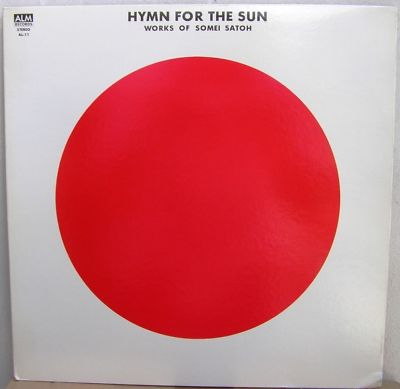
SOMEI SATOH
HYMN FOR THE SUN LP
ALM Records
Gatefold Cover
Very rare mid-70's japanese album of hypnotic minimalism, a kind of japanese La Monte Young or Terry Riley.
Some info on the release: Released on the highly collectable ALM Records label (Somei Satoh, Norio Sato, Yuji Takahashi, John Cage, Akio Suzuki, Sano Kiyohiko, East Bionic Symphonia, Takehisa Kosugi). Material from the period 1973-1975, released back in 1976. One of Satoh's masterworks, a real masterpiece of minimalism, to be compared with the best moments of Steve Reich, Charlemagne Palestine, La Monte Young, Glenn Branca, Terry Riley and the like.
SOMEI SATOH was born in 1947 in Sendai (northern Honshu), Japan. He began his career in 1969 with "Tone Field," an experimental, mixed media group based in Tokyo. In 1972 he produced "Global Vision," a multimedia arts festival, that encompassed musical events, works by visual artists and improvisational performance groups. In one of his most interesting projects held at a hot springs resort in Tochigi Prefecture in 1981, Satoh places eight speakers approximately one kilometer apart on mountain tops overlooking a huge valley. As a man-made fog rose from below, the music from the speakers combined with laser beams and moved the clouds into various formations. Satoh has collaborated twice since 1985 with theater designer, Manuel Luetgenhorst in dramatic stagings of his music at The Arts at St. Ann's in Brooklyn, New York. He has written more than thirty compositions, including works for piano, orchestra, chamber music, choral and electronic music, theater pieces and music for traditional Japanese instruments.
Somei Satoh is a composer of the post-war generation whose hauntingly evocative musical language is a curious fusion of Japanese timbral sensibilities with 19th century Romanticism and electronic technology. He has been deeply influenced by Shintoism, the writings of the Zen Buddhist scholar DT Suzuki, his Japanese cultural heritage as well as the multimedia art forms of the sixties. Satoh's elegant and passionate style convincingly integrates these diverse elements into an inimitably individual approach to contemporary Japanese music.
Like Toshiro Mayazumi adn Toru Takemitsu, the most well-known of contemporaryJ apanese composers outside Japan today, Satoh has succeeded in reshaping his native musical resources in synthesis with Western forms and instrumental sonorities. His work cannot, however, be considered within the mainstream of contemporary Japanese art music, for he writes in an unreservedly non- international style, remarkably free from any constraints of academism. This may be attributed to the fact that being primarily self-taught, he has never been subjected to a formal musical education. Satoh has on occasion, been referred to as a composer of gendai hogaku (contemporary traditional music). Much as Satoh is reluctant to be so classified, this assessment of his writing has some validity if one views him as reworking the traditional Japanese musical aesthetic in a broader, abstract context infusing it with a new vitality.
Minimalism, that Eastern-derived Western phenomenon born of the sixties, has much in common with the hypnotic, regular pulsations of rock. "Litania" and "Incarnation II", among others of Satoh's compositions which rely primarily on the prolongation of a single unit of sound, draw upon this repetitive element. In Satoh's case, however, the repetitions are perceived more as vibrations because of the rapidity of the individual beats in conjunction with an extremely slow overall pulse. This creates the sensation of being in a rhythmic limbo, caught in a framework of suspended time which is typically Japanese. This experience can be summed up in the Japanese word 'ma' which may be defined as the natural distance between two or more events existing in a continuity. In contrast to the West's perception of time and space as separate entities, in Japanese thinking both time and space are measured in terms of intervals. It is the coincidental conceptualization of these elements which is perhaps the main feature distinguishing Japan's artistic expression from that of the West. In Satoh's own words, "My music is limited to certain elements of sound and there are many calm repetitions. There is also much prolongation of a single sound. I think silence and the prolongation of sound is the same thing in terms of space. The only difference is that there is either the presence or absence of sound. More important is whether the space is "living" or not. Our [Japanese] sense of time and space is different from that of the West. For example, in the Shinto religion, there is the term 'imanaka' which is not just the present moment which lies between the stretch of past eternity and future immortality, but also the manifestation of the moment of all time which is multi-layered and multi-dimensional .... I would like it if the listener could abandon all previous conceptions of time and experience a new sense of time presented in this music as if eternal time can be lived in a single moment." May be of interest for those into Taj Mahal Travellers, Toshi Ichiyanagi and Michio Mamiya, Toshiya Sukegawa, and Masahiko Sato, Toshi Tsuchitori, Joji Yuasa and Toshiro Mayuzumi.
Condition: Vinyl lies in mint condition, looks crystal clear and plays PERFECTLY, while cover lies in excellent- condition, with minor corner bending on the bottom, otherwise perfect.
Tracklist
A1 Litania (1973) 13:17 A2 Mirror (1975) 13:35 B1 Hymn For The Sun (1973) 24:31SHIPPING & PAYMENT
Shipping: Shipping for this LP is 7$ airmail in Europe / 9$ for the rest of the world
Registered mail: +5$
Insurance: optional
Combined shipping: BIG discounts
Payment: Paypal
Packaging: I am a collector too and i know
price rating





![[SEALED] MURIEL WINSTON A Fresh Viewpoint STRATA EAST spiritual jazz RARE](https://www.popsike.mobi/php/thumbnail.php?url=https://www.popsike.pics/pix/20120317/180843914401.jpg)